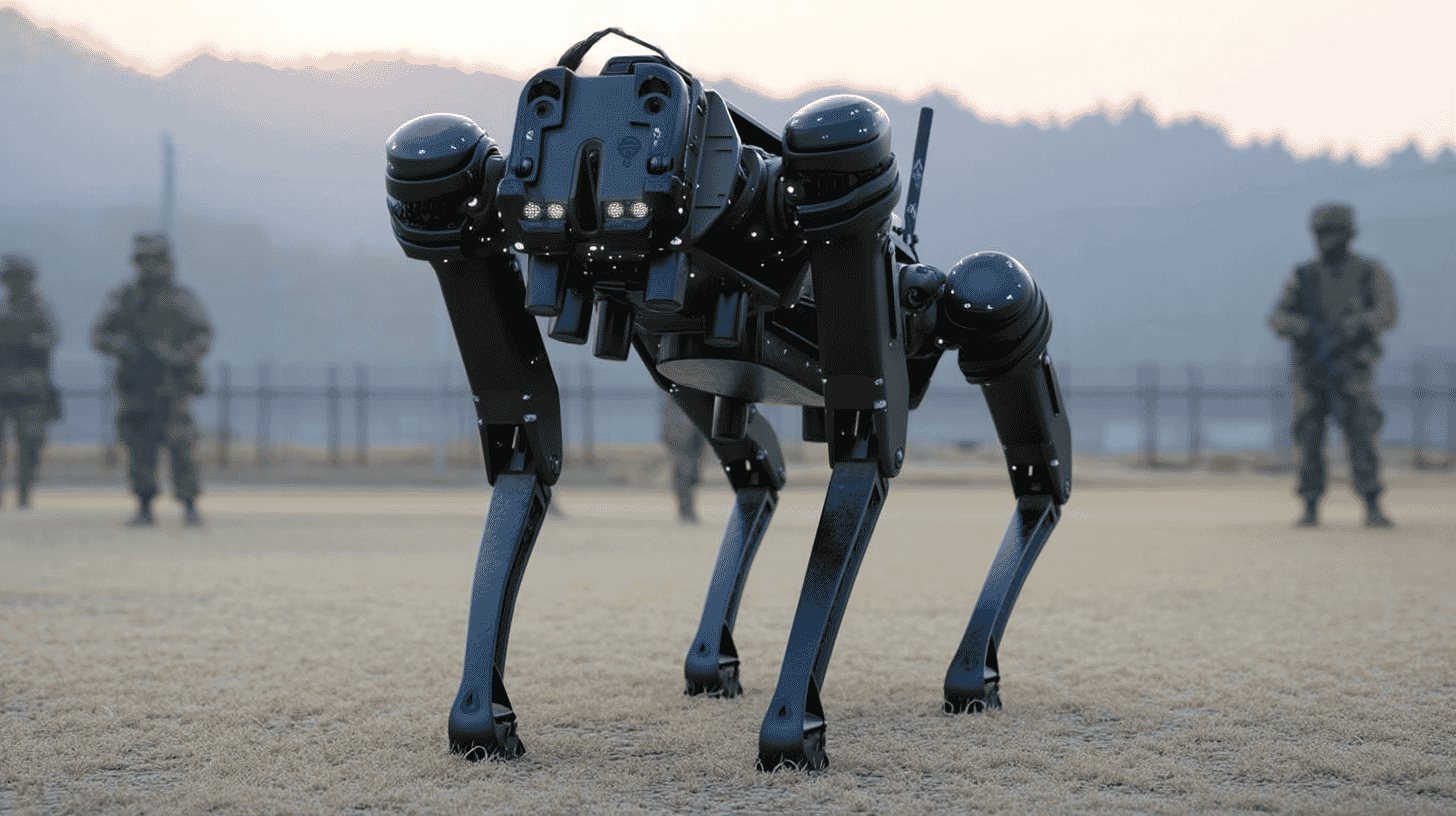
In January 2026, something straight out of science fiction appeared at Japan's annual New Year military exercise: four-legged "robot dogs" that emerged from transport helicopters and advanced alongside soldiers. The images spread across social media, drawing attention to Japan's defense technology modernization. These robot dogs had already proven their worth during the 2024 Noto Peninsula earthquake disaster relief. What does this "human-machine integration" mean for a Self-Defense Force facing chronic personnel shortages?
Vision 60 Debuts at Annual Parachute Training Exercise
On January 11, 2026, the Japan Ground Self-Defense Force (JGSDF) conducted its annual "First Parachute Training of the Year" (NYJIP26) at Narashino Training Area in Chiba Prefecture. This exercise simulates defensive operations against enemy invasion, featuring joint airborne operations with allied nations including the United States, Canada, and Germany. The event was livestreamed on YouTube.
After soldiers descended to the ground, the robot dogs appeared, immediately deployed to conduct reconnaissance operations. Defense Minister Shinjiro Koizumi also observed the exercise, where images of robot dogs disembarking from CH-47 transport helicopters and advancing with troops made headlines.
These robot dogs are the "Vision 60," a quadruped unmanned ground vehicle (Q-UGV) developed by Ghost Robotics, headquartered in Philadelphia, USA.
Vision 60: Specifications and Capabilities
The Vision 60 is a military-grade quadruped robot with impressive specifications:
Basic Specifications:
- Weight: Approximately 51 kg (112 lbs)
- Maximum Payload: 10 kg (22 lbs)
- Walking Speed: Standard 1 m/s, fast-walk 1.6 m/s, run 2.2 m/s, sprint 3 m/s
- Continuous Walking: Approximately 3.15 hours (at 0.9 m/s)
- Standby Time: Up to 21 hours (with sensors, compute, and radio active)
- Range: Approximately 10 km (terrain and payload dependent)
Environmental Durability:
- Dust/Water Protection: IP67 rated (can withstand 1 meter submersion for 30 minutes)
- Operating Temperature: -40°C to 55°C (-40°F to 131°F)
Onboard Technology:
- NVIDIA Xavier CPU/GPU for edge computing
- 5 stereo RGB cameras and multiple Time-of-Flight sensors
- 3D LiDAR-based SLAM (Simultaneous Localization and Mapping)
- Autonomous navigation in GPS-enabled and GPS-denied environments
- Wi-Fi, 4G/LTE communications (5G under trial)
A key feature is Ghost Robotics' proprietary "blind mode" technology. Even when vision sensors are obscured by mud, rain, snow, or direct sunlight, the robot can continue walking using control systems that mimic mammalian locomotion. This allows mission completion in environments that would disable other robots.
Disaster Relief During the Noto Peninsula Earthquake
The January 2026 training wasn't Vision 60's first deployment in Japan. During the January 2024 Noto Peninsula earthquake, the JGSDF's Joint Task Force (JTF) deployed robot dogs for disaster relief operations.
A Vision 60 unit nicknamed "Yamato" assisted in evacuating residents from isolated villages in Wajima City to secondary evacuation centers. After conducting operator training and reconnaissance of evacuation routes, the robot supported safe guidance of evacuees.
This unit was customized with cameras and gas detectors, provided to the Self-Defense Force by S.T. Japan (based in Chuo-ku, Tokyo), the domestic distributor for Vision 60.
Air Self-Defense Force Explores Base Security Applications
The Ground Self-Defense Force isn't alone in exploring robot dog applications. The Japan Air Self-Defense Force (JASDF) has also been researching their use.
In March 2024, the JASDF announced testing of a "dog-type surveillance system" at its Base Guard Training Squadron at Hyakuri Base in Ibaraki Prefecture. Base patrol and security is a critical 24/7 mission regardless of weather, but the Self-Defense Forces face chronic personnel shortages.
Amid Japan's declining birthrate and aging population, the Air Self-Defense Force is exploring automation of base security to allow personnel to be deployed where decision-making is essential. Mitsubishi Corporation has signed a distribution agreement with Ghost Robotics for the Japanese market, and the JASDF is reportedly considering Vision 60 deployment.
Ministry of Defense Strengthens Unmanned Asset Capabilities
Robot dog adoption is part of the Ministry of Defense's broader push to strengthen "unmanned asset defense capabilities."
According to the 2025 Defense White Paper, the Ministry positions "human-machine integration" as the future of missions across all domains: land, sea, air, space, and cyber. The FY2025 budget includes 1.4 billion yen for UGV control systems and system integration research. The goal is to develop a unified platform that can control large, medium, and small UGVs for front-line reconnaissance, casualty evacuation, and supply transport by FY2027.
The Acquisition, Technology & Logistics Agency (ATLA) is also advancing research on "multi-purpose autonomous robots" capable of navigating unstructured terrain without GNSS by recognizing surrounding environments.
Concerns About Military Applications
However, military applications of robot dogs have raised concerns.
In the United States, a remote-operated rifle called "SPUR" (Special Purpose Unmanned Rifle), made by SWORD International, has been mounted on the Vision 60, reportedly capable of engaging targets approximately 1.2 km away. The U.S. Marine Corps has also demonstrated rifle-equipped robot dogs.
Japan's Self-Defense Force Vision 60 units are currently unarmed, designated for reconnaissance, surveillance, and guidance support. However, as the platform is technically capable of weaponization, future operational policies warrant attention.
Additionally, robot dogs lack the olfactory and auditory capabilities of actual military or search-and-rescue dogs, making them unsuitable for locating survivors in disaster zones. Appropriate deployment based on mission requirements is essential.
What About Your Country?
In Japan, there are various opinions about defense robots. How does your country view military robotics and unmanned systems?









Global Discussion
16 comments