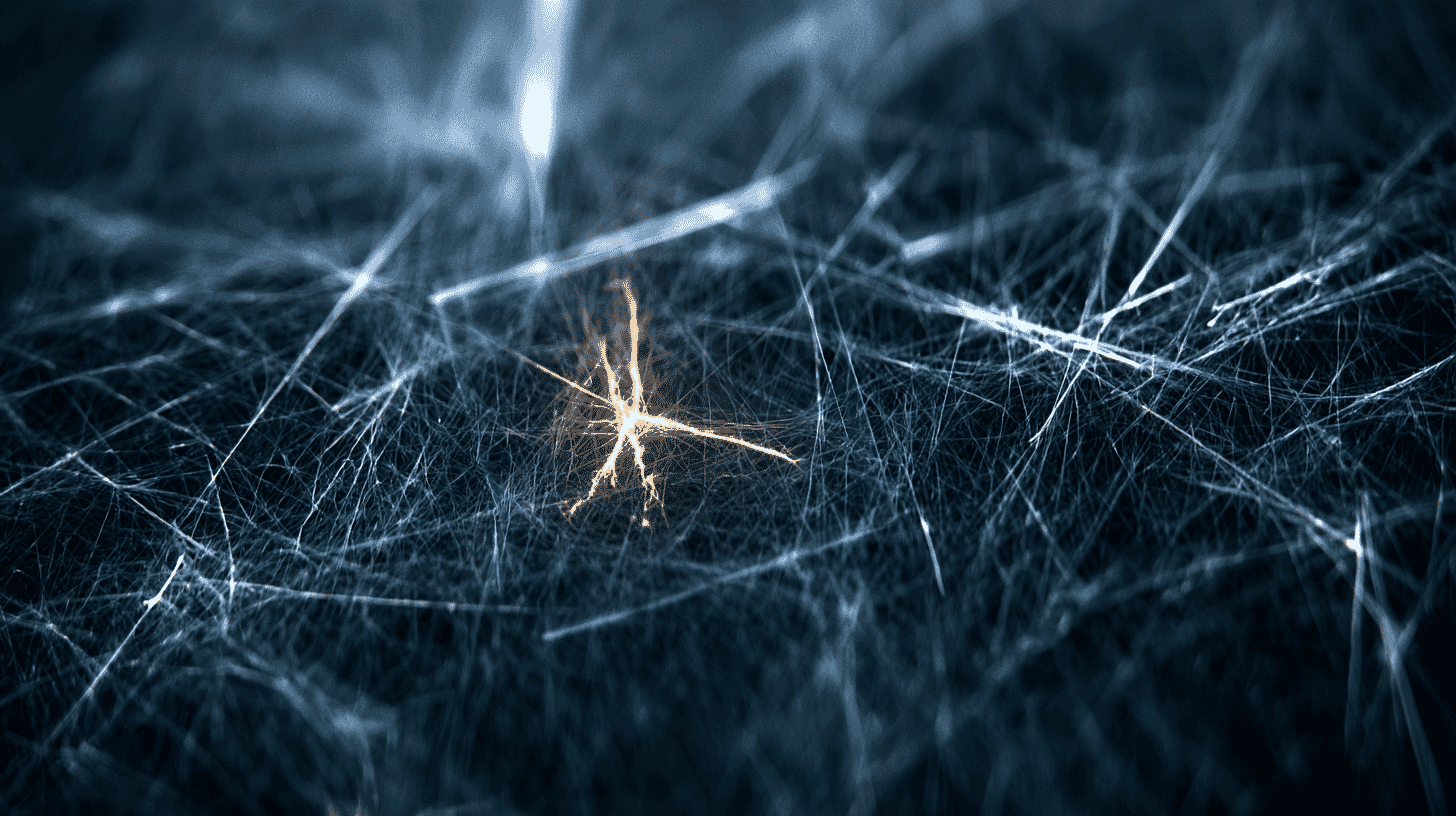
🔬 For nearly 25 years, physicists had fully identified exactly one atomic nucleus holding two Lambda particles, a short-lived kind of nucleus that does not occur naturally on Earth. When a team led by RIKEN pinned down a second one, the search tool was a deep-learning model reading microscope images of photographic film.
A million lines per square centimeter
The protons and neutrons in ordinary nuclei are built from two kinds of quarks, "up" and "down," the smallest known building blocks of matter. A hypernucleus has an extra passenger: a hyperon, a particle carrying a heavier "strange" quark. Load a nucleus with two of the simplest hyperons, called Lambda particles, and you get a double-Lambda hypernucleus. Physicists can make one in an accelerator, and it falls apart almost instantly.
The way to watch its whole life is surprisingly old-fashioned. It uses nuclear emulsion, a special photographic film that records the path of every electrically charged particle passing through it. Under an optical microscope, those tracks can be measured to under 1 micrometer. The catch is that the film records everything and has no timestamp. According to RIKEN, the plates used at J-PARC, the Japan Proton Accelerator Research Complex in Tokai, Ibaraki Prefecture, run jointly by KEK and the Japan Atomic Energy Agency, hold about 1 million tracks per square centimeter.
A double-Lambda event looks like a tiny branch with three forks: one where the nucleus forms, one where the first Lambda decays, one where the second does. Since hypernuclei were first seen in emulsion in 1953, only 47 candidate events carrying two strange quarks had turned up there, according to the new paper. Just one double-Lambda hypernucleus among them had been pinned down to its exact isotope. That was the "Nagara event," spotted on January 18, 2001, by a Gifu University graduate student in film from a KEK experiment, and named after the Nagara River, which flows through the university's home city. The double-Lambda track was 8 to 9 micrometers long, about the size of a human red blood cell.
What the AI did, and what it didn't
The traditional search worked like following footprints. Detectors flagged where a promising particle entered the film, and people traced it under the microscope. At J-PARC's E07 experiment, that approach reached only about 10% of the events expected to be in the film. It produced 33 candidate events, only 3 identified, and no uniquely identified double-Lambda nucleus. The 2019 "Mino event," a beryllium candidate, left the neutron count open at 4 to 6.
Takehiko Saito, chief scientist of RIKEN's High Energy Nuclear Physics Laboratory, began wondering while working in Germany whether image-recognition AI could help. He moved to RIKEN in 2019 and teamed up with specialists at Rikkyo University's Graduate School of Artificial Intelligence and Science. The group first tried the approach in 2021, using machine learning to detect hypertritons, the lightest hypernuclei, in E07 film.
The first obstacle was training data. With only one confirmed real example, there was almost nothing to learn from. The team generated events with Geant4, a standard simulation package, then used a generative adversarial network (GAN), a type of generative AI, to make the simulated pictures look like real microscope images. That became the training material for an object-detection model called Mask R-CNN. On simulated images, it caught 93.8% of the target events. Shown the real 2001 photograph of the Nagara event, it picked it out with a confidence score of 0.974.
Run on 0.2% of the E07 film, the model cut the images needing a human look down to 0.17% of the original and flagged 6 double-Lambda candidates. From there, it was people's work. Three of the paper's authors checked candidates under microscopes. For one of them, the team measured each track's length, angle and thickness, listed every pattern of particles and decays that could explain the picture, and struck out the ones that broke conservation of energy and momentum. One answer survived: a boron-13 double-Lambda hypernucleus (5 protons, 6 neutrons, 2 Lambda particles). The paper appeared online in Nature Communications on November 22, 2025, and RIKEN announced it on December 18, 2025.
The AI's job was to shrink a haystack to a handful of spots worth checking. The identification came from the kind of careful measurement emulsion physicists have done for decades. The paper names its own limitation too: the model mostly learned the Nagara-type shape, and differences between simulated and real images could introduce bias.
"It's still only the second case," Saito told JST's Science Portal in September 2026. "But the fact that machine learning found it in just 10 months matters a great deal to me."
How strongly do two Lambdas pull together?
The nuclear force pulls particles together yet pushes back when they get too close, and how it works is still not fully understood. With only protons and neutrons, it is hard to tell how the type of quark shapes that force. Adding strange quarks changes one condition at a time.
The Nagara event produced the first number. Two Lambdas inside the nucleus were bound 0.67 MeV (plus or minus 0.17) more tightly than two separate ones would be. In plain terms, they attract weakly. The new boron-13 nucleus gave 2.83 MeV (plus or minus 1.18). That is roughly 4 times as much, though the uncertainty is still large. The authors present it as the first direct sign that how hard two Lambdas pull on each other depends on the nucleus around them, but a single event cannot settle that.
The neutron stars that are too heavy
Neutron stars are the leftovers of supernova explosions, with a radius of about 10 kilometers. According to RIKEN, a teaspoon of their core would weigh a billion tons. At such densities, some neutrons are expected to turn into hyperons. But hyperons soften the star's matter, and in theoretical models the star can no longer support more than about twice the mass of the Sun. Yet a neutron star that heavy was measured in 2010. The mismatch is known as the "hyperon puzzle," and it remains unsolved.
Solving it means knowing how hyperons push and pull on one another. But hyperons live so briefly that smashing them into each other to measure the force is hard. According to the paper, the ALICE experiment at Europe's LHC estimates the pull between Lambdas another way, from correlations among particles produced in collisions. Only emulsion lets researchers follow two Lambdas decaying inside a nucleus, event by event, by eye.
Why Japan kept the film
Most of particle physics went digital long ago. Detectors like Kamiokande turn particles into electrical signals in real time, and emulsion can look like a relic. Japanese labs held on to it anyway. A 2017 Nagoya University feature describes how, after film manufacturers stopped making it, a lab there learned the craft and built its own film and scanning systems. That paid off in November 2017, when an international survey that included a Nagoya University team reported in Nature, using this film among other tools, a large unknown void inside Khufu's pyramid.
The other 99.8%
If the detection rate from that first 0.2% holds, the paper estimates the full E07 dataset contains more than 2,000 events with two strange quarks, hundreds of them awaiting identification. The authors say the method could make visual inspection about 500 times more efficient. "There's still plenty of treasure buried in there, so let's dig all of it up," Saito said. He also wants to collect more data with a new type of detector at a US accelerator facility.
An algorithm sifts a mountain of images, and a person confirms what it flags. Where does your country, or your workplace, draw the line between what a machine is trusted to find and what a person has to sign off on?
References
- https://scienceportal.jst.go.jp/stories/20260925_s01/
- https://www.riken.jp/press/2025/20251218_1/index.html
- https://doi.org/10.1038/s41467-025-66517-x
- https://www.riken.jp/press/2025/20250829_1/index.html
- https://www1.gifu-u.ac.jp/~physics/Nakazawa/hypernuclei/nagara/
- https://www.aip.nagoya-u.ac.jp/public/nu_research_ja/features/detail/0004198.html
- https://doi.org/10.1038/nature09466
- https://www.natureasia.com/ja-jp/ndigest/v15/n3/%E3%83%94%E3%83%A9%E3%83%9F%E3%83%83%E3%83%89%E3%81%AE%E5%B7%A8%E5%A4%A7%E6%96%B0%E7%A9%BA%E9%96%93%E3%82%92%E7%A7%91%E5%AD%A6%E7%9A%84%E3%81%AB%E7%99%BA%E8%A6%8B/91244





Global Discussion
4 comments