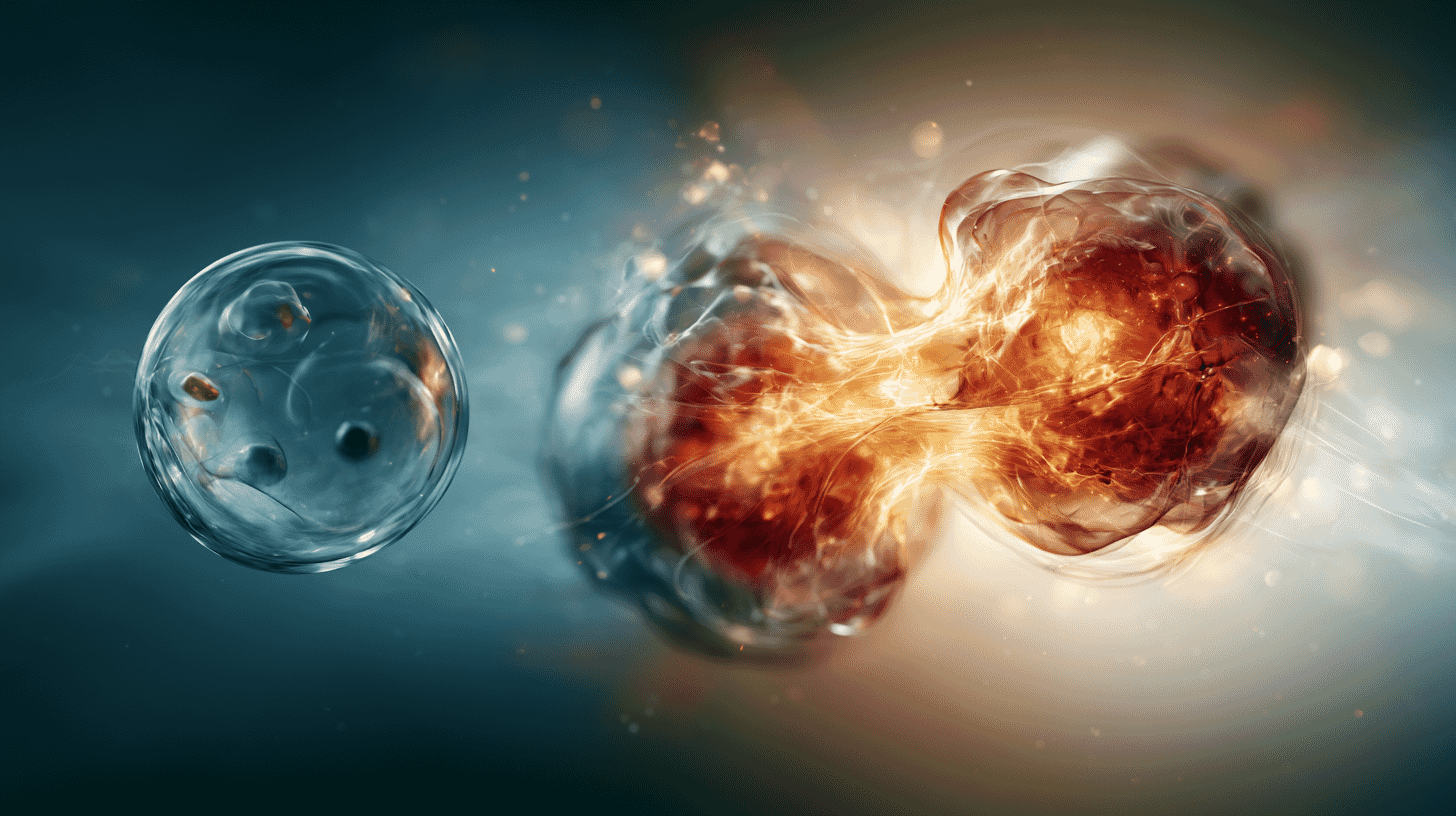
🧬 Take a heap of molecules that are, on their own, not alive: fats, proteins, loops of DNA. Coax them into something that feeds itself, grows, and splits in two. Manage that, and you've nudged open one of biology's oldest locked doors: what actually separates the living from the non-living? On June 8, more than 100 researchers spread across six Asian countries laid out a 10-year plan to find out, not by theorizing but by building.
The question that's been open for 20 years
Assembling a cell from scratch, what scientists call "bottom-up" synthetic biology, is one of the hardest goals in the field. You start with lifeless parts and try to make them behave like life. Get there, and you don't just settle a philosophical argument; you also gain a cell you can program from the ground up, with no evolutionary baggage to work around.
Japan has been circling this idea for a while. A research society devoted to "creating cells" formed here in 2007, among the earliest such groups anywhere. In the 2010s, Europe and the United States built their own communities: Germany's Max Planck-backed MaxSynBio, the Dutch BaSyC consortium, the UK's fabriCELL, and the US-based Build-a-Cell network, which kicked off in 2017 with a workshop at Caltech where participants showed up to a metaphorical construction site.
Two decades of that work paid off in pieces. Labs learned to rebuild individual cellular functions, a membrane here, a protein-making reaction there, outside any living cell. The catalog of working parts grew impressively.
Why the pieces won't snap together
And that's exactly where the field hit a wall. The parts work. Getting them to work together, in one container, at the same time, in a system that actually keeps running: nobody has done it. As the new roadmap and its authors frame it, integration is a feat of a higher order than any single module, and it remains unsolved worldwide.
The roadmap is unusually blunt about why. It names four bottlenecks:
Keeping the lights on. Most lab-built systems run on energy molecules like ATP poured in at the start. When that fuel runs out, the system stops. A real cell regenerates its own energy continuously; the synthetic ones mostly can't, which caps how long they can act on their own.
The ribosome problem. The ribosome, the molecular machine that reads genetic instructions and builds proteins, is recursively self-referential: it's made of proteins and RNA, and assembling a new one requires enzymes and chemical tweaks that current artificial methods don't fully reproduce. Without a ribosome that can rebuild itself, a cell can't sustain its own protein production.
No rulebook. There's still no systematic, physics-based guide for designing the controllable modules a cell needs. How do you mechanically couple membrane growth to cell division, for instance? Largely unknown.
Timing and place. Copying DNA, sorting it, and splitting the cell all have to happen in the right order, in the right spot. Coordinating that is, the authors say, the deepest system-level bottleneck of all.
The fix isn't another lab, it's a factory
In October 2023, researchers from China, Japan, South Korea, Singapore, Thailand and Malaysia founded the SynCell Asia Initiative and started meeting in workshops to hammer out a shared plan. The effort is led by the Shenzhen Institute of Advanced Technology (SIAT) of the Chinese Academy of Sciences, which supplies both the paper's first and corresponding authors. The Japanese contingent is heavyweight too: teams from Waseda, the University of Tokyo, RIKEN, Science Tokyo, Kobe University and Osaka University. The paper landed in Nature Biotechnology on May 26, with RIKEN and the universities announcing it on June 8.
Their central bet is less about a single experiment than about how the work is organized. Instead of every lab racing alone, each with its own reagents and quirks, the roadmap proposes an AI-driven central biofoundry: a "central factory" that prepares standardized, upgradeable synthetic cells and reagents, then ships them through automated pipelines to workstations in each participating country. The whole thing runs as a closed loop, design, build, test, learn, repeat, with AI steering each cycle.
Around that core sit three more ideas: profiling single synthetic cells across their genes, proteins, and metabolites to feed machine-learning models; pairing "white-box" mechanistic models with "black-box" data-driven ones to find the design rules that matter; and deliberately evolving synthetic cells, generating many variations and selecting the ones that work, to surface useful behaviors that rational design might miss.
The authors are upfront that this organizational model, a central factory plus distributed workstations with open standards across borders, has no real precedent. That's part of the pitch. The bottleneck isn't only scientific; it's that everyone's been building in their own corner.
ProtoCell, then AutoCell
The plan splits into two stages, and the names tell the story.
ProtoCell (years 1–5). Built on a stable bubble of fatty molecules, a phospholipid vesicle, essentially a cell-sized container. The targets are concrete: a minimal genome of at least 200 genes, a system that can produce more than 90% of the protein types it needs, and the ability to make key metabolites internally. The team also wants a "digital twin," a software model of the cell, to study how mechanical and chemical signals jointly trigger division.
AutoCell (years 6–10). This is where it gets self-sufficient. AutoCell drops the externally supplied protein-making machinery and encodes its own ribosome regeneration in its genome. The benchmark: a coordinated grow-and-divide cycle that runs at least 10 times in a row. From there, the cells would be evolved under different pressures, and eventually grouped into populations that swap materials and split up tasks, the faint beginnings of something like a tissue.
Worth stating plainly: this cell does not exist yet. The achievement being announced is the plan itself: a shared, staged, testable strategy where there used to be scattered effort. In a field that has spent 20 years proving it can build the parts, agreeing on how to assemble them is its own kind of milestone.
What a built-from-scratch cell would change
If the pieces ever do click together, the payoff runs in two directions. There's the practical one, programmable cells as a platform for drug discovery and biomanufacturing, plus the modeling, automation, and AI tools the project would force into existence along the way. Even partial synthetic systems are already finding academic and industrial use. Japan's government, for its part, has folded synthetic biology into its list of strategic priority fields, and a national science agency published a survey report on the area this past March.
Then there's the other direction, the one that drew everyone in to begin with. Europe assembled a cluster of national consortia; the US built the first network to reach across borders. Now Asia is adding a third pole, with a distinctly different blueprint: standardize, automate, share, and treat the whole continent as one lab.
Which leaves the question the whole effort is really chasing. Suppose someone does assemble a cell from molecules that were never alive, and it grows and divides on its own. Would you call that thing alive? Where's the line for you, and is anyone in your country working on the same puzzle?
References
- RIKEN press release (2026-06-08): https://www.riken.jp/press/2026/20260608_1/index.html
- Waseda University news (2026-06-08): https://www.waseda.jp/inst/research/news/84635
- Nature Biotechnology, "A framework for building a synthetic cell from the SynCell Asia initiative": https://www.nature.com/articles/s41587-026-03153-w
- Build-a-Cell / synthetic cell community background: https://elifesciences.org/articles/73556








Global Discussion
3 comments