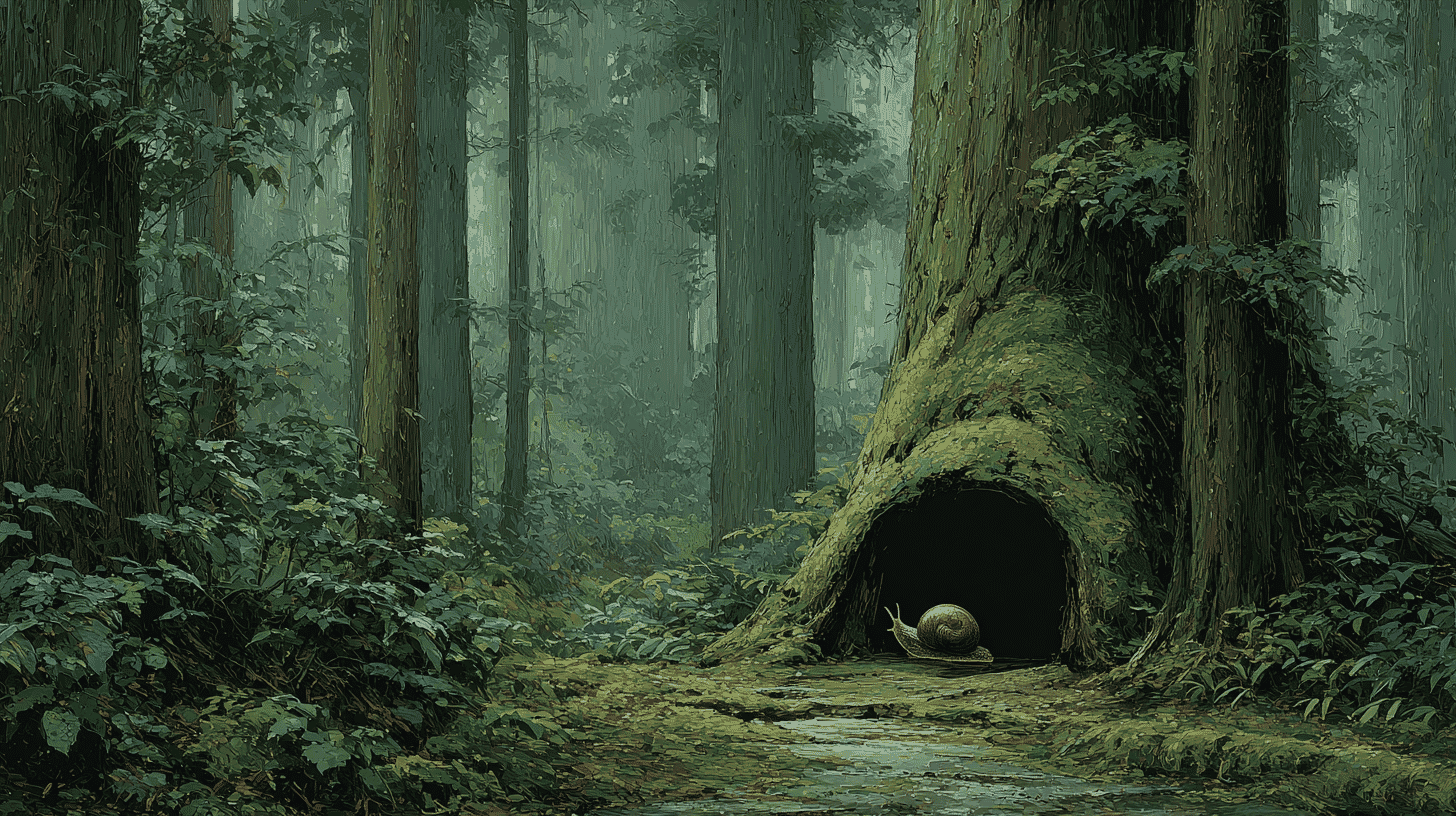
🐌 Walk into a Japanese mountain forest after rain and you might spot what looks like a fallen twig on the trail. Then it moves. The yamanamekuji is Japan's largest native slug, big enough that hikers routinely mistake it for a stick or a small snake. It never turns up in city flowerbeds. It carries a full set of male and female sex organs in a single body. And it spends its life doing something the forest cannot manage without: eating mushrooms, then carrying their spores somewhere new.
A giant that stays in the mountains
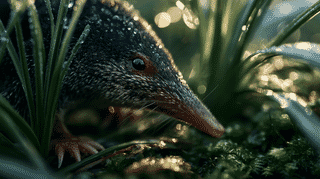
The animal's scientific name is Meghimatium fruhstorferi, described in 1901. Field guides list a body length of 130 to 160 millimeters, and specimens approaching 20 centimeters are reported often enough that "nearly 20cm" has become the standard way people describe it. Its back is grey-brown to almost black, with a broad dark band running down each side and rows of granular ridges across the surface. Look closely at the right flank and you may catch a small hole opening and closing: the pneumostome, the breathing pore that all air-breathing land gastropods have.

Source: Wikimedia Commons
It lives on Honshu, Shikoku and Kyushu, in mountain woodland. By day it hides beneath fallen logs, emerging at night and on wet days. A paler yellowish subspecies, daiseniana, has been recorded in prefectures including Tottori, Ishikawa, Kyoto and Iwate. In the northern forests of Okinawa's main island there is a similar giant, known as yanbaru-yamanamekuji, that belongs to the same genus but has never been formally described. It still has no scientific name.
What it is not is a garden animal. The yamanamekuji does not appear in vegetable plots or urban flowerbeds. That single fact separates it from almost every slug an ordinary person in Japan actually meets.
Big, but not the champion
Twenty centimeters sounds like a record. It isn't, quite.
The Pacific banana slug of North America, Ariolimax columbianus, reaches 25 centimeters and 115 grams, which makes it the second-largest land slug on Earth. The title goes to Limax cinereoniger, a European species that can stretch to 30 centimeters. Europe's familiar large black slug, Arion ater, extends to 10–15 centimeters and rarely to 20. Its notorious relative Arion vulgaris, the "Spanish slug," matures at 6–15 centimeters and is the only land gastropod on the DAISIE list of Europe's hundred worst invasive species.
Line them up and a pattern appears. The really big slugs are, overwhelmingly, forest animals: damp shade, deadwood, fungi, leaf litter. The banana slug haunts the Pacific Northwest's rainforest floor from northern California to Alaska. The yamanamekuji haunts the Japanese mountains. Neither one is the creature raiding your lettuce.
One body, both sexes
Slugs and snails are simultaneous hermaphrodites: each individual carries functioning male and female reproductive organs at the same time. In the yamanamekuji this produces one of the strangest sights in a Japanese forest. Two slugs coil around each other into a spiral, exchange sperm, and then separate. Both go on to lay eggs. Neither is the mother; both are.
Self-fertilization is possible and has been reported when no partner is available, but it appears to be rare: a fallback, not a strategy. Educational nature centers that document the mating spiral point out why the arrangement suits this animal so well. A slug travels a few meters an hour. Searching a dark forest for a mate of the opposite sex, at that speed, would be a punishing constraint. Being both sexes at once solves the problem: every adult you bump into is a potential partner, and every encounter can produce two clutches of eggs instead of one.
Mushroom eater, spore courier
Ask what the yamanamekuji is for, ecologically, and there's a precise answer, because researchers studied this exact species.
A 2022 paper in the journal Ecology and Evolution by Kitabayashi and Tuno examined whether M. fruhstorferi disperses fungal spores. It does, efficiently. Spores turned up under the microscope in the droppings of wild-caught slugs, and DNA analysis of those droppings found both major fungal groups, with the mushroom order Agaricales dominant. In the lab, slugs fed on a bolete carried enormous numbers of spores through their digestive tracts. More surprising: spores of oyster mushrooms, honey fungus and Gymnopilus that had passed through a slug germinated better than spores collected the ordinary way, from a spore print. In the field, the researchers tracked slugs covering up to 10.3 meters in five hours, wandering over soil, leaf litter, rotting wood and tree trunks.
Put that together and you get a slow, mucus-trailed delivery service. Wood-decay fungi and the mycorrhizal fungi that feed tree roots need to reach scattered patches of deadwood and soil. Wind carries spores. So, it turns out, does a slug, one that eats the mushroom, walks ten meters, and deposits a viable, primed payload exactly where fungi like to grow. Its rasping tongue, the radula, also shreds fungal tissue and dead plant matter into finer fragments that soil microbes can work on.
The one real complaint against it is that it sometimes chews cultivated shiitake. Compared to what it does for the forest, that is a small bill.
The slugs in Japanese gardens are the foreigners
Here is the twist most Japanese people never learn. The slug in your Japanese garden is almost certainly Ambigolimax valentianus, 5 to 7 centimeters long, brown with faint stripes and a flattened internal shell under the skin of its back. It is European. It is thought to have arrived in Japan around the 1950s, and it is now the most common slug found around houses across the country, and a genuine pest of leafy vegetables and seedlings. Before it took over, the ordinary Japanese garden slug was a species called kiiro-namekuji. Nobody has confirmed a living one in years.
Then, in 2006, a household garden in Ibaraki Prefecture produced something new: Limax maximus, the leopard slug, another European native, patterned like its namesake and growing to roughly 20 centimeters. Kyoto University's Hiroko Udaka launched a citizen-science project called the "Slug Dragnet" in 2015, asking the public to report sightings, and records have since come in from as far away as Hokkaido and Nagano. A study presented to the Ecological Society of Japan reported that the leopard slug is a habitat generalist, at home from rural woodland edges to city streets; that where it turned up in beer traps, the European garden slug turned up less, hinting at competition; and that sites it had invaded tended to have lower diversity of land snails.
So Japan now has two twenty-centimeter slugs. One is native, lives in the mountains, and moves fungal spores around the forest. The other arrived in a shipment, lives wherever it likes, and may be pushing other snails out. They are not the same story, and it would be a shame if the first got blamed for the second.
If you meet one
Look, don't touch. That has nothing to do with the yamanamekuji being sinister. Slugs and snails worldwide can host the rat lungworm, Angiostrongylus cantonensis, a parasite that occasionally infects humans and can cause serious meningitis. Japan's confirmed human cases are few and were nearly all traced to Okinawa. Never eat one raw, wash produce properly, and wash your hands after handling any gastropod. Public health authorities specifically warn against folk remedies involving raw slugs, and yes, one exists: in Tsuwano, Shimane Prefecture, slugs steeped in cooking oil have been used as a treatment for insect bites, and the slug in question was reportedly this species.
Otherwise, leave it alone and let it work. It is not an invader, not a crop pest, and not a monster. It is a large, slow, wet animal doing unglamorous maintenance on a Japanese forest, and it was doing it long before anyone thought to be disgusted by it.
Which giant lives in your local woods, and does anyone there know what it's actually doing?
References
- https://newsdig.tbs.co.jp/articles/rsk/2794426
- https://ja.wikipedia.org/wiki/ヤマナメクジ
- https://onlinelibrary.wiley.com/doi/full/10.1002/ece3.8565
- https://sites.google.com/site/udakawebsite/madarakouranamekuji-limax-maximus
- https://esj.ne.jp/meeting/abst/70/P1-332.html
- https://id-info.jihs.go.jp/infectious-diseases/angiostrongyliasis/detail/index.html




Global Discussion
3 comments