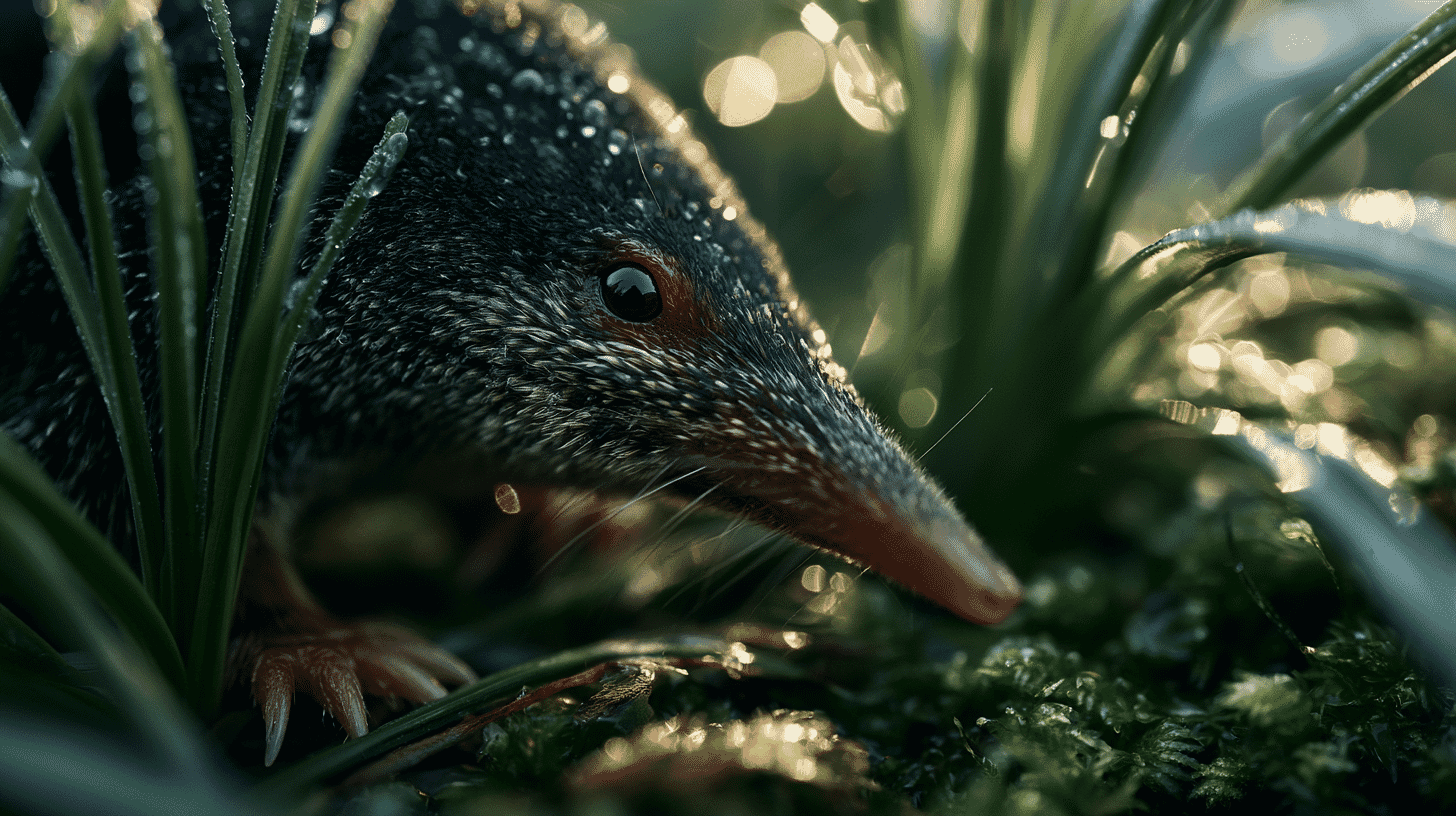
🐭 It weighs about as much as a small coin and cannot survive even a few hours without eating. Keeping one alive in a lab has long defeated researchers. Breeding one, and watching it court, mate, give birth and raise its young under human care, was considered close to impossible. A team in northern Japan just did it, for the first time anywhere in the world. And it is really a rehearsal for something harder: saving a cousin that ranks among the smallest mammals on Earth.
On May 27, 2026, researchers from Hokkaido University, Tokai University and Sapporo's Maruyama Zoo announced that they had achieved the world's first captive breeding of the slender shrew (Sorex gracillimus), a tiny insectivore found across Northeast Asia and, within Japan, only in Hokkaido. The findings were published online in the journal Mammal Study.
The mammal that can't afford to skip a meal
Shrews look like mice, but they are not rodents. They belong to a group closer to moles and hedgehogs, and they live their entire lives in fast-forward. Their hearts race, their bodies burn energy at a furious rate, and many species cannot go more than a few hours without food before starving. The slender shrew weighs just three to four grams as an adult, about the weight of three or four one-yen coins, and is the second-smallest of the four shrew species in Hokkaido.
That biology is exactly what has kept these animals out of the lab. They are so sensitive to changes in their surroundings, and so dependent on a constant supply of food, that simply keeping one alive for an extended period was an unsolved problem. Breeding them, which requires keeping not one but a pair healthy long enough to court, conceive and raise young, had never been done.
Larger, hardier relatives such as the long-clawed shrew had been bred in captivity before. But for a small, delicate species like the slender shrew, there were no success stories at all. Without that, the most basic facts of its life were essentially blank: how long it carries young, how it mates, when the babies wean.
From a Nemuro meadow to a zoo enclosure
The project began in the field. In August 2021, the team captured 19 wild slender shrews near the coastal grasslands of Nemuro, in eastern Hokkaido, and brought them to Maruyama Zoo. Two of the females turned out to be pregnant, and that September they gave birth in captivity to 13 young between them, an early sign that this might actually work.
From there the team moved to deliberate, controlled breeding. Through 2022 they raised animals individually over long periods, then paired sexually mature individuals, some wild-caught and some zoo-born, and recorded everything on video. Out of those pairings came three successful pregnancies and births under full captive conditions. Along the way, the researchers established something that had never existed: a stable, long-term husbandry method for all four of Hokkaido's shrew species. The zoo still keeps five slender shrews, off public display.
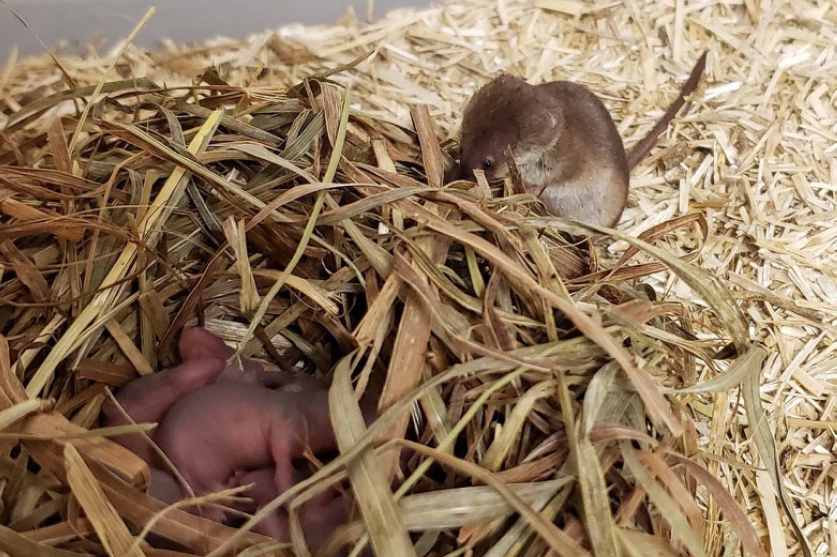
Source: Hokkaido University press release (photo: Sapporo Maruyama Zoo)
What the cameras revealed
Once the animals were breeding, the team could finally watch behavior no one had documented before. They sorted it into three categories, contact, courtship contact and mounting, and timed each one.
The biggest surprise was the courtship itself. In larger shrews, mating tends to be aggressive, with the sexes attacking each other. Slender shrews were gentler: the team described an almost playful back-and-forth, with the male following the female around before mating, mounting only about 0.4 to 0.8 times per hour. It was the first time anyone had put numbers to a slender shrew's reproductive behavior.
The rest of the life cycle finally got filled in too. Pregnancy lasts 25 to 29 days. The young wean about 25 to 30 days after birth. And the growth is staggering: a newborn weighs roughly 0.3 grams, about a few grains of rice, and balloons to more than ten times that, about 3.5 grams, in only 20 days or so.
The real target: a "Tokyo" shrew that lives nowhere near Tokyo
Here is the part that makes this more than a zoo milestone. Hokkaido is also home to a much smaller relative, the Eurasian least shrew, known in Japan as the Tokyo shrew (Sorex minutissimus hawkeri). It weighs only about 1.5 to 2 grams, which puts it among the smallest mammals on the planet, generally reckoned second only to the Etruscan shrew by body mass. Japan's Environment Ministry lists it as Vulnerable on its Red List.
Its name is a small comedy of errors. When the species was described in the early 20th century, the specimen's label read that it came from "Yedo," the old name for Tokyo. In fact the label should have read "Yezo," the old name for Hokkaido. The mix-up stuck, and so a creature that has never lived anywhere near Tokyo carries the capital's name to this day. It was not confirmed again in Hokkaido until 1957.
Protecting a species this tiny and this fragile almost certainly means learning to breed it under human care, a form of "ex-situ conservation": keeping a backup population outside the wild as insurance against extinction, with the long-term hope of one day returning animals to nature. But strict limits on how many can be captured have kept research on the Tokyo shrew at a near standstill. That is why the team deliberately chose the slender shrew, whose body size is close to its endangered cousin's, as a stand-in to crack the technique first. Lead researcher Satoshi Ohdachi of Hokkaido University's Institute of Low Temperature Science says the methods and knowledge gained here should be a major help in eventually breeding the Tokyo shrew.
A creature you could lose in a handful of grass, bred for the first time so that an even tinier one might be saved. Somewhere near you there is probably an animal just as small and just as overlooked. Is anyone keeping track of it?
References
- https://www.hokudai.ac.jp/news/2026/05/post-2297.html
- https://www.hokudai.ac.jp/news/pdf/260527_pr.pdf
- https://www.tokai.ac.jp/news/detail/post_658.html
- https://doi.org/10.3106/ms2025-0020
- https://news.yahoo.co.jp/articles/ac70f72a69aa4f3264104cc2d8fe5c5268aad57a
- https://en.wikipedia.org/wiki/Eurasian_least_shrew
- https://ikilog.biodic.go.jp/Rdb/zukan?_action=rn009









Global Discussion
4 comments