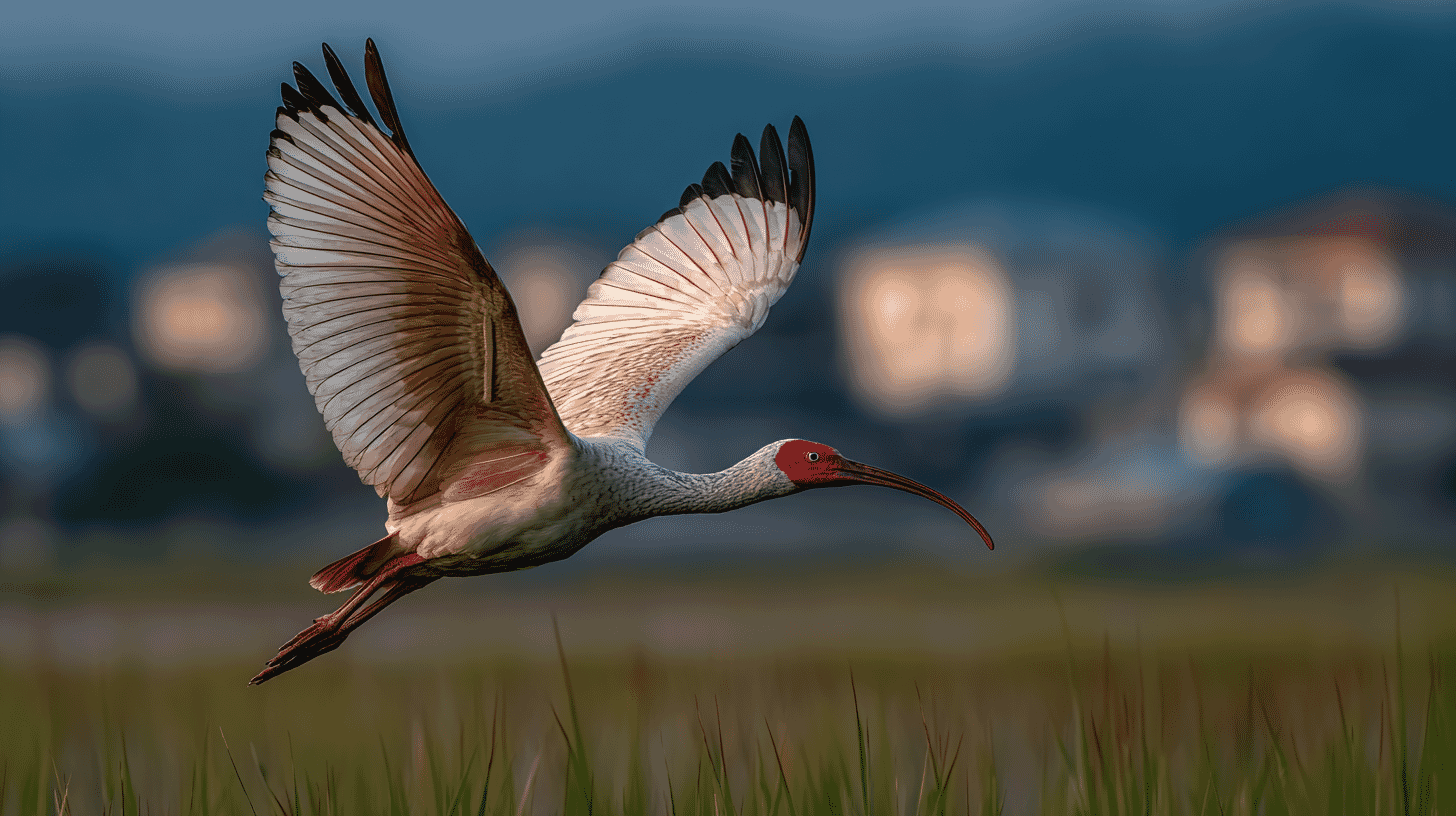
Fifty-six years. In 1970, the last wild Crested Ibis on Honshu, named "Nori," was captured on the Noto Peninsula, and her species disappeared from the mainland sky. On May 31, 2026, Crested Ibises returned to that same sky. The release ceremony, attended by Crown Prince Akishino and Crown Princess Kiko, marks both a milestone in endangered species recovery and a symbol of resilience for a peninsula still rebuilding from the devastating 2024 earthquake.
What "Nori" Took With Her, and What 19 Birds Bring Back
The Crested Ibis (Nipponia nippon) takes its scientific name from Japan itself: the Latinized form of "Nipponia" reflects how strongly this peach-feathered bird is woven into the country's identity. Yet by the mid-20th century, it had been driven to the brink of extinction.
The mainland's final chapter was written on the Noto Peninsula. After Crested Ibis populations were rediscovered there in 1929 in the Bijozan mountains of Ishikawa, Noto became Honshu's last refuge. But the combination of degraded satoyama (rural landscape) ecosystems, agricultural pesticides, habitat development, and overhunting drove numbers steadily downward. In 1970, the final remaining wild bird was captured in Anamizu Town, given the name "Nori," and transferred to the Sado Crested Ibis Conservation Center in Niigata. Her capture marked the moment the species vanished from Honshu's wild.
Fifty-six years later, with Nori's preserved specimen now displayed at the Ishikawa Prefectural Museum of History, nineteen Crested Ibises will return to Noto's sky. It is the first wild release of the species on Honshu in modern history.
What Happened on May 31 in Hakui
The ceremony took place at the Yoki Ground Golf Course in Hakui City, Ishikawa Prefecture. Wildlife managers used both methods: a "hard release," in which eight birds went straight out of wooden carrying boxes on the day, and a "soft release," in which the remainder are kept in an on-site cage to acclimate before flying free naturally. Nineteen birds are earmarked for release in total.
Of the nineteen birds, three were hatched at the Ishikawa Zoo in Nomi City. The rest had trained since March at the Sado Crested Ibis Conservation Center, learning to fly and forage, and were transported to Hakui the day before the release.
The chosen release site, the Minamikata district of Hakui, sits on the edge of Lake Ouchigata, surrounded by rice paddies that fall well within the typical 2-kilometer foraging range of the species. Environmental surveys confirmed abundant prey species and a recovering ecosystem comparable to Sado's. Since 2011, several wild Crested Ibises presumed to have flown over from Sado have been spotted in this very area.
A short drive from the release site stands Mount Bijozan, where in 1956 a man named Yoshio Murakami captured what is believed to be the first photograph of a wild Crested Ibis on Honshu. Now 101, Mr. Murakami lived to witness the homecoming his photographs had anticipated seven decades earlier, a living record of seventy years of Crested Ibis conservation.
The Imperial Couple's First Joint Visit to Ishikawa in 24 Years
On May 1, 2026, Ishikawa Prefecture announced that Their Imperial Highnesses Crown Prince Akishino and Crown Princess Kiko would attend the release ceremony. It was their first joint official visit to Ishikawa in 24 years, since a national lifelong learning festival in Kanazawa in 2002, and their fifth overall.
The couple flew from Haneda to Komatsu Airport, then went on to Hakui City Hall, where Governor Hiroyoshi Yamano briefed them on prefectural affairs and the recovery from the 2024 Noto Peninsula earthquake. They attended the commemorative ceremony at the Yoki Exchange Center and the release itself at the golf course. Speaking at the ceremony, Crown Prince Akishino noted that Noto had been the mainland's last habitat and said he felt deeply moved that the birds were being released there after half a century. When he and the assembled officials cut the ribbon, the ibises burst out of their boxes and into the sky.
The connection between the Imperial couple and Crested Ibis conservation runs deep. On September 25, 2008, when Japan's first-ever experimental release of Crested Ibises took place on Sado Island, the Crown Prince and Crown Princess were also present. Crown Prince Akishino, a trained zoologist who serves as a visiting researcher at Kyoto University's Wildlife Research Center, has long been associated with biodiversity conservation. Eighteen years after witnessing the rebirth of the species on Sado, he and Princess Kiko saw the next chapter open on Honshu.
There is another layer of meaning. Since the New Year's Day 2024 earthquake that devastated the Noto Peninsula, Crown Prince Akishino has visited the disaster zone three times alone, and Crown Princess Kiko has done the same. This was their first joint visit since the disaster. Ishikawa Prefecture has written the Crested Ibis into its earthquake and flood recovery plan as a symbol of the region's rebuilding.
Why Expand to Honshu Now
The artificial breeding program that began in 1999, when China gifted Japan a pair named "You-You" and "Yang-Yang", took roughly a quarter century to fully succeed. As of December 2024, more than 570 wild Crested Ibises live on Sado Island, with another 140 or so in captive care nationwide. The "Sado Model," combining reduced-pesticide rice cultivation with ecological certification, has drawn attention from conservation experts worldwide.
But concentrating an entire species in one location is biologically risky. A single outbreak of avian influenza could wipe out the wild population overnight. Geographic dispersal is essential risk management. In February 2026, the Ministry of the Environment formally designated the Noto region as the first Honshu release site. A second Honshu release site is planned for Izumo City in Shimane Prefecture during the first half of fiscal year 2027. The slow expansion of the species across the mainland is finally beginning.
Comparing Comeback Stories: California Condor and Korean Stork
Stories of birds returning from the edge of extinction are not unique to Japan.
The California Condor, North America's largest bird with a wingspan of about three meters, had only 22 wild individuals remaining in 1982. In 1987, U.S. authorities took the controversial step of capturing every last wild bird for a captive breeding program. Releases resumed in 1992, and the total population has now climbed past 500 individuals. Yet the condor still battles new threats, particularly lead poisoning from spent hunting ammunition and avian influenza.
South Korea's Oriental Stork tells a parallel story. The last wild stork was shot by a poacher in 1971, and the final captive bird died in 1994, marking national extinction. In 1996, an institute in North Chungcheong Province imported 38 birds from Japan, Russia, and Germany to launch a breeding program. Wild releases began in 2015 in Yesan City, and by 2016 the first wild-born chicks had hatched. As of 2026, around 130 birds live wild in South Korea.
The shared lessons across these three programs are clear. Discovery, capture, breeding, and reintroduction must be sustained across decades, not years. Local communities must come to embrace the species as "their own." Habitat restoration, rice paddies, wetlands, foraging grounds, must proceed in parallel with bird releases. Japan's Honshu Crested Ibis program reflects all three principles.
Remaining Challenges: Stork Competition and Food Supply
Caution remains warranted. At 101, Mr. Murakami still voices concern about whether the released birds will truly settle in. Oriental Storks (Konotori), reintroduced in Hyogo Prefecture's Toyooka City, have begun nesting in Ishikawa. The Minamikata release area has had stork sightings. Storks are larger than ibises and could potentially outcompete them for food.
That said, with sufficient prey available, coexistence is possible. Murakami himself has voiced hope that "Noto could become the only place in Japan where Crested Ibises and Oriental Storks can be observed together." Hakui City and the Noto Region Crested Ibis Release Acceptance Promotion Council have spent years recreating the satoyama habitat techniques perfected on Sado: reduced-pesticide rice farming, biotope construction, and fish ladders in irrigation channels. Some of the rice paddy reconstruction work made necessary by the 2024 earthquake has, by happy coincidence, supported habitat restoration.
The release is not the finish line but the start of a long process of monitoring and adjustment. A second Honshu release is planned for autumn 2026, also in the Noto region, with Izumo in Shimane Prefecture to follow in the first half of fiscal 2027. The strategy is to plant "points" across Honshu that will gradually connect into "lines" and eventually a continuous "surface" of recovered habitat.
Where Are the Endangered Birds in Your Country?
The Crested Ibis story is a mirror, reflecting how easily humans can drive a species toward extinction and how much time, money and effort are required to bring it back. Now that peach-tinted wings have opened over Honshu again, the moment signifies more than a single bird's return. It poses a question: can our societies actually recover what we have lost?
The California Condor, the Korean Oriental Stork, the Japanese Crested Ibis: each country carries its own version of this story. Does your country have a bird that has been brought back from the brink, or one currently fighting its way back? How are local communities involved in the effort? We'd love to hear your story.
References
- https://www.env.go.jp/press/press_04493.html
- https://news.yahoo.co.jp/articles/745915f56a3c4cb75f700e394fa49ac7e2b6f7a9
- https://www.hokkoku.co.jp/articles/-/2094612
- https://www.pref.ishikawa.lg.jp/sizen/toki/top-kakawari.html
- https://www.pref.ishikawa.lg.jp/sizen/toki/toki-quiz-rekisi.html
- https://www.nippon.com/en/japan-topics/g02153/
- https://www.worldtimes.co.jp/japan/20250906-199465/
- https://en.wikipedia.org/wiki/Oriental_stork
- https://www.fws.gov/program/california-condor-recovery
- https://www.koreaherald.com/article/2863985






Global Discussion
15 comments