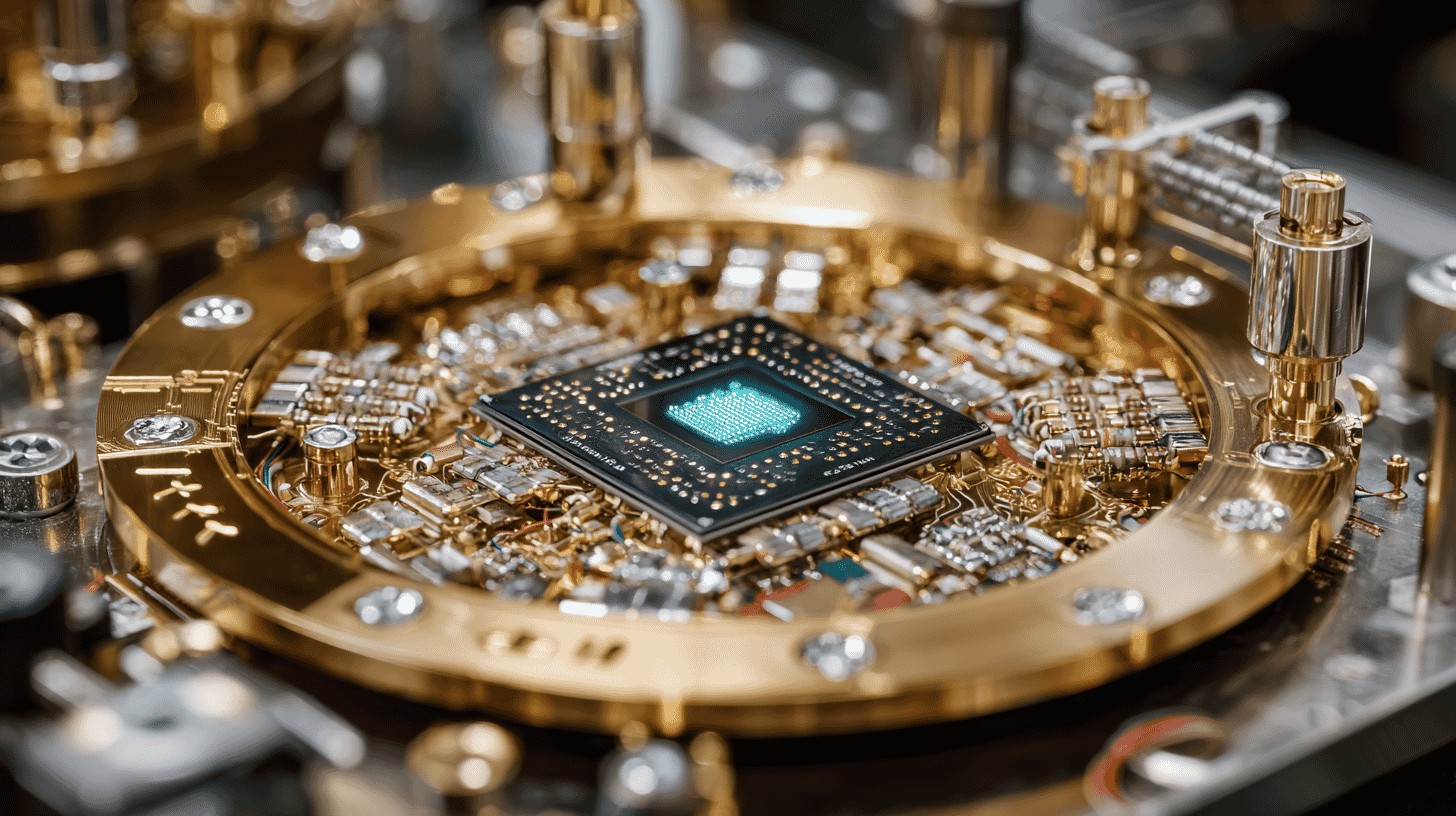
Japan just doubled down on its homegrown quantum computing ambitions. RIKEN and Osaka University have launched "Ei-II", a 144-qubit superconducting quantum computer built entirely with domestic technology. While IBM races toward 4,000+ qubits and Google makes headlines with error-correction breakthroughs, Japan is carving its own path in the global quantum race. Here's why it matters.
What Is Ei-II? Japan's 144-Qubit Quantum Machine
On March 26, 2026, a joint research group from RIKEN's Center for Quantum Computing and Osaka University's Center for Quantum Information and Quantum Biology (QIQB) announced the launch of cloud services for "Ei-II" (pronounced "ay-two"), a new quantum computer equipped with a 144-qubit superconducting chip.
Ei-II is the successor to "Ei" (meaning "wisdom" in Japanese), the country's first domestically built superconducting quantum computer, which debuted in March 2023 with 64 qubits. The new machine more than doubles the qubit count, arranging 144 qubits in a 12×12 two-dimensional grid on a chip measuring just 28×28mm, small enough to fit in your palm.
The improvements go beyond sheer numbers. The team adopted a new approach of lowering the resonance frequency, which significantly extended qubit coherence time, the duration a qubit can hold information before it decays. This reduces the probability of errors during computation. Meanwhile, optimized wiring layouts kept the entire system, including the cryogenic cooling equipment that chills the chip to near absolute zero (about -273°C or -460°F), the same physical size as the original Ei. In other words, they doubled computing power without expanding the footprint.
Two Machines, Zero Downtime
One of the most practically significant aspects of Ei-II's launch is that Japan's quantum cloud service has now shifted to a multi-system configuration.
Previously, when the original Ei needed calibration or maintenance, the entire cloud service had to shut down temporarily. Now, with both Ei and Ei-II running in parallel, one machine can handle user requests while the other undergoes maintenance. This may sound mundane compared to qubit breakthroughs, but for researchers and corporate users who depend on consistent access, uninterrupted service availability is a game-changer.
Users can now access three systems via the cloud: Ei-II, the original Ei, and Qulacs, a quantum circuit simulator running on classical hardware. Access has expanded from institutions directly collaborating on hardware development to a broader community of researchers working on quantum algorithms and real-world applications.
How Does Ei-II Compare to IBM and Google?
If 144 qubits sounds modest compared to the numbers coming from Silicon Valley, that's because qubit count alone doesn't tell the whole story.
IBM unveiled its 1,121-qubit Condor processor in 2023 and currently operates the 156-qubit Heron as its flagship. IBM's roadmap calls for a 1,386-qubit Kookaburra processor in 2026, with plans to link three chips into a 4,158-qubit system. The company is targeting verified quantum advantage by the end of 2026 and a fault-tolerant quantum computer with roughly 200 logical qubits by 2029.
Google took a different approach with its 105-qubit Willow chip, released in late 2024. Rather than chasing qubit count, Google focused on quality, achieving "below threshold" quantum error correction for the first time, where adding more qubits actually reduces rather than increases errors. Willow's T1 coherence time approaches 100 microseconds, a fivefold improvement over its predecessor Sycamore.
Ei-II occupies a different niche. Its significance lies not in competing head-to-head on qubit count, but in demonstrating that Japan can independently design and fabricate superconducting quantum chips of meaningful scale. At 144 qubits, the machine has entered the regime where classical supercomputers struggle to simulate its behavior, a threshold that matters for real research.
| System | Qubits | Type | Developer | Key Feature |
|---|---|---|---|---|
| Ei-II | 144 | Superconducting | RIKEN / Osaka Univ. | Domestic design, extended coherence, compact form |
| Ei (1st gen) | 64 | Superconducting | RIKEN / Osaka Univ. | Japan's first domestic superconducting QC |
| IBM Heron r2 | 156 | Superconducting | IBM | IBM's current flagship processor |
| IBM Condor | 1,121 | Superconducting | IBM | Highest qubit count (single chip) |
| Google Willow | 105 | Superconducting | Below-threshold error correction |
Japan's Quantum Roadmap: A Multi-Pronged Strategy
Ei-II fits into a broader national quantum strategy that Japan has been building since 2021, when the government designated RIKEN as the core hub for quantum technology innovation.
What makes Japan's approach distinctive is its diversity. While Ei-II represents the superconducting track, Hitachi has achieved world-class accuracy with silicon-based qubits, a potentially game-changing approach because it could leverage existing semiconductor manufacturing infrastructure. Osaka University is also advancing ion trap quantum computing architectures. And companies like Oxide Corporation are supplying critical UV laser components for neutral-atom quantum systems used by international players.
RIKEN has also partnered with Fujitsu, which has over 20 engineers stationed at RIKEN's facility working on manufacturing and implementation technologies for 1,000+ qubit systems. The Japanese government has allocated over 100 billion yen (roughly $670 million) to quantum technology, with a significant portion directed toward business demonstrations in logistics, drug discovery, and financial optimization.
The roadmap ahead focuses on achieving fault-tolerant quantum computing (FTQC), machines that can correct their own errors in real time and run complex calculations reliably over extended periods. Ei-II is a stepping stone toward that goal.
Why Build Domestically When IBM and Google Exist?
This is a fair question, and it's one Japanese researchers hear frequently. The answer involves both strategic necessity and practical benefits.
Quantum computing is expected to eventually impact national security through its potential to break encryption, simulate advanced materials, and optimize defense logistics. Relying entirely on foreign technology for such a critical capability carries significant risk. By maintaining domestic chip design and fabrication expertise, Japan preserves its ability to operate independently in the quantum era.
There's also a practical dimension: having domestic quantum hardware allows Japanese researchers and companies to customize systems for local needs, iterate quickly on experimental designs, and build the human capital needed for a domestic quantum industry.
Ei-II represents Japan's commitment to being a developer, not just a user, in the global quantum computing ecosystem. Whether 144 qubits is enough to compete with IBM's thousands remains to be seen, but the capability to build it at all puts Japan in a small club of nations with homegrown quantum computing technology.
In Japan, reactions to Ei-II range from pride in domestic innovation to concern about the gap with American tech giants. How is quantum computing developing in your country? Do you think building domestic quantum technology matters, or is it better to rely on global leaders? Share your thoughts in the comments!








Global Discussion
15 comments