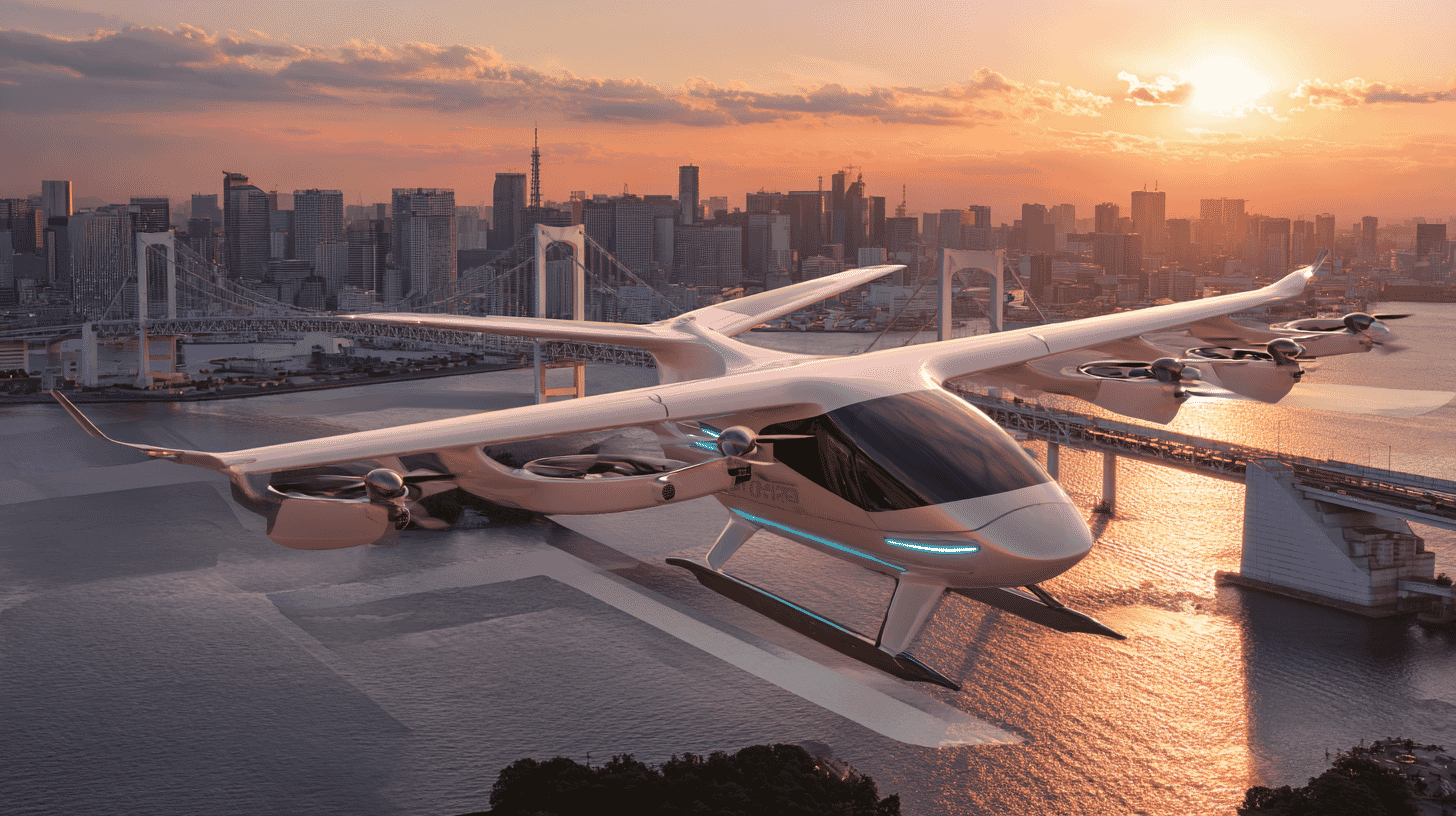
Imagine stepping into a quiet, electric aircraft on a Tokyo rooftop, with no runway and no jet fumes, and soaring over the bay to Osaka in minutes. That sci-fi dream just got a concrete timeline. Japanese startup AirX has officially ordered two "flying cars" and plans to launch commercial service by 2029.
AirX Signs Landmark Deal for Electric Flying Cars
In early February 2026, Tokyo-based startup AirX announced a binding order agreement with Eve Air Mobility, a subsidiary of Brazilian aerospace giant Embraer, for two electric vertical take-off and landing (eVTOL) aircraft. The deal also includes options to purchase up to 48 additional units, bringing the potential fleet to 50 aircraft in a deal reportedly worth up to $150 million.
This is Eve's first binding agreement in the Asia-Pacific region, and it was unveiled at the 2026 Singapore Airshow. The initial two aircraft are scheduled for delivery in 2029, with AirX planning to deploy them for sightseeing routes and "last-mile" transportation in the Tokyo and Osaka Bay areas.
"We are excited to partner with Eve Air Mobility to bring next-generation air transportation to Japan," said Kiwamu Tezuka, founder and CEO of AirX. "This collaboration reinforces our commitment to sustainability and innovation."
What Exactly Is a "Flying Car"?
Despite the catchy name, a "flying car" (空飛ぶクルマ / sora tobu kuruma) doesn't literally drive on roads and then take off. The term is Japan's popular nickname for eVTOL aircraft, electric-powered vehicles that can take off and land vertically, like a helicopter, but with multiple rotors similar to a large drone. They're designed to be quieter, cleaner, and eventually cheaper than traditional helicopters.
Eve's eVTOL features fixed wings like an airplane combined with multiple rotors. It carries one pilot and up to four passengers, with a range of approximately 60 miles (100 km). Because it runs entirely on electricity, it produces zero emissions during flight, a key selling point for urban environments.
Who Is AirX?
Founded in 2015 by Kiwamu Tezuka and Daiki Tada, two former colleagues at a marketing software company, AirX started as a platform connecting customers with helicopter charter and sightseeing services. Through its digital platforms AIROS Skyview and AIROS Charter, the company has built a network of helipads across Japan and established relationships with aviation operators.
The company's philosophy is "liberating human potential" (人の可能性を解放する / hito no kanōsei wo kaihō suru), the idea that removing transportation barriers gives people more freedom with their time and lives.
AirX raised approximately $8.3 million (1.25 billion yen) in its Series B funding round in March 2025, bringing total funding to about $10 million (1.5 billion yen). Investors include a subsidiary of Seibu Holdings (a major railway and hospitality group), Nissei Capital, and Pegasus Tech Ventures.
The company has also been conducting test flights with Chinese-made EHang 216-S autonomous aircraft, successfully completing demonstration flights in Okinawa and Tsukuba, Ibaraki Prefecture.
Why Eve Air Mobility?
AirX chose Eve Air Mobility for a strategic reason: Embraer's pedigree. Eve is backed by Embraer, one of the world's largest aircraft manufacturers with over 56 years of aerospace experience. This gives Eve's eVTOL a significant credibility advantage when it comes to navigating Japan's strict aviation certification process through the Japan Civil Aviation Bureau (JCAB).
The partnership actually dates back to April 2024, when AirX signed a Letter of Intent (LOI) for up to 10 aircraft. The February 2026 agreement upgrades this to a firm, binding order, a sign that both companies are moving from vision to execution.
Eve is currently building eVTOL production facilities in Brazil and has a global backlog of over 2,900 aircraft orders. The company also provides urban air traffic management software called "Vector," which AirX plans to integrate into its operations.
Japan's Flying Car Landscape: Not Just AirX
AirX isn't working in isolation. Japan has been actively pursuing flying car technology as part of a national strategy, and the Expo 2025 Osaka served as a major showcase:
SkyDrive, Japan's homegrown flying car developer, demonstrated its SD-05 aircraft at the Expo. The company conducted multiple demo flights, including an impressive 5-minute, 720-meter flight over Osaka Bay in August 2025. SkyDrive is working with Suzuki Motors on manufacturing and aims for commercial operations. Its aircraft price is set at approximately $1.3 million (200 million yen) for initial production units.
ANA Holdings partnered with U.S.-based Joby Aviation to showcase the Joby S4, a five-seat eVTOL with a 100-mile (160 km) range that also flew at the Expo.
Marubeni Corporation teamed up with U.S.-based LIFT Aircraft and UK-based Vertical Aerospace to demonstrate additional eVTOL concepts.
The Japanese government supports this movement through its "Regional Revitalization Strategy," which identifies eVTOL as a potential solution for improving transportation access in remote islands and mountainous areas. The Cabinet Office's Aviation and Space Working Group has also placed next-generation aircraft implementation on its agenda.
The Road (or Sky) to 2029: Challenges Ahead
While the momentum is real, several hurdles remain:
Regulatory framework: Japan's aviation regulations need updates to accommodate autonomous and semi-autonomous eVTOL operations. Questions around accident liability for autonomous flights remain unresolved. Industry observers estimate Japan may be about five years behind China, where EHang's autonomous aircraft already has type certification.
Infrastructure: Vertiports (dedicated landing pads for eVTOL) need to be built across urban areas. Osaka Metro has already built the "Osaka Port Vertiport," and SkyDrive has proposed a "Diamond Route" connecting four areas in Osaka. But scaling this nationwide will require massive investment.
Public acceptance: While Japanese consumers are generally excited about the technology, concerns about safety, noise, and cost remain. The nickname "flying car" was deliberately chosen to make the concept feel familiar and accessible, like a car everyone can use, not an exclusive luxury.
Battery technology: Current eVTOL range is limited (the EHang 216-S offers only about 20 miles/35 km per charge with 21 minutes of flight time from a 2-hour charge). Longer ranges will require advances in battery density and ultra-fast charging infrastructure.
What This Means for Tourism and Daily Life
For tourists, flying cars could transform how people experience Japan. Imagine a 15-minute aerial sightseeing tour over Tokyo Bay, or a quick hop from Osaka's urban center to a resort island. AirX already offers helicopter sightseeing tours, a 22-minute Tokyo night flight starts at about $400 (59,800 yen), and eVTOL services could eventually bring prices down dramatically.
For rural communities, the impact could be even more profound. Japan's aging society faces serious transportation challenges in remote areas where bus routes are being cut and train lines discontinued. Flying cars could provide vital connections for isolated communities, serve as emergency medical transport, and support disaster relief operations. AirX has already signed disaster response agreements with cities like Sagamihara in Kanagawa Prefecture.
A Glimpse of the Future
The trajectory is clear: Japan is positioning itself as a global leader in urban air mobility. Between AirX's commercial ambitions, SkyDrive's domestic manufacturing push, and strong government backing, the pieces are falling into place.
By 2029, when AirX's first Eve eVTOL aircraft touch down in Japan, the country's urban skylines may look quite different from today. Whether these machines become everyday transportation or remain a premium experience will depend on how quickly costs come down and infrastructure scales up.
One thing is certain: the era of flying cars in Japan is no longer science fiction, it's a business plan with a delivery date.
Japan is making bold moves toward making flying cars a reality. Does your country have similar urban air mobility projects? Would you ride a flying car if it were available in your city?
References
- https://www.travelvoice.jp/20260205-159214
- https://www.prnewswire.com/news-releases/airx-signs-firm-order-agreement-with-eve-air-mobility-for-two-evtol-aircraft-302678290.html
- https://www.eveairmobility.com/airx-signs-firm-order-agreement-with-eve-air-mobility-for-two-evtol-aircraft/
- https://www.expo2025.or.jp/future-index/smart-mobility/advanced-air-mobility/
- https://prtimes.jp/main/html/rd/p/000000249.000028531.html









Global Discussion
15 comments