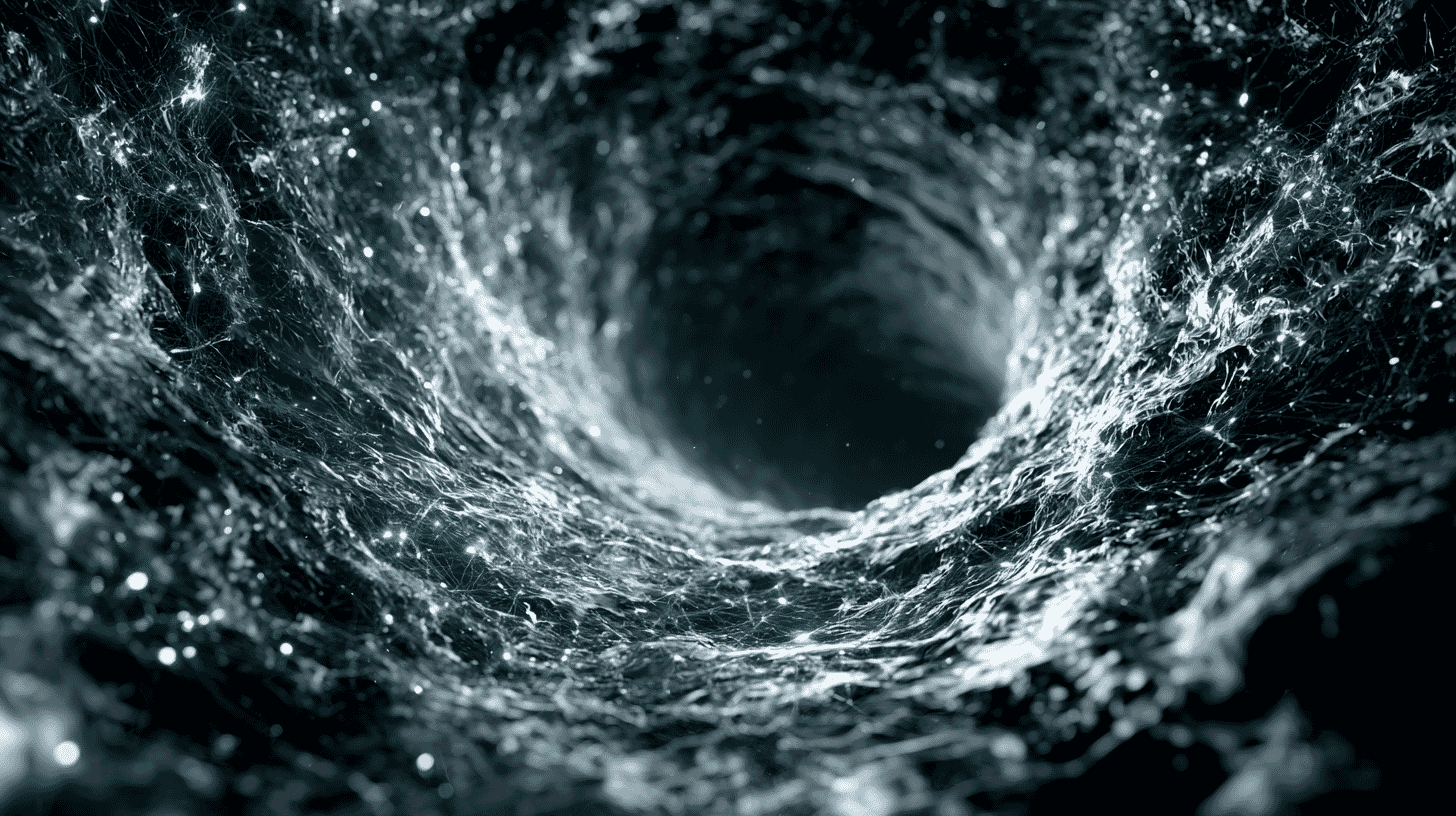
Ask people where drug-resistant bacteria come from and most will picture a hospital bed. A research team at the Institute of Science Tokyo looked lower down, at the slick film clinging to the inside of the hospital's drainpipes. Resistant bacteria were not merely concentrated there. The resistance genes inside that film were switched on, and running far harder than the ones in the wastewater flowing past.
What that slime actually is
The film in your kitchen sink and the plaque on your teeth belong to the same category of thing. They are less dirt than architecture. When bacteria settle on a solid surface, they secrete a sticky matrix of sugars and proteins and burrow into it. That is a biofilm, and the Science Tokyo press release points to kitchen slime and dental plaque as everyday examples.
The awkward part is what the matrix does to drugs. Disinfectants and antibiotics struggle to penetrate it. From a bacterium's point of view, this is housing that does not wash away, does not dry out, and does not let the chemicals reach you. A hospital drain adds one more feature: a daily inflow of leftover antibiotics and bacteria from patients.
Having a gene is not the same as using it
The team, led by assistant professor Yusuke Ota and professor Ryoichi Saito of the university's Graduate School of Medical and Dental Sciences, placed plastic surfaces in the wastewater system of Science Tokyo Hospital, let biofilm form on them naturally, and compared that film against the wastewater running around it.
Most previous surveys of hospital wastewater have counted which resistance genes are present. The tool for that is metagenomics: pull DNA out of an environmental sample and read all of it at once. It is essentially an inventory of the blueprints sitting in the warehouse.
But stock on a shelf and stock in use are different questions. So the team paired it with metatranscriptomics, which reads the RNA that bacteria are actually transcribing and shows how hard each gene is working. That is closer to walking the production floor.
DNA and RNA, read together. The two-layer approach is where this study earns its keep.
What turned up inside the pipes
The first finding is the plainest. Drug-resistant E. coli accumulated inside the biofilm at strikingly higher concentrations than in the surrounding wastewater. The film works as a vessel.
Among the resistance genes detected were blaIMP-1, blaIMP-11, blaNDM-1 and blaOXA-23. All of them encode carbapenemases, enzymes that break down carbapenems, the antibiotics kept in reserve for the most serious infections.
Then came the expression data. The blaIMP family, described in the release as the most widespread carbapenemase group in Japan, was expressed at markedly higher levels inside the biofilm than in the wastewater. The team attributes this to a network in which mobile genetic elements act as central hubs, tying resistance genes to the surrounding environmental bacteria. Mobile genetic elements are stretches of DNA that can relocate on their own and hand resistance genes to other species.
Culture work backed up the sequencing. Four blaIMP-1-producing isolates, including Citrobacter freundii and Pseudomonas aeruginosa, were recovered from the biofilm, and whole-genome sequencing placed their resistance genes right next to mobile genetic elements.
Why the drain becomes a place to intervene
That hospital wastewater serves as a reservoir for resistant organisms is old news. What the release pushes is the distinction between spreading and evolving. The team says nobody had previously watched, in motion, how the film in a drain helps resistance get acquired and handed around.
Accept that framing and the coordinates of infection control shift a little. Alongside hand hygiene and antibiotic stewardship at the bedside, the plumbing itself becomes a target. Japan's National Action Plan on Antimicrobial Resistance 2023-2027, adopted in April 2023, rests partly on a One Health approach that works across the human and animal divide. A pipe fits into that framework in an unusually concrete way.
How big is the problem? The GRAM Project's global estimate, published in The Lancet in 2024, projects 8.22 million deaths associated with antimicrobial resistance annually by 2050, and 1.91 million deaths directly attributable to it. The Science Tokyo release cites the 8.22 million figure as well.
Ripping out the plumbing is not a guaranteed fix
So the drain is a target. Does that mean replacing the pipes solves it? Not quite.
A study from the University of Virginia and collaborators, published in npj Antimicrobials and Resistance on January 27, 2026, replaced the plumbing under handwashing sinks in six intensive care rooms and tracked the drain biofilm for three months before and three months after. Carbapenemase-producing Enterobacterales turned up in 16 of the 18 samples collected after replacement, against 7 of 18 before it (p = 0.006). Total resistance gene load also rose in the new plumbing.
The authors suggest that tearing out a microbial community that took years to stabilise leaves an ecological gap, and that faster-growing resistant organisms move into it. Swapping the pipes is the intuitive response, and it may produce the opposite of the intended result.
Notably, the Science Tokyo team is not proposing replacement either. Their stated next steps are methods that specifically suppress biofilm formation, better protocols for cleaning the inside of pipes, and a shift in environmental monitoring so that attached biofilm is sampled alongside the water itself. As of July 2026, all of that sits at the applied-research stage.
There are limits. This is a single facility's wastewater system. Whether the same structure holds in other hospitals or other countries has to be tested separately. That said, measuring your own institution's drains and publishing what you find is not a common dataset in this field.
Infection control outside the bedside
Conversations about resistance tend to collapse into personal behaviour: do not overuse antibiotics. This study points somewhere adjacent: building services, cleaning procedure, and the quieter question of what a monitoring programme decides to measure at all.
Testing sewage stopped being an exotic idea after COVID-19 made wastewater surveillance routine in many countries. Loading resistance onto machinery that already exists, and shifting where the sample gets taken, is not a large institutional leap.
Is hospital wastewater treated as part of infection control where you live, or is it still just something that goes down the drain?
References
- https://www.isct.ac.jp/ja/news/6g158f0trd3z
- https://doi.org/10.1016/j.bioflm.2026.100377
- https://www.nature.com/articles/s44259-025-00176-2
- https://www.healthdata.org/news-events/newsroom/news-releases/lancet-more-39-million-deaths-antibiotic-resistant-infections
- https://www.mhlw.go.jp/content/10900000/ap_honbun.pdf








Global Discussion
4 comments