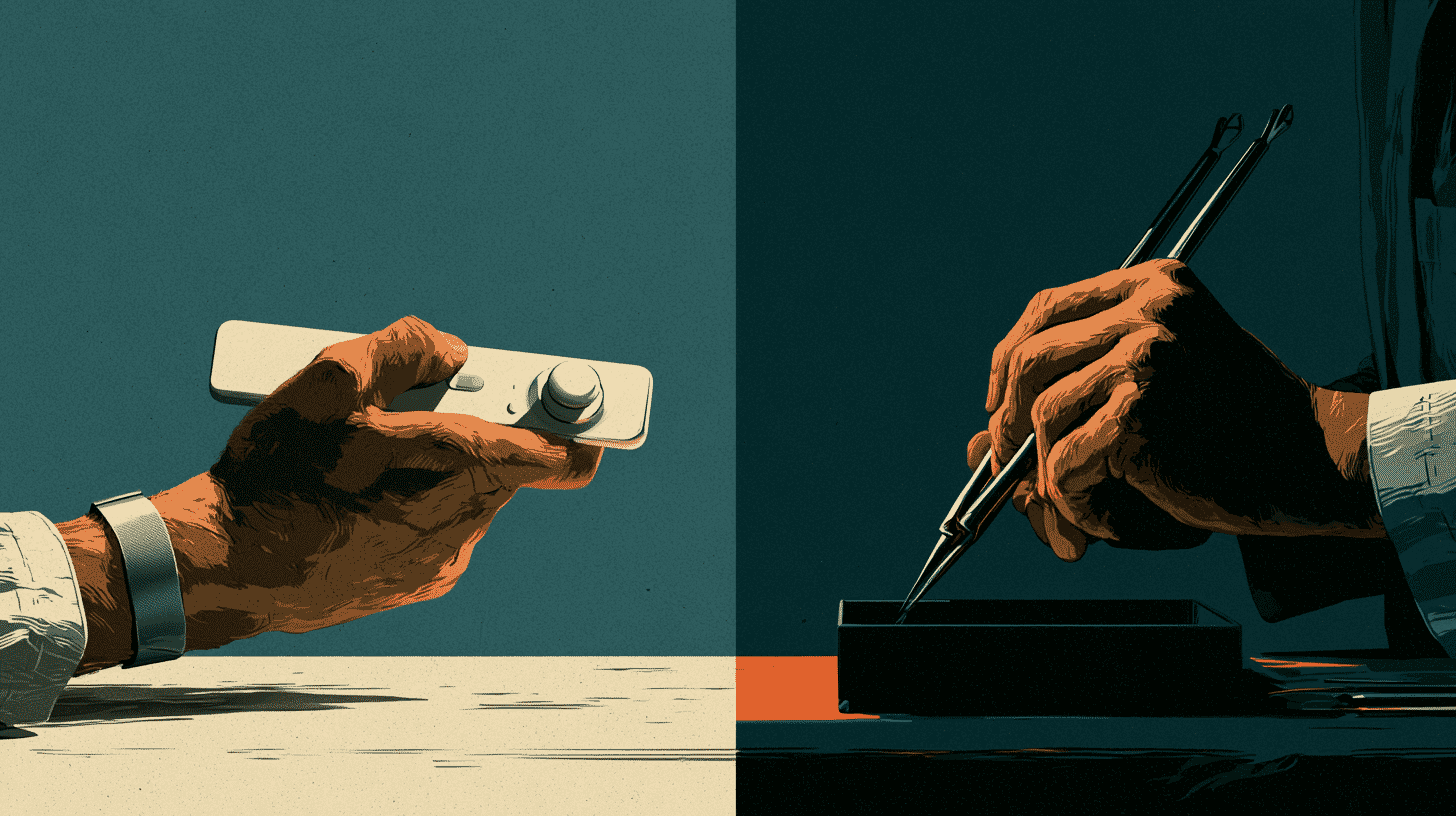
🐒 A German orthopaedics team spent its study days handing students two things: a set of arthroscopic instruments, and a Wii remote. Students who were better at rolling a monkey through an obstacle course also tended to score better on the surgical trainer. Students who were good at Splatoon 2 did not. And the question almost every earlier study leaned on, "do you play games?", predicted nothing at all.
Keyhole surgery is a controller problem
Arthroscopy is keyhole surgery for joints: knees, shoulders, hips. A few holes a couple of millimetres across, a camera through one of them, instruments through the others, and the surgeon works entirely by watching a monitor.
To a gamer this starts to sound familiar. Depth collapses, since a three-dimensional joint arrives on a flat screen. The instruments invert: move your hand left and the tip goes right, a quirk surgeons call the fulcrum effect. There is almost no tactile feedback, because you are feeling tissue through a metal rod. What remains is hand-eye coordination, two-handed choreography, and spatial reasoning while your non-dominant hand steers the camera.
Trainees practise on box trainers and VR simulators. Both work, both are expensive, and both are booked solid, which is why medical educators keep asking whether something cheaper could carry part of the load.
What the study actually did
The paper landed in Medical Science Educator on 20 July 2026, open access, from a group at Charité – Universitätsmedizin Berlin and University Hospital Münster, with Tom Folkerts as first author and Dennis Liem as senior author.
Fifty students took part, 41 from medicine and 9 from other faculties: 38 men and 12 women, mean age 23.04, everyone between 19 and 30, with 42 right-handers and 8 left-handers. Anyone who had taken an arthroscopy course or handled the instruments before was excluded. Recruitment aimed for 25 "gamers", defined as more than three hours a week, and 25 "non-gamers".
The surgical half used a Sawbones FAST-Trainer box with three modules:
- Maze: guide a 7.9 mm steel ball around the maze track with a probe, then swap the probe and the camera between your hands and bring it back.
- Transfer: place six cylinders into memorised positions using a grasper.
- Numbers: find the numbers 1 to 21 in order and puncture each one.
Each module was scored in seconds, with time penalties added for errors. Low scores are the good ones. Two raters graded the video independently and agreed almost perfectly (ICC 0.982, 0.985 and 0.922).
The gaming half was Super Monkey Ball: Step & Roll on a Wii with the Wii Remote Plus, 10 stages back to back with 60 seconds each, plus Splatoon 2 on a Switch Pro Controller with tilt aiming. Both were boiled down to a single number built from in-game points, lives and time, and here high scores are the good ones. Half the group started with the games and half with the trainer, assigned at random, so nobody got a warm-up advantage.
The monkey landed. The squid missed.
"Gamer" versus "non-gamer" explained nothing. Not on the Maze (p = 0.432), the Transfer (p = 0.426) or the Numbers module (p = 0.227), and not on the combined score either (p = 0.566). Error counts refused to separate the groups as well.
The label was not even a good label. Self-declared gamers buried the non-gamers at Splatoon 2, averaging 8,581 points against 616 (p < 0.001). At Super Monkey Ball they managed 52,543 against 49,864, a gap of 2,679 points that means nothing statistically (p = 0.172). Three hours a week of whatever you happen to play does not make you good at tilting a monkey.
Monkey Ball scores did line up with surgical scores. Against the Numbers module, r = -0.418, p = 0.003; against overall arthroscopy performance, r = -0.356, p = 0.011. Those minus signs are the good direction, since a low arthroscopy score means fast and clean. Both are moderate associations rather than tight ones. Maze (r = -0.241) and Transfer (r = -0.186) pointed the same way but missed significance. Splatoon 2 correlated with nothing at all.
The regression model turned up a fourth result. The only independent predictor of overall arthroscopy performance was how dexterous students said they were. Not weekly hours, not childhood gaming, not age, sex or handedness. People had a rough sense of their own hands before anyone measured them. Richey's group, testing 49 medical students, found the opposite kind of predictor: athletic experience mattered, gaming experience did not.
Why the monkey? Twenty years of a strange research thread
The authors' first explanation is the controller. Rolling the ball in Step & Roll means tilting a wand in physical space, a gesture closer to steering a rigid instrument through a port than thumbsticks and triggers are. The paper backs this with laparoscopy research. Giannotti's group found four weeks of Wii training lifted simulator scores against a control group; Ju's team put the Wii slightly ahead of a PlayStation 2; Kulkarni's group found laparoscopic skill tracked Wii performance more closely than Xbox performance, and put that down to the resemblance between controller movements and instrument handling.
The trouble is that the thread does not close. Super Monkey Ball is in this study because of a 2007 paper, when James Rosser's team at Beth Israel Medical Center in New York put 33 surgeons through a laparoscopic skills course and sat them down with three games none of them had played before: Super Monkey Ball 2, Star Wars Racer Revenge and Silent Scope. Monkey Ball produced the strongest link of the three to laparoscopic skill and suturing, and surgeons who had once played more than three hours a week made 37% fewer errors and worked 27% faster. That three-hour line became every later study's definition of a gamer, this one included.
And Super Monkey Ball 2 was a GameCube game. Analogue stick, no motion control anywhere. So either the Wii remote is the mechanism, or there is something about this particular series, and the research since then has not managed to separate the two.
Japan has its own entry in the thread. In a study published online in 2024, Minoru Hattori of Hiroshima University's medical education centre and Hiroyuki Egi of Kitasato University Medical Center modelled gaming experience, spatial cognition and laparoscopic skill together in 50 medical students. Experience helped, but the sharper finding was the ceiling: students who played heavily without a matching gain in spatial cognition ended up worse at the laparoscopic tasks. The German paper cites it. A 2021 systematic review by Gupta's group had already flagged the gap this study falls into, noting that gaming looks useful for laparoscopic and robotic work but has not behaved consistently for arthroscopy.
What the study does not say
It does not say games make surgeons. Nobody trained anybody here; this was a single session with two sets of measurements. The correlation could be a shared third factor showing up in both scores, with visuospatial ability the obvious candidate, and the authors say as much themselves.
The caveats are theirs too. Fifty is larger than most studies in this corner of the literature and still small. Participation was voluntary, so students already drawn to arthroscopy may be overrepresented. The gaming questionnaire had to be built from scratch, because no validated instrument for this exists. And gamers were not better at Monkey Ball, which the authors admit undercuts their own grouping. The paper also does not report whether anyone had played Monkey Ball before.
What they propose is narrow. If a game score reflects one facet of arthroscopic aptitude, a cheap console and a fixed task could flag which students need extra spatial training before they get anywhere near the expensive simulator. Not a replacement. A filter.
Two Japanese games in a German lab
Both games came from Japan, and the paper even names the cities: Sega in Ōta, Tokyo, and Nintendo in Kyoto. Neither company built anything here with medicine in mind. Step & Roll, sold in Japan as Super Monkey Ball Athletic, shipped for the Wii on 25 February 2010 as a living-room party game, and the series is still running; Banana Rumble arrived on Switch on 25 June 2024. Somewhere along the way, a game about a monkey in a plastic ball kept turning up in surgical education research.
In Japan, Monkey Ball is remembered as the thing you played with your family, not as laboratory equipment. Would a medical school near you put a games console in the skills lab? And be honest: would you feel better or worse knowing that the surgeon holding the camera warms up on a video game?
References
- https://link.springer.com/article/10.1007/s40670-026-02827-z
- https://automaton-media.com/articles/newsjp/20260808-459297/
- https://pubmed.ncbi.nlm.nih.gov/17309970/
- https://pubmed.ncbi.nlm.nih.gov/39034682/
- https://pubmed.ncbi.nlm.nih.gov/33376998/
- https://www.nintendo.co.jp/wii/software/smbj/index.html
- https://www.sega.co.jp/release/240625_1.html








Global Discussion
4 comments