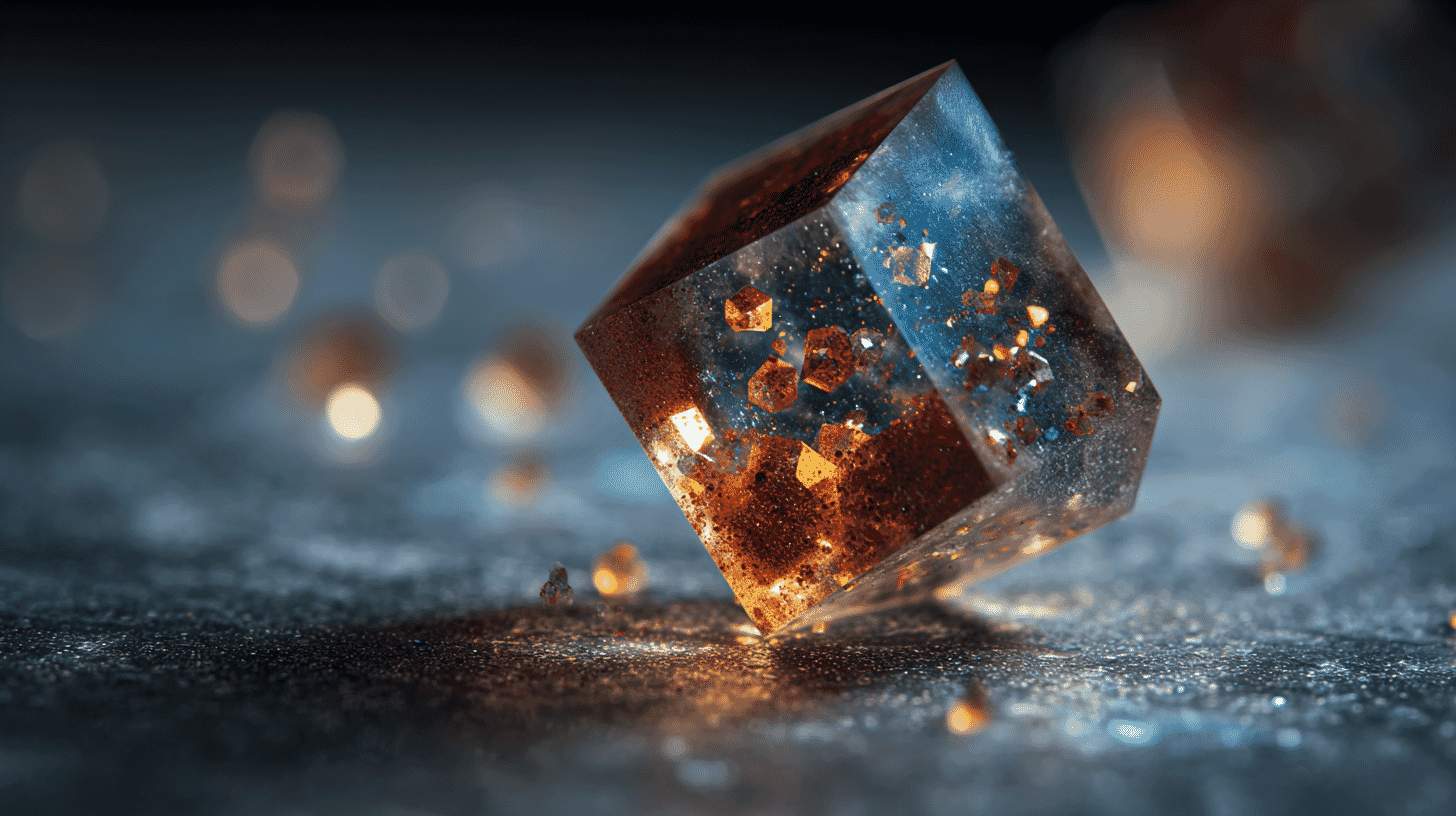
For over a century, aluminum oxide was considered "unglassable", impossible to form into a solid, transparent bulk piece. A Japanese research team just proved that wrong, creating a see-through chunk of amorphous alumina with a dielectric constant of 11.3, higher than sapphire itself. Published in JACS, this breakthrough could change the game for semiconductors and capacitors.
Breaking a Century-Old Rule in Materials Science
Aluminum oxide (alumina, Al₂O₃) is everywhere. It forms the sapphire crystal in your smartphone camera cover, protects engine parts, and even coats everyday cookware through a process called anodizing. As a crystalline material, alumina is one of the most useful ceramics on the planet.
But here's what scientists have struggled with for over 100 years: unlike common glass (which is amorphous silicon dioxide), alumina stubbornly refuses to become glass. You can melt it and cool it as fast as you like, it always crystallizes. Thin films and nanoparticles of amorphous alumina exist, but creating a visible, millimeter-scale transparent chunk? That was considered fundamentally impossible.
A team led by Associate Professor Hideki Hashimoto and Professor Toshinori Okura at Kogakuin University, along with Senior Researchers Yohei Onodera and Masashi Miyakawa at NIMS (National Institute for Materials Science), has now shattered that assumption. In collaboration with Kyoto University, Nagoya University, Tohoku University, Shimane University, JEOL Ltd., Okamoto Glass Co., and several other institutions, they produced exactly what the textbooks said couldn't be made.
Squeeze, Don't Melt
The team's approach was the opposite of traditional glassmaking. Instead of melting material and rapidly cooling it, they started with a porous amorphous alumina thin film, the same kind used in everyday anodized aluminum (the coating on pots and lunch boxes).
They then applied extreme pressure at room temperature: 9.4 GPa, or roughly 94,000 times atmospheric pressure. That's comparable to conditions deep within Earth's mantle. Under this crushing force, the pores and grain boundaries in the film disappeared, and the particles fused into a single, transparent, millimeter-sized bulk piece.
No melting. No cooling. Just pure compression, and a material that wasn't supposed to exist was born.
A Dielectric Constant That Beats Sapphire
The properties of this new material are remarkable. Its dielectric constant, a measure of how well a material can store electrical energy, clocked in at approximately 11.3. For reference, α-Al₂O₃ (sapphire), the most well-known crystalline form of alumina, has a dielectric constant of about 10.
An amorphous material outperforming its crystalline counterpart in dielectric properties is counterintuitive and genuinely surprising in materials science. On top of that, the bulk amorphous alumina exceeded standard silica glass in density, thermal conductivity, hardness (Vickers), and dielectric constant across the board. It was even harder than aluminosilicate glass, which is known for its high hardness.
The Secret: Pentahedral Pyramids
What makes this material so special at the atomic level?
Using Japan's world-class research facilities, SPring-8 (one of the world's largest synchrotron radiation facilities) and J-PARC (a high-intensity proton accelerator), the team conducted detailed structural analysis combining solid-state NMR, X-ray diffraction, and neutron diffraction.
They discovered that the primary structural unit of amorphous alumina is a five-coordinated pyramid (AlO₅), imagine an octahedron (the six-coordinated structure found in crystalline alumina) with one oxygen atom missing, creating a distorted, lopsided shape.
This AlO₅ pyramid is inherently unstable and easily deformed by electric fields. When pressure is applied, these pyramids distort further while six-coordinated octahedra (AlO₆) also increase in number. The two types of structural units connect through edge-sharing, a dense linkage pattern rarely seen in typical amorphous materials, creating an ultra-dense network.
The team proposes that this combination of "wobbly" pyramids and rigid octahedra connected in a crystal-like dense matrix is what generates the record-high dielectric response.
Real-World Potential: Semiconductors and Capacitors
This isn't just a triumph of basic science. High-dielectric-constant materials are critical for next-generation semiconductor devices (as gate insulators) and for capacitors used in everything from smartphones to electric vehicles.
The global semiconductor industry is actively searching for new "high-k" dielectric materials. A transparent, hard, thermally conductive amorphous material with a dielectric constant exceeding sapphire could offer entirely new options for substrate materials and multilayer ceramic capacitors (MLCCs).
Moreover, the research team suggests their concept, controlling atomic coordination and connectivity through high pressure to enhance material properties, can be generalized to other oxide systems. This opens a new frontier in materials design where pressure, not composition, is the primary tool.
Published in JACS: A Stamp of Excellence
The findings were published on April 7, 2026, in the Journal of the American Chemical Society (JACS), one of the most prestigious journals in chemistry worldwide. The paper, titled "Bulk Amorphous Alumina: The Density-Driven Interplay of Pentahedral Pyramids and Octahedra for High Dielectric Permittivity," lists nearly 30 co-authors, a testament to the scale of cross-institutional collaboration in Japanese materials science.
Why Japan Leads in Materials Science
This breakthrough illustrates several strengths of Japan's research ecosystem. World-class large-scale facilities like SPring-8 and J-PARC, NIMS's ultra-high-pressure expertise, and deep university-industry partnerships all came together to achieve what was deemed impossible for a century.
Japan is sometimes called a "materials superpower." From carbon fiber to lithium-ion battery components to semiconductor photoresists, Japanese materials technology underpins much of the global high-tech supply chain. This amorphous alumina research adds another impressive chapter to that legacy.
What's the state of fundamental materials research in your country? Have researchers there ever overturned a century-old assumption? We'd love to hear your perspective.






Global Discussion
14 comments