
5,200 land hermit crabs, a protected natural monument, were stuffed into suitcases. The mass poaching case uncovered in May 2025 on Amami Oshima, a World Natural Heritage island, exposed the serious challenges Japan's remote islands face in protecting rare wildlife. It came to light because of a "suspicious noise" from a hotel room. Here is the overseas pet market behind the case and the efforts to protect the island.
5,200 Hermit Crabs That Almost Vanished
On May 6, 2025, something odd happened at a hotel on Amami Oshima in Kagoshima Prefecture. Hermit crabs were found in a room after guests had checked out, and suitcases left in the hotel's care were making strange rustling sounds. Suspicious hotel staff alerted the authorities, bringing an unprecedented poaching case to light.
Police found about 160 kg of land hermit crabs in six suitcases, all protected as national natural monuments. The next day, Amami police arrested three Chinese men in their twenties on suspicion of violating the Act on Protection of Cultural Properties.
The investigation found that the three had spent about a week from April 30 visiting beaches around the island, collecting the crabs by hand. They had gathered about 5,200. A curator at the Amami City Museum noted that "collecting more than 5,000 takes considerable effort. They may have had knowledge of the animals' ecology."
¥20,000 Each: The Overseas Pet Market Driving Poaching
Why were so many hermit crabs targeted? Behind it lies high-priced trade in the pet markets of China and Taiwan.
According to Japan's Agency for Cultural Affairs, capturing and trading land hermit crabs in Japan is permitted only as a special exception for certain specialist dealers in Okinawa. Overseas, however, the purple land hermit crab is particularly popular, with some reportedly traded for ¥20,000 each. If all 5,200 were sold, the total would exceed ¥100 million.
Just a month earlier, two Taiwanese men were arrested on Miyakojima in Okinawa trying to take 998 land hermit crabs off the island, discovered in cardboard boxes during airport baggage checks. They told investigators they had not caught the crabs themselves but had been asked to carry them, suggesting an organized smuggling network.
A 2025 study by Japan's National Institute for Environmental Studies found that some online sellers in Taiwan openly say they obtained the crabs "through e-commerce via China," pointing to a smuggling route from Japan through China to Taiwan.
A History of Repeated Poaching on Amami Oshima
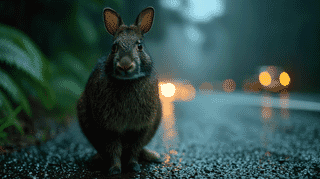
The Amami Islands, including Amami Oshima, were inscribed as a UNESCO World Natural Heritage site in 2021 as "Amami-Oshima Island, Tokunoshima Island, Northern part of Okinawa Island, and Iriomote Island." With around 50 endemic species of vertebrates, including the Amami rabbit and Lidth's jay, and more than 800 endemic insects, it is an ecosystem of global importance.
That rarity, however, attracts poachers. In 2019 a Tokyo pet shop manager and others received prison sentences for violating the Species Conservation Act. Since the World Heritage listing the situation has not improved and, if anything, has worsened.
In July 2023, two cases occurred at Amami Airport involving attempts to take out hundreds of unregulated stag beetles and near-threatened Amami sword-tailed newts. Illegal insect traps keep turning up along forest roads, and theft of rare plants has been reported. An endemic stag beetle, Neolucanus protogenetivus, once sold for ¥26,500 on an online auction.
Such cases continue. In June 2026, two Chinese men were arrested on suspicion of violating the Act on Protection of Cultural Properties for capturing about 12.8 kg of land hermit crabs without permission on a beach on Amami Oshima.
A ¥300,000 Fine: Laws That Have Lost Their Deterrent Power
The three arrested in the Amami case were summarily indicted for violating the Act on Protection of Cultural Properties and each ordered to pay a ¥300,000 fine. Whether that is appropriate for the organized poaching of 5,200 natural monuments, allegedly intended for sale overseas, is open to debate.
If all 5,200 had sold for ¥20,000 each, the total would have been ¥104 million. A ¥300,000 fine is far too light to deter poaching.
Kagoshima Prefecture's ordinance provides for up to one year in prison or a fine of up to ¥500,000 for capturing rare wild species, but that too is hardly enough given the high prices overseas. A further problem is that there are few legal tools to deal with mass removal of unregulated species. Some species, such as the Amami sword-tailed newt and certain stag beetles, are not regulated, so even mass collection is difficult to police under current law.
Border Controls at Their Limit
Enforcement also faces serious problems. The airport is not the only way wildlife leaves Amami Oshima. Ferries, where baggage checks are not required, are effectively impossible to monitor.
At the airport, the Ministry of the Environment and Japan Airlines use tablets to help identify rare species, but it is hard for non-expert airport staff to identify them accurately in a short time. Amami City and the ministry run patrols, but covering the whole of the large island is unrealistic.
This hermit crab case came to light only because hotel staff reported it. The curator warns: "We were lucky to notice this time, but it may be just the tip of the iceberg."
Island-Wide Efforts at Protection
Those who share this sense of crisis are taking action. In June 2024, WWF Japan held a seminar on countering the poaching and removal of wildlife on Amami Oshima, attended by about 120 people from government, airlines, e-commerce companies and eco-tour guides.
At the seminar, a representative of LY Corporation (LINE Yahoo) described round-the-clock monitoring of its online marketplaces and announced a ban on listings of wild-caught amphibians from July 2025. Japan Airlines, working with the Ministry of the Environment on species identification, called for experts to be stationed at airports and for a permit system that would in principle ban taking wildlife off the island.
Some areas have already moved ahead. Kumejima in Okinawa has an ordinance banning the capture of live wild animals and plants across the town, and Toshima Village in Kagoshima bans catching insects on village land. On Amami Oshima, debate is growing over an ordinance banning the removal of all wildlife from the island, but concerns about limiting academic research and children's experiences of nature keep many cautious.
After the poaching case, the World Natural Heritage promotion consortium, made up of the Amami Oshima Nature Conservation Council, the Ministry of the Environment and others, issued a joint statement asking people to refrain from taking wildlife off the island. A ministry official urged visitors "to treat creatures that have lived there for thousands of years with respect."
Passing the World Natural Heritage On to Future Generations
Of the confiscated hermit crabs, about 4,500 that were still alive were returned to five beaches on the island on expert advice. After about a month of stress in captivity they moved awkwardly on the sand, but were eventually seen heading into the pandanus thickets.
The remaining 700 or so had already died. And no one knows how much poaching goes undetected.
Protecting the ecosystem of a World Natural Heritage island is not a problem for Japan alone. The illegal wildlife trade is a global criminal industry worth tens of billions of dollars a year, and as long as there is demand, poaching will not stop. Changing consumers' attitudes and strengthening cross-border enforcement are essential.
In Japan, debate ranges from calls for tougher penalties and stronger border controls to the importance of biodiversity education. How does your country deal with wildlife poaching and illegal trade?
References
- https://373news.com/news/local/detail/214236/
- https://373news.com/news/local/detail/235572/
- https://amamishimbun.co.jp/2025/06/12/56575/
- https://www.nankainn.com/news/weather/密猟、盗掘、大量持ち出し 事例頻発、生態系保護
- https://www.wwf.or.jp/staffblog/news/5970.html
- https://www.cnn.co.jp/world/35232829.html
- https://kyushu.env.go.jp/okinawa/awcc/smuggling.html
- https://www.nies.go.jp/whatsnew/2025/20250731/20250731-2.html




Global Discussion
16 comments