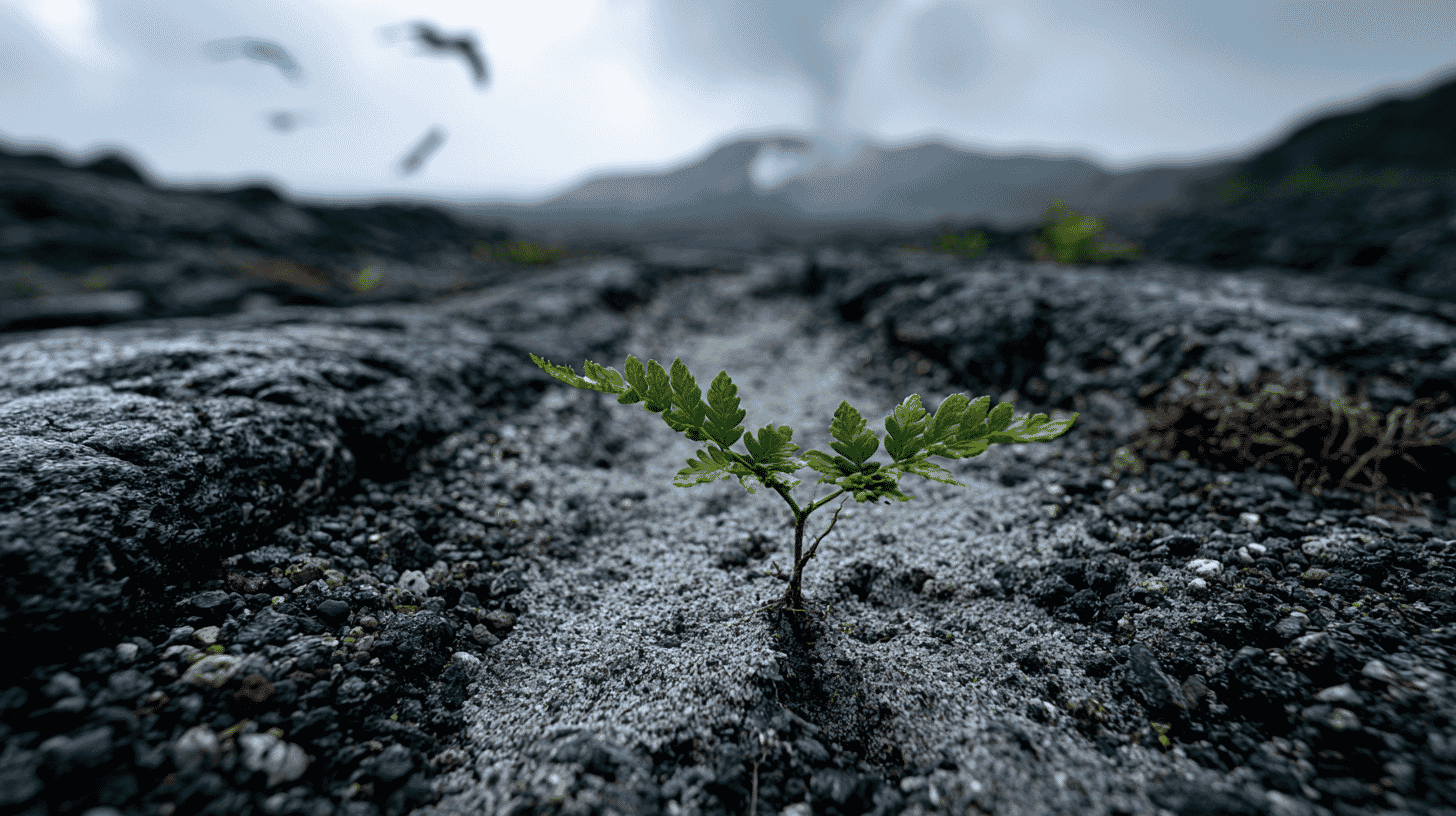
🌋 Before you can set foot on Nishinoshima, you have to get in the water. Researchers heading ashore are required to wade in completely, gear and all, so that not a single seed rides in on a boot lace.
Two studies published in 2026 explain why Japan bothers. On an island where an ecosystem is restarting from nothing, the first seeds did not arrive with us. The DNA points to birds that cross oceans.
New boots, a clean room, and a swim
The landing rules for Nishinoshima were issued on June 14, 2016, jointly by the scientific committee overseeing the Ogasawara (Bonin) Islands World Heritage site and the agencies that manage it: the Ministry of the Environment, the Forestry Agency, the Tokyo Metropolitan Government, and the village of Ogasawara.
They are not gentle. Boots, clothing and bags used on the island should be new. If new gear is not available, it must be painstakingly cleaned by freezing or alcohol washing. Equipment is prepared in a clean room. Then, immediately before landing, everyone wades fully into the sea with their luggage, a procedure the rules call a wet landing, to rinse off any seeds or hitchhiking organisms. Survey plans also go through a quarantine check by outside parties, meaning government agencies and independent experts.
The rules cap the number of people and the frequency of visits at the absolute minimum. Nishinoshima, Minami-Iwoto and Kita-Iwoto are singled out as places where human influence remains almost nil; landings on Minami-Iwoto happen roughly once a decade or less often. Part of the old island is state-owned forest land, and getting on it requires an academic purpose. The whole island sits inside a special protection zone of Ogasawara National Park.
Do all of that, and things still get through. The North Atlantic has the cautionary tale. Surtsey, off the south coast of Iceland, was born in a submarine eruption that began in November 1963 and was placed under legal protection in 1965: a closed laboratory, no visitors. And yet in the summer of 1969, a researcher spotted an unfamiliar plant growing in a crack in the lava. It was a tomato, 15 centimeters tall. He rolled the surrounding rocks aside and found the source underneath. Somebody had relieved themselves there. Ágúst Bjarnason bagged the whole thing, carried it off the island, and said nothing for 45 years. According to Iceland Review, he finally described the episode in the local paper Eyjafréttir in 2015.
The island that got reset
Nishinoshima sits about 1,000 kilometers south of Tokyo and roughly 130 kilometers west of Chichijima, the nearest inhabited island in the Ogasawara chain. There is almost nothing else out there.
A 1973 eruption produced a new island, and from November 20, 2013, it began to grow in earnest. Between 2013 and 2020, eruptions buried the old surface completely under fresh volcanic material. Most of the land plants and animals died. The island's entire biological inventory was wiped.
Ecologists call what follows primary succession: the build-up of a living community on ground that had none. It happens where glaciers retreat and where lava cools. According to the Forestry and Forest Products Research Institute, an oceanic island whose ecosystem has been reset this thoroughly is exceptionally rare worldwide, and researchers describe Nishinoshima as a natural laboratory.
Japan's Ministry of the Environment runs a scientific survey of Nishinoshima every year. An eruption warning covers roughly 1.5 kilometers around the summit crater, which takes in nearly the whole island, so in years when landing is impossible the work is done by drone and by unmanned rovers.
The seeds came by bird
On August 7, 2026, the University of Tsukuba and the Forestry and Forest Products Research Institute published one answer.
Their subject was goosegrass, Eleusine indica, an unglamorous roadside weed found across the temperate and tropical world. The team analyzed chloroplast and nuclear DNA from 342 individual plants collected on Nishinoshima and across Japan, the Ogasawara Islands, Indonesia and elsewhere.
Chloroplast DNA has a useful quirk. It is not inherited through pollen, only through seed, which makes it a good tracer for where a seed physically came from rather than who pollinated it.
All 25 plants sampled on Nishinoshima carried the same chloroplast type, designated haplotype IV. Genetic diversity was essentially zero. The researchers read that as a population founded by a single seed, or at most a handful. Genetically, the Nishinoshima plants sat close to populations in the Ogasawara Islands, Okinawa and Indonesia.
So who carried them? Goosegrass seeds are tiny, roughly 1.0 to 1.5 millimeters, and turn slightly sticky when wet. Nishinoshima hosts nesting seabirds that range enormous distances, brown boobies among them. The team concluded that the most likely route was a seed stuck to a bird, moving up from the tropics via Okinawa and the Ogasawara chain. The paper ran in the Journal of Plant Research.
By the time the answer came, the plants were gone
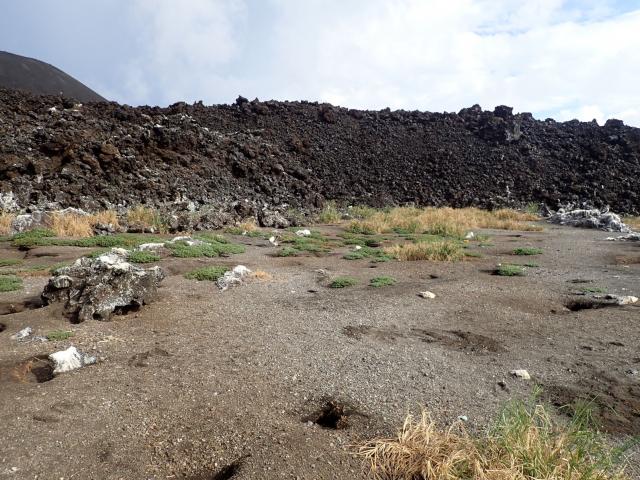
Those samples were collected in September 2019. When the environment ministry's survey team landed, the only ground that had escaped the post-2013 lava was a scrap of the old island measuring 0.5 hectares. Three plant species were hanging on there: goosegrass, barnyard grass and common purslane.
Source: Forestry and Forest Products Research Institute / University of Tsukuba
Three months later, in December 2019, the volcano started up again. The major eruption of 2020 buried those 0.5 hectares under ash and lava. The goosegrass population is gone, and there is nothing left to monitor.
Which means the 2026 DNA work traced the origin of a population that no longer exists, nearly seven years after the fact. All that survived was a handful of samples grabbed in a gap between eruptions, and an answer that arrived too late to use.
Starting over
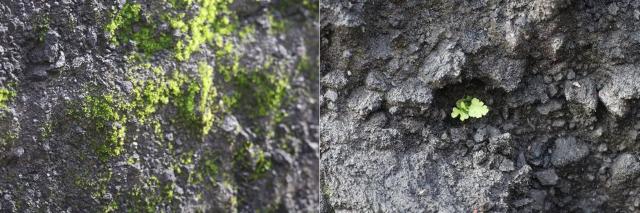
On July 17, 2026, a team from Tokyo Metropolitan University, Kyoto University, the University of Tsukuba, the Forestry and Forest Products Research Institute and the Japan Wildlife Research Center announced the first confirmed land plants on Nishinoshima since the eruptions. Algae had turned up during the 2022 landing; land plants had not. The find came from the annual survey conducted July 22 to 29, 2025, the first landing in three years. The team had a few hours on the ground.
They found three species: one moss, Trematodon longicollis, and two ferns, one in the genus Hypolepis and one in Nephrolepis. Both ferns were young sporophytes about a centimeter across, which suggests they arrived very recently. The moss was growing in a small gully carved by ash erosion; the ferns clung to the scoria slopes nearby. There were seabird nesting traces in the vicinity.
Source: Forestry and Forest Products Research Institute
All three are pioneer species that travel long distances as spores and tolerate drought, harsh sun and nutrient-poor ground. What carried them has not been pinned down. The seabird nests nearby are suggestive, but nobody traced a route through their genes the way the goosegrass team did.
Line the numbers up and Nishinoshima looks slow. According to UNESCO, the first vascular plant appeared on Surtsey in 1965, ten species had established within the first decade, and by 2004 the island held 60 vascular species alongside 75 bryophytes. More than five years after the 2013 to 2020 eruptions ended, Nishinoshima has two vascular species, both ferns, and one moss.
The comparison deserves a caveat. Surtsey has been recorded continuously for sixty years. The Nishinoshima figure comes from a few hours spent near the northeastern shore, on the strip of land outside the eruption warning zone, and is not a full accounting of the island. The researchers point to extreme geographic isolation, salt exposure and a shortage of fresh water as the likely brakes. Surtsey is about 32 kilometers from the Icelandic mainland. Nishinoshima is 130 kilometers from its nearest neighbor and 1,000 from Tokyo. The isolation differs by an order of magnitude.
The North Atlantic produced a parallel answer. A paper in Ecology Letters in October 2025 by Pawel Wasowicz and colleagues examined all 78 vascular plant species recorded on Surtsey and found that species lacking any long-distance dispersal traits were the dominant group, while 62 of them had empirical support for having traveled through the guts of aquatic birds: gulls, geese and shorebirds. The route differs from the one proposed for Nishinoshima, where the seeds are thought to have stuck to feathers rather than passed through a bird. Different mechanism, same agent, in two oceans.
Nishinoshima is not finished erupting. The Japan Meteorological Agency's assessment for June 2026 notes that no eruption has been observed since October 4, 2023, but that steam continues to vent near the summit crater and discolored water rings the island, which it reads as a still comparatively active volcano. The next eruption could erase everything again.
Japan sends the survey ship anyway, every year, and dunks its scientists in the ocean before letting them ashore. Not in order to see the island, but in order to see it while adding nothing to it.
Does your country have a place it has decided not to enter? Who guards it, and what exactly are they protecting it from?
References
- https://www.ffpri.go.jp/press/2026/20260807-02/index.html
- https://www.ffpri.go.jp/press/2026/20260717/index.html
- https://doi.org/10.1007/s10265-026-01738-9
- https://doi.org/10.1002/njb.05253
- https://doi.org/10.1111/ele.70234
- https://kanto.env.go.jp/pre_2016/post_82.html
- https://www.env.go.jp/press/press_00730.html
- https://www.data.jma.go.jp/vois/data/report/monthly_v-act_doc/tokyo/26m06/326_26m06.pdf
- https://whc.unesco.org/en/list/1267/
- https://www.icelandreview.com/news/dirty-secret-uncovered-doing-business-surtsey/
- https://www8.cao.go.jp/ocean/kokkyouritou/nishinoshima/nishinoshima.html







Global Discussion
4 comments