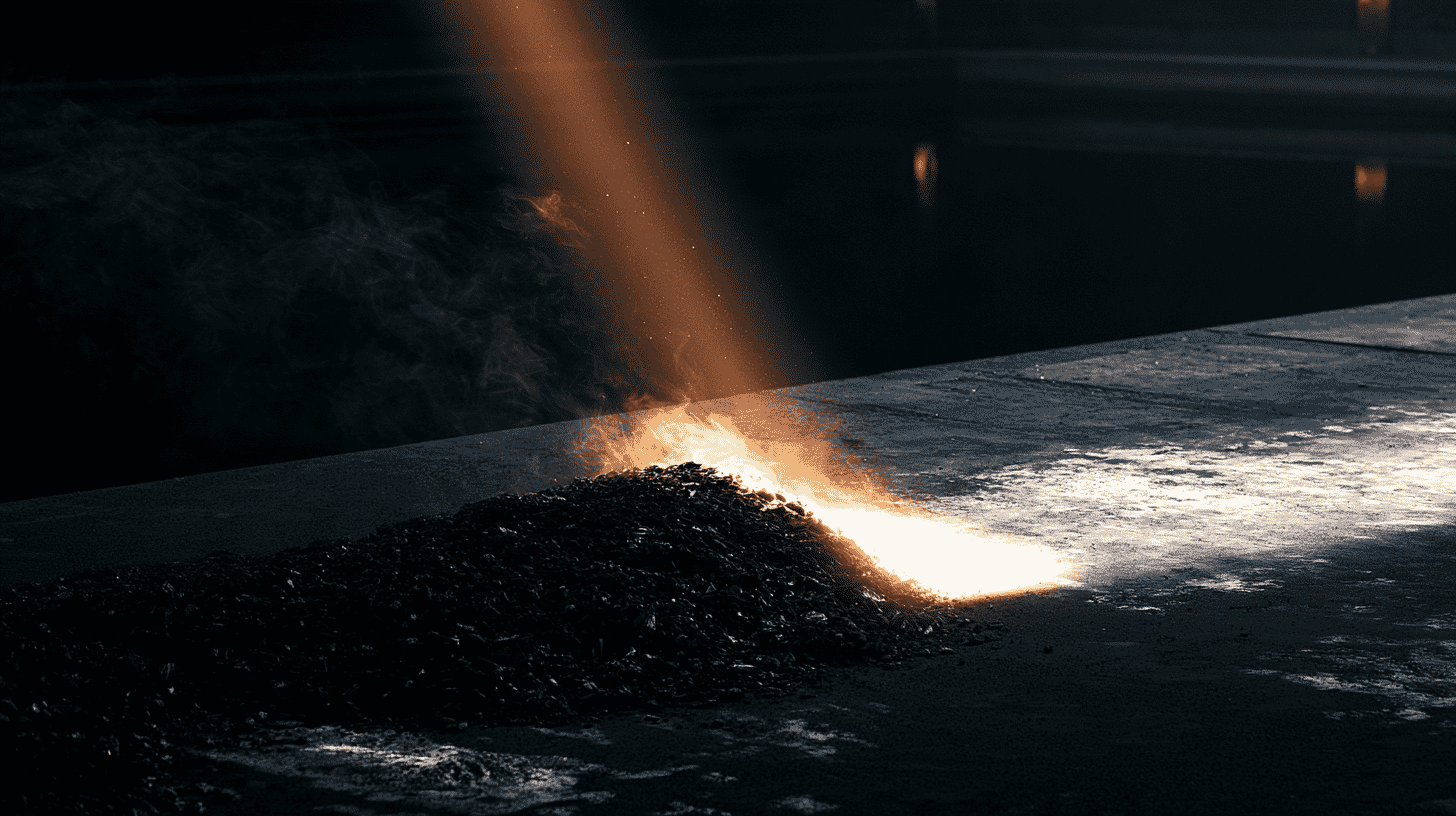
🔦 When a water plant or factory uses activated carbon to pull PFAS out of water, the chemicals don't disappear. They move into the carbon. On October 2, 2026, Furukawa Electric and Ryuki Engineering announced a way to destroy PFAS by firing a laser at that carbon, reporting a destruction efficiency of 99.999% or more.
Where does PFAS go after it leaves the water?
PFAS, a large family of synthetic fluorinated compounds, barely break down in nature because of their strong carbon-fluorine bonds. Hence the nickname "forever chemicals." Since April 1, 2026, Japan has had a legally binding tap-water standard of 50 nanograms per liter for PFOS and PFOA combined, the two best-known PFAS.
In Kibichuo, a town in Okayama Prefecture, PFAS above the national provisional target turned up at the Enjo water plant for three years from 2020. In 2023 the town announced a reading of about 28 times that target. The suspected source was spent carbon that had not been regenerated, sitting in bulk bags at a materials yard upstream of the town's water intake. A pollution mediation over where that carbon came from and who pays was accepted by Okayama Prefecture's pollution review board on September 7, 2026 (our earlier story on contamination in 26 prefectures).
Japan's Ministry of the Environment had already weighed in. A notice to local governments on March 26, 2025 told holders to avoid long outdoor stockpiling and, when handing carbon to a regenerator, to confirm that the regenerator prevents PFAS from escaping, for example by measuring concentrations in its wastewater and exhaust.
A rust-removal laser, pointed at carbon
Furukawa Electric is known for optical fiber and cable. The new technique grows out of its Infra Laser, a fiber laser system (one that amplifies light inside an optical fiber to produce an intense beam) built to strip rust and paint from railways, ships and bridges without touching them. A version developed with JR Central for railway bogies entered use in November 2025.
Its partner, Ryuki Engineering, is an environmental equipment maker and a leading domestic supplier of large dust collectors for tunnel construction. It also makes ECO Clean LFP, a water-treatment unit that coats filters with powdered activated carbon to adsorb PFAS. In late February 2026, a groundwater system built around that unit went on sale through a joint arrangement.
The mechanism is heat, not photochemistry. The laser hits the carbon directly, the light is converted to heat at the surface, and the surface reaches above 1,100°C in a short time. On paper, that matches the combustion gas temperature Japan's national technical guidance recommends for incinerating PFOA-containing waste (about 1,100°C or higher). The laser creates it at a single irradiated spot rather than inside a furnace.
After irradiation, the team collected the PFAS left in solid and gas phases and measured it by LC-MS/MS (liquid chromatography with tandem mass spectrometry). A chart in the release shows 9,970,000 nanograms (about 10 milligrams) before treatment and 16 nanograms after. That clears the 99.999% destruction efficiency that the Basel Convention's technical guidelines, part of the international treaty on hazardous waste, describe as environmentally sound.
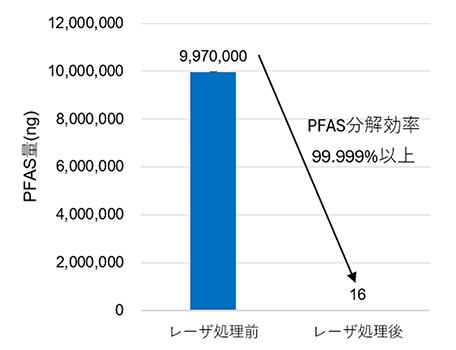
Source: Furukawa Electric and Ryuki Engineering
According to the two companies, PFAS can be broken down without fully burning the carbon, which could allow reuse and lower CO2. Their goal is on-site volume reduction instead of incineration. For now, this is an element technology, the basic building block that comes before a practical system.
Five methods, five different targets
Over the past year or so, Japan has produced a run of announcements on reducing or destroying PFAS.
| Method | Who | What it treats | Conditions | Published figure | Stage |
|---|---|---|---|---|---|
| Melting furnace | Kubota | Waste hauled to the furnace | 1,250-1,400°C | PFOS 99.9992% | Tested in a 5-ton-per-day furnace |
| Ultrasound | Hitachi High-Tech and FUST Lab | Contaminated water | Ultrasound in the 400 kHz band | Up to about 99.98% (concentration reduction) | Lab tests |
| Photocatalysis | Ritsumeikan University | PFOA and PFOS | Zinc oxide nanocrystals and near-UV LEDs, room temperature | Broken down to fluoride ions | Research |
| Bacteria | Kobe University | Culture medium and landfill leachate | Room temperature | Up to 17.8% PFOS reduction (in culture medium) | Research |
| Laser | Furukawa Electric and Ryuki Engineering | Activated carbon that has adsorbed PFAS | Surface above 1,100°C | 99.999% or more | Element technology |
Of the five, two deal with PFAS after it has been collected: the furnace and the laser. Kubota also lists spent water-treatment carbon among the PFAS-bearing wastes that urgently need a treatment method (our Kubota story). Where the furnace means trucking the carbon away, the laser points to treating it on site without burning it up. The bacteria work still can't separate breakdown from simple adsorption (our Kobe University story).
What the announcement doesn't say
The 99.999% figure comes from a test on about 10 milligrams of PFAS. How many grams of carbon were treated, and for how long? What laser power was used? Which PFAS compounds? The release doesn't say. Power consumption and cost per kilogram can't be compared yet.
The fate of the fluorine isn't covered either. Destroying PFAS doesn't make fluorine atoms vanish. In thermal methods, the fluorine can come out as acid gases such as hydrogen fluoride, which then have to be scrubbed from the exhaust. In a Ministry of the Environment demonstration that heat-treated contaminated soil, baking soda was injected to remove those acid gases.
Without enough heat, PFAS can break down only partway, into small volatile fluorinated compounds. Kubota checked for C2F6, a marker of incomplete breakdown, using US Environmental Protection Agency (EPA) methods, and it was below the detection limit. The new announcement doesn't mention testing for volatile fluorinated compounds of that kind.
The EPA's own interim guidance, updated in April 2024, lists certain carbon reactivation units among thermal options while saying uncertainties remain for thermal treatment.
From 10 milligrams to a nation's worth of carbon
The more PFAS that water treatment removes, the more PFAS-laden carbon piles up. But there is a long way from a 10-milligram test to the volume of carbon coming out of water plants nationwide. No timeline for practical use has been given, and the two companies say they will keep researching together.
Where does used filter carbon from water treatment end up where you live? Is it regenerated, burned, or still sitting in a pile somewhere?
References
- https://www.furukawa.co.jp/release/2026/dev_20261002.html
- https://www.furukawa.co.jp/infra-laser/
- https://pr.mono.ipros.com/ryuki/product/detail/2000799399/
- https://digitalpr.jp/r/129819
- https://www.env.go.jp/press/press_00075.html
- https://www.env.go.jp/content/000301642.pdf
- https://news.ksb.co.jp/article/16877945
- https://www.sakigake.jp/news/article/20260424CO0078/
- https://www.kubota.co.jp/news/2026/20260616-001204.html
- https://www.kubota.co.jp/kubotapress/technology/pfas.html
- https://www.env.go.jp/content/000405021.pdf
- https://prtimes.jp/main/html/rd/p/000000217.000049375.html
- https://www.ritsumei.ac.jp/rgiro/news/article?id=270
- https://www.kobe-u.ac.jp/ja/news/article/20260715-68128/
- https://www.epa.gov/system/files/documents/2024-04/fact-sheet-epa-pfas-destruction-and-disposal_0.pdf









Global Discussion
3 comments