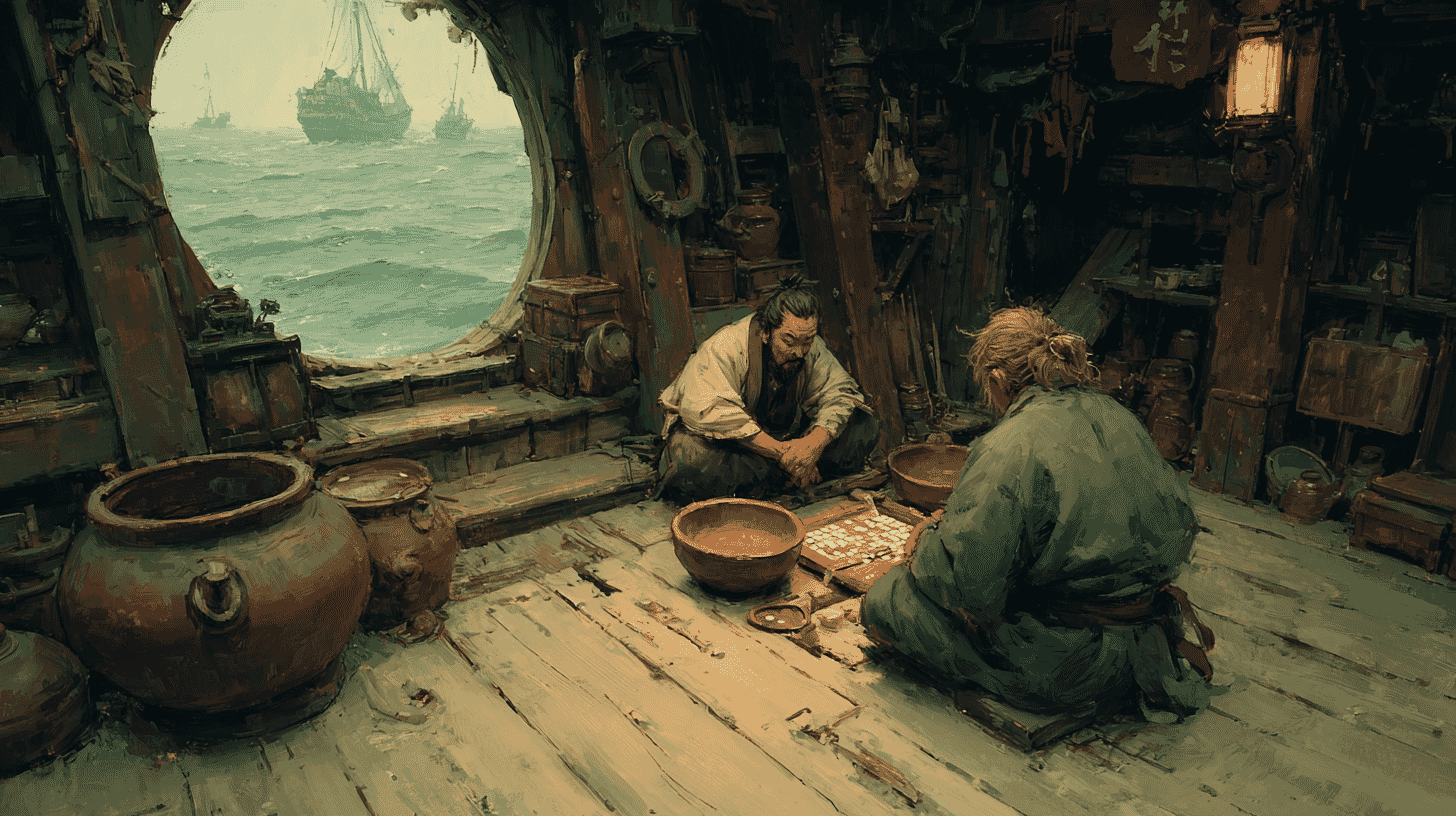
🎲 In the summer of 1281, a fleet sent to invade Japan was wrecked by a storm off Takashima, a small island in Nagasaki Prefecture. This month, divers working about 17 to 20 meters down found what looks like one ship's kitchen, and in it, 34 dice and game tiles. The archaeologist in charge has a guess about who was playing: the cooks, on a break.
Were They on Holiday?
Matsuura City announced the find on October 28, 2026. The dig, which began on October 2, focused on the stern of the third of three wrecks from the 13th-century invasions found off Takashima since 2011. Under more than a meter of mud, the team uncovered bulkheads and what appears to be the keel. Around them lay ceramics, plates, a grinding bowl and an iron object that looks like a kitchen knife. The dice and tiles were found nearby.
Yoshifumi Ikeda, a specially appointed professor of archaeology at Kokugakuin University who led the survey, told Kyodo News he suspects the people who cooked on board sat down for a card game once the work was done. Nothing like it had come up from any of the three wrecks before.
This ship has produced other surprises this year. In April, the city reported a wooden board from its hull inked with a Yuan-dynasty era name, possibly a notice posted for the crew. Were the invaders treating this as a long trip?
A Kitchen on the Seabed
About 15 meters of the stern survives. Combined with sections mapped last year, the team now estimates the ship was about 30 meters long, likely the largest of the three. The bulkheads that divide its hull into compartments are typical of Chinese ships of the period.
A ship of that size carried a lot of people for a long time. According to the History of Yuan, the official chronicle of the dynasty, the southern fleet put to sea in the sixth month of the Chinese calendar, so by the time the storm hit, its men had been at sea for weeks.
The research team called the finds a rare look at daily life on board. Most of what has come out of this seabed over the years has been gear for war: ceramic bombs, swords, stone anchors.
Dice, Tiles and the Mahjong Question
Japanese headlines called the tiles "the origin of mahjong." The reporting underneath is more careful. Ikeda told NBC Nagasaki Broadcasting that the tiles match those used in tien gow (天九, "heaven and nine"), a traditional Chinese game. Kyodo reported that the objects may be equipment for a game said to be an ancestor of mahjong, and that they will now be examined in detail. Their material and size have not been released.
Tien gow is played with Chinese dominoes: a set of 32 tiles, each showing one possible throw of two dice. The tiles have a long history in the region this ship most likely came from. The writer Zhou Mi (1232–1298) recorded peddlers in Hangzhou, the Southern Song capital, selling tiles and dice in the reign of Emperor Xiaozong (1162–1189). A crewman from southern China packing both in 1281 would have been entirely ordinary.
Mahjong is another matter. It developed in 19th-century Qing China, most likely from draw-and-discard card games, and the tiles came later. Calling tien gow "the origin of mahjong" is popular shorthand, not settled history. Whatever these pieces were for, the likeliest answer is gambling, or just passing time.
Sailors everywhere did the same. When England's warship Mary Rose sank in 1545, it took 11 bone dice down with it, ranging from 7.8 millimeters to just 4.8 millimeters across. The Mary Rose Trust points out that a 1541 English law banned most games other than archery, and tiny dice were easy to hide.
Who Was on Board
History calls it the "Mongol invasion," but this ship probably carried few Mongols.
The 1281 attack came in two fleets. One sailed from Korea with Mongol, northern Chinese and Korean troops. The other, far larger, sailed from southern China. Two years earlier, in 1279, the Yuan had finished conquering the Song dynasty, and the southern army was built from those defeated Song soldiers. Japanese reference works put it at 100,000 men. Accounts give the two fleets 900 and 3,500 ships, with 142,000 men in all, numbers that are likely exaggerated.
Which fleet this particular ship belonged to has not been stated. Its Chinese-style hull fits the southern one. So does another find reported in August: the end of an arrow from this seabed site that matches Southern Song designs, apparently seized by the Yuan and reused against Japan.
The historian Masaaki Sugiyama has gone further, arguing that the southern force was part army and part settler group, a way for the Yuan to find a use for a mass of former Song soldiers. That is one scholar's view, not a consensus, and dice in a galley prove nothing either way. Still, if the men in this galley had lost their country two years earlier and were crossing the sea on the orders of the emperor who conquered them, a set of tiles looks less like holiday entertainment and more like a way to get through the waiting.
For the People of Tsushima and Iki
Seen from the other side, none of this is funny. In 1274, the first invasion fell on the islands of Tsushima and Iki before reaching Kyushu. On Tsushima, deputy governor Sō Sukekuni met the landing with about 80 mounted samurai and was killed. Taira no Kagetaka, his counterpart on Iki, also died. Islanders were killed or carried off. In June 1281, the fleet from Korea struck both islands again.
Whatever the crews did in their spare hours, for the people on those islands these ships meant killing and capture.
The Storm Later Called "Kamikaze"
On August 15, 1281 (Julian calendar), a typhoon struck the fleet as it lay at anchor. Many ships had crowded into Imari Bay, and Takashima sits at its mouth. In Japanese records, the wind rose on the night of the 30th day of the seventh month, and by the first day of the intercalary month that followed, the fleet was all but gone.
The History of Yuan describes what came next. The commanders kept the soundest ships for themselves and left, abandoning more than 100,000 soldiers on the shore. Japanese forces attacked them, and 20,000 to 30,000 were taken prisoner. Mongol, Korean and northern Chinese captives were killed. The former Song soldiers were spared and made slaves. The chronicle closes with a claim that only three men out of 100,000 made it home, a figure no one should take literally.
The storm was later called kamikaze, or "divine wind," and taken as proof that the gods protected Japan. In World War II the word was given to Japan's suicide pilots.
So if a cook on this ship rolled dice after dinner, he most likely drowned that August night, or died on the shore, or lived out his life as a captive in Japan.
Digging Together, 745 Years Later
Researchers from South Korea and Mongolia, whose institutions have cooperation agreements with Matsuura City, joined the work, sharing analysis of finds and underwater survey methods. Ikeda told NBC he hopes Takashima can seed an international research network. After four years, the survey of the third wreck is wrapping up; as of October 2026, a different part of the seabed is planned from fiscal 2027.
The site was made a National Historic Site in 2012, Japan's first underwater site to receive that status. The wrecks cannot be visited, but finds from the seabed are shown at the Matsuura City Buried Cultural Properties Center on Takashima.
745 years on, researchers from countries on both sides of that war are digging in the same mud. Has a wreck or dig in your country turned up something this ordinary, a die, a comb, a cooking pot, that suddenly made the people who owned it feel close?
References
- https://www.tokyo-np.co.jp/article/524502
- https://newsdig.tbs.co.jp/articles/-/3045528
- https://newsdig.tbs.co.jp/articles/-/3042546
- https://www.sakigake.jp/news/article/20260430CO0088/
- https://www.sakigake.jp/news/article/20260820CO0152/
- https://www.kokugakuin.ac.jp/en/account/234410
- https://en.wikipedia.org/wiki/Chinese_dominoes
- https://en.wikipedia.org/wiki/Tien_Gow
- https://en.wikipedia.org/wiki/Mahjong
- https://maryrose.org/five-tiny-things-recovered-from-the-mary-rose/
- https://en.wikipedia.org/wiki/Mary_Rose
- https://en.wikipedia.org/wiki/Mongol_invasions_of_Japan
- https://kotobank.jp/word/%E5%85%83%E5%AF%87-60419
- https://ja.wikipedia.org/wiki/%E5%BC%98%E5%AE%89%E3%81%AE%E5%BD%B9
- https://zh.wikisource.org/wiki/%E5%85%83%E5%8F%B2/%E5%8D%B7208
- https://www.britannica.com/event/kamikaze-of-1274-and-1281
- https://en.wikipedia.org/wiki/Takashima_K%C5%8Dzaki_Site
- https://sitereports.nabunken.go.jp/event/94









Global Discussion
4 comments