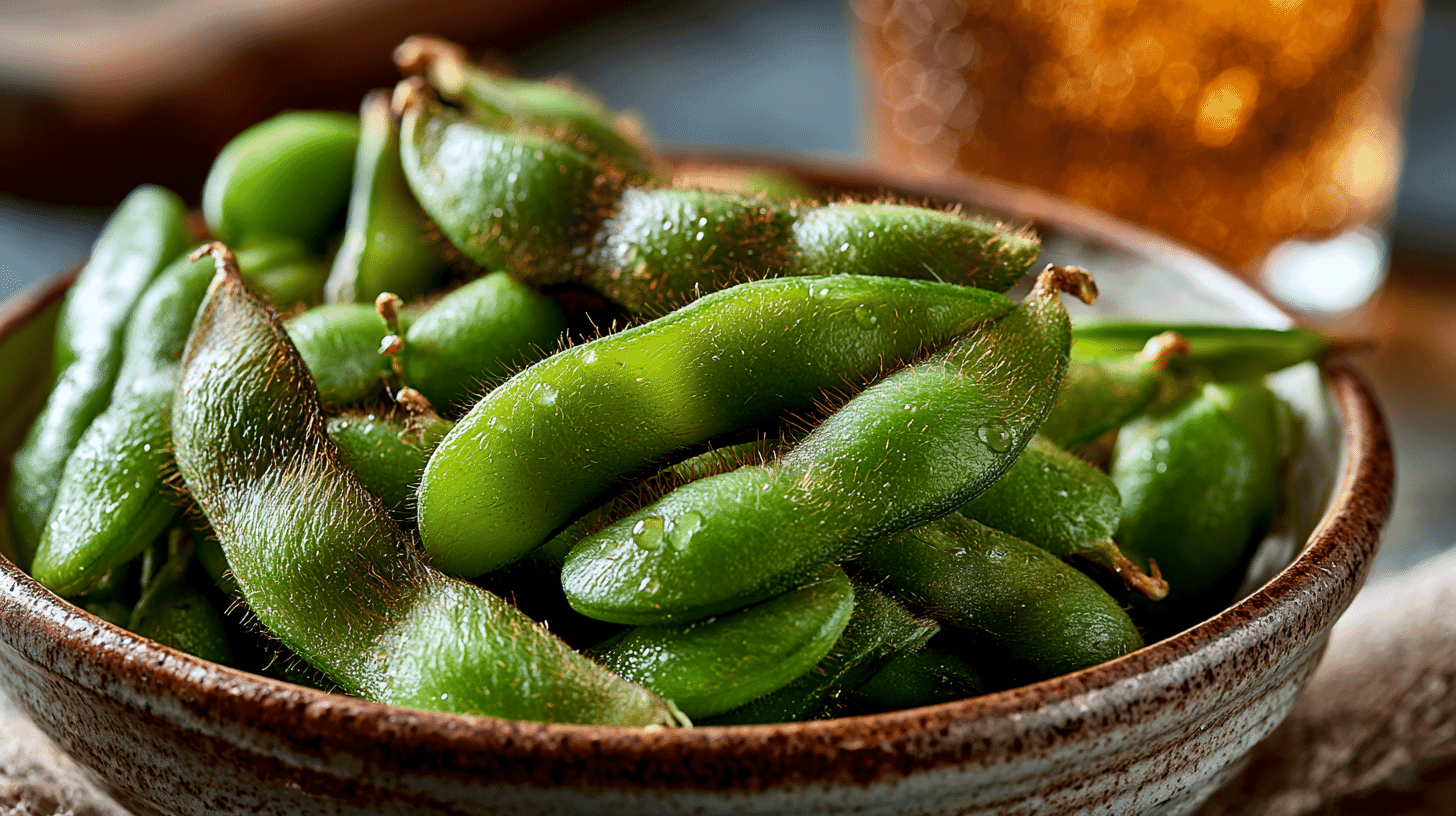
🫛 The world eats it as "edamame." But the most prized edamame in Japan, dadachamame, grown in one small corner of the north, has long kept a secret: why is it so much better than the bag from the freezer aisle? A team at Yamagata University now has an answer, and it's a strange one. The flavor traces back to a gene that broke.
The bean a feudal lord couldn't stop eating
Edamame is just soybeans picked young, while the pods are still green and tender. Most of what the world eats is generic. Dadachamame is not. It comes from Tsuruoka, on the Shonai plain of Yamagata Prefecture, where farmers have guarded the same heirloom strains since the Edo period (1603–1868), reselecting the best seeds by hand, season after season.
Even the name is local. The story goes that a feudal lord of the area loved the beans so much he kept asking which household had sent that day's batch: "whose dadacha's edamame is this?" Dadacha means "father" in the Shonai dialect. The name stuck.
You can tell it apart by sight: smaller pods with a deep pinch in the middle and a coat of brown fuzz, not the smooth green you might picture. Boil a handful and the kitchen fills with a sweet, almost chestnut-like smell. It's pricey, too: a branded pack can run several times the cost of ordinary edamame.

Source: Yamagata Prefecture / Science Portal (JST)
What your tongue is actually tasting
Start with the flavor itself. A lot of what we register as savory and sweet in food comes from free amino acids, meaning amino acids floating loose in the cell rather than locked away inside proteins. Think of protein as amino acids packed in a warehouse, and free amino acids as the ones already out on the table, where your tongue can reach them. Glutamate is the famous umami one, the same compound behind kombu broth and MSG, while alanine reads as sweet.
Dadachamame is unusually loaded with these free amino acids, and earlier studies had already pinned its edge on that chemistry. The open question was which gene was doing the loading.
Thirteen years to corner a single gene
Professor Yuki Hoshino of Yamagata University, working with Naohiro Shioya of the United Graduate School of Agricultural Sciences at Iwate University and Eri Ogiso of Tokyo University of Agriculture and Technology, went after it the slow way. They crossed a dadachamame strain called Shirayama with a standard soybean variety, Enrei, then let the offspring self-pollinate for eight generations across thirteen years, a patient shuffling of the two plants' DNA into 344 distinct lines.
With that many genetic combinations on the table, they could measure each line's free-amino-acid content, read its DNA, and look for the stretch of chromosome that traveled along with the flavor. The signal landed on chromosome 11, one of the soybean's twenty.
The flavor came from a gene that broke
The gene sitting there is called tof11. And here's the twist: it isn't a special "flavor gene" that dadachamame evolved. It's a soybean gene, TOF11, with a single missing letter of DNA: one deleted base that knocked it out of action.
In ordinary soybeans, TOF11 helps set the timing of flowering and ripening. Break it, and the plant flowers and matures earlier. That alone explains a quirk of dadachamame: while regular soybeans ripen in autumn, dadachamame comes in during the heat of summer, exactly when you want a cold beer and a bowl of edamame.
But the broken gene does something else, the new work shows: it pushes up those free amino acids. As for why, Hoshino offers a hypothesis. Strong summer sun stresses a plant, and to cope, plants often adjust their internal water balance. Hoshino suspects tof11 is tied to that defense, ramping up free-amino-acid metabolism to help the cells hold on to water. If that's right, the umami we prize is essentially a by-product of the bean fighting to survive a hot Shonai summer. This last part, though, is the researchers' interpretation, not yet a settled case.
One of Japan's great regional delicacies, then, owes its flavor to a genetic typo that happened to make the bean both earlier and tastier.
There's still a brake on the flavor
The story has a kicker. Right next to tof11, the team found a second gene pulling the other way: one that lowers free amino acids.
Hoshino puts it in plain arithmetic: if the boosting gene works at "+10," the nearby suppressor works at about "−3," leaving a net "+7." That +7 is the dadachamame flavor we already love. Cancel out the −3 through breeding, and you might get an even richer bean.
The lab now wants to check whether the same gene is at work in dadachamame's other strains, the early Kanro and the late-summer Oura, each of which tastes subtly different. And the lesson travels well beyond one bean: if a single broken gene can tune both ripening time and flavor at once, breeders have a new dial to turn in other crops, too.
So the next time a bowl of edamame lands on your table, you can thank a gene that quit doing its job. Japan has spent centuries fussing over one small bean from one small place. Does your country have a hometown vegetable, a tomato, a chili, a grain, that locals swear tastes better than anyone else's? Its secret might be hiding in the DNA, too.
References
- Science Portal (JST), "Dadachamame's flavor owes to a gene that speeds flowering and ripening, Yamagata Univ.," May 8, 2026 | https://scienceportal.jst.go.jp/newsflash/20260508_n01/
- Yamagata University press release, April 1, 2026 | https://www.yamagata-u.ac.jp/jp/information/press/20260401_01/
- Published in Theoretical and Applied Genetics (online edition, March 24, 2026)








Global Discussion
3 comments