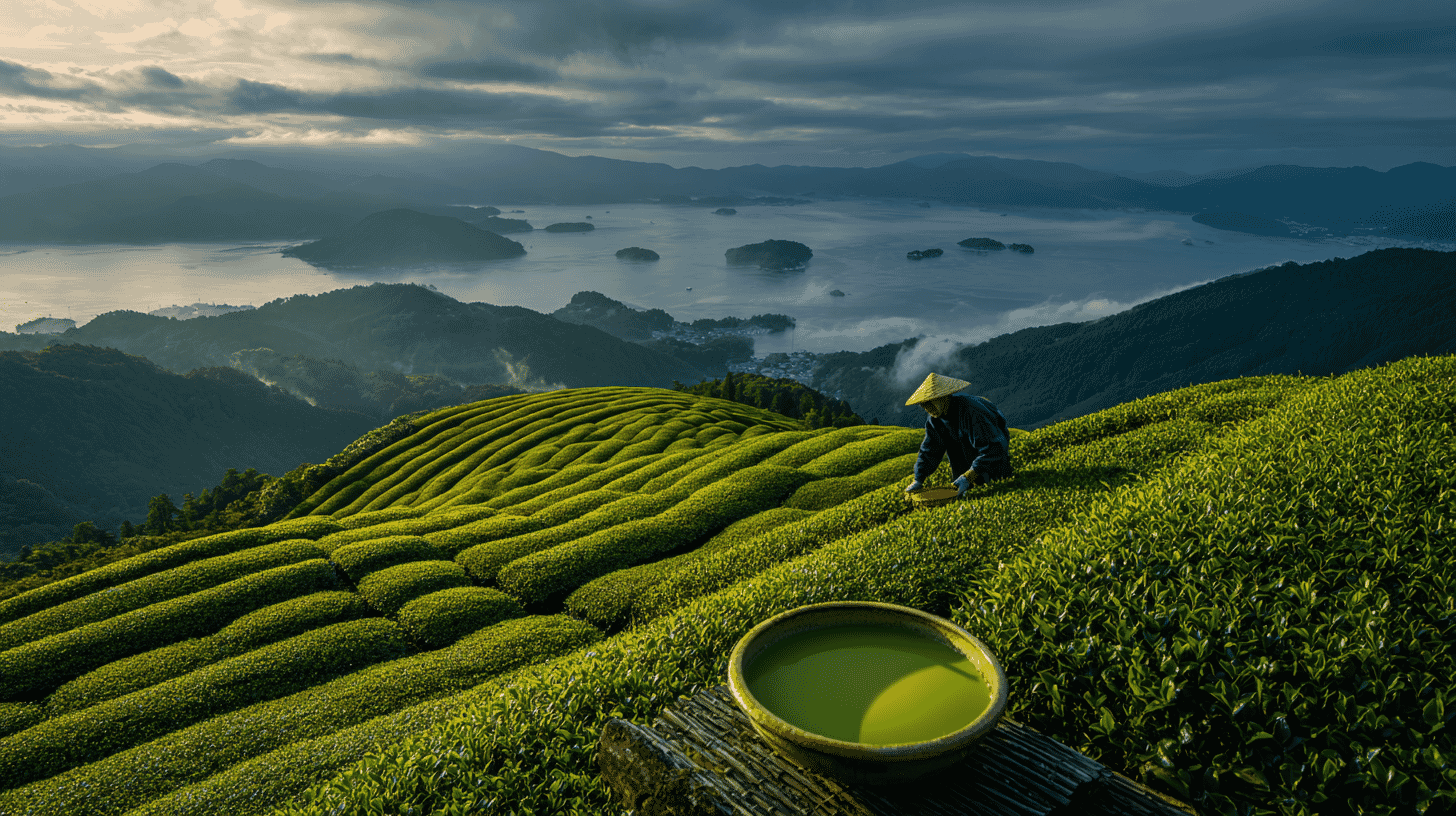
The prefecture famous for udon noodles is betting on matcha. Kagawa Prefecture has earmarked ¥5 million ($31,000) in its 2026 budget to research tencha, the raw material for matcha. Compared to Kagoshima's $16 million mega-factory or Ibaraki's $2.5 million in subsidies, it's a tiny figure. But the fact that Japan's smallest prefecture is making this move tells you everything about how massive the global matcha boom has become.
Kagawa's Tea Story: From 403 Hectares to Just 11
When you hear "Kagawa," you think of sanuki udon, the thick, chewy noodles that have made this prefecture a pilgrimage destination for noodle lovers worldwide. Tea barely registers.
Yet tucked away in the hills of Takase-chō in Mitoyo City lies a little-known gem: Takase Tea. Serious cultivation began in 1956, and the tea won Japan's prestigious Minister of Agriculture Award at national competitions. Emperor Shōwa and Empress Kōjun were once presented with Takase's new-harvest tea during a visit to the prefecture.
But the numbers paint a sobering picture. At its peak in 1975, Kagawa had 403 hectares of tea fields. By 2014, that had shrunk to 67 hectares producing 93 tons. In 2024, only 11 hectares remain, all in Takase-chō, producing a mere 15.8 tons. Every last leaf goes to sencha (standard green tea). Tencha? Zero.
Aging farmers, crumbling equipment, no successors, it's the familiar crisis facing rural agriculture across Japan, compressed into one small corner of Shikoku island.
Why Matcha, Why Now: The $453 Million Signal
The catalyst for Kagawa's pivot is unmistakable.
Japan's green tea exports (predominantly matcha powder) surpassed 10,000 tons for the first time in 2025, reaching a record ¥72.1 billion ($453 million) in export value. Data from Japan's Tea Export Promotion Council shows the momentum continuing into 2026, with EU-bound powdered green tea exports tripling year-on-year in January alone.
In 2025, Japan's Ministry of Agriculture formally declared a national policy shift: move away from sencha, move toward tencha. The economics are compelling. Sencha fetches an average of ¥1,223 per kilogram ($7.70), while tencha commands ¥3,141 ($19.80), roughly 2.6 times the price.
This triggered a nationwide scramble. Kagoshima's JA Group is building a $16 million matcha processing plant capable of producing 300 tons annually (completion: November 2027). Ibaraki Prefecture is offering $2.5 million in subsidies to help farmers install tencha processing facilities. Shizuoka, Japan's traditional sencha heartland, is pivoting wholesale.
Kagawa's Strategy: What Can $31,000 Buy?
Against this backdrop of billions in investment, Kagawa's ¥5 million ($31,000) research budget looks almost comically small. It's less than 0.2% of Kagoshima's factory investment.
But there's method in the modesty.
The plan is to test tencha yields at a tea field owned by the prefectural agricultural experiment station in Mannō Town. The goal: determine whether Kagawa's climate and soil can support viable tencha production. Experts will also be brought in to calculate the minimum profitable scale, a critical question since tencha requires years before first harvest and a dedicated processing facility ("tencha furnace") costing $1.3–1.9 million.
"We want to explore whether there's potential to revitalize tea production in the prefecture," says the Kagawa Prefectural Agriculture Production and Distribution Division. If results are promising, the prefecture will consider promoting tencha conversion, developing new production areas, and even repurposing abandoned farmland.
Small Prefecture, Unexpected Advantages
Kagawa may be Japan's smallest prefecture by area, but it has agricultural credentials. Mitoyo City boasts Shikoku's highest agricultural output, producing grapes, peaches, mandarin oranges, lettuce, and more. Takase Tea, while accounting for just 0.2% of national tea output, is prized for its quality, a mellow sweetness and elegant aroma cultivated in mountain valley microclimates.
Small scale can be an asset. Because Takase Tea is produced in a tight-knit community, traceability is near-perfect. Every farmer's practices, fertilizers, pesticides, harvest timing, are documented and managed collectively. In an era when overseas consumers increasingly demand transparency and food safety credentials, this is no small advantage.
There's also the marketing angle. Kagawa already has international name recognition through sanuki udon. "Matcha from the Udon Prefecture" is the kind of quirky, memorable branding that cuts through the noise in crowded overseas markets. Udon tourism is already a thing; matcha tourism could ride the same wave.
The Barriers Are Real
None of this will be easy.
Tencha cultivation requires shade-growing, covering tea fields with tarps or screens to block sunlight, which forces leaves to produce more chlorophyll and L-theanine (the amino acid that gives matcha its characteristic umami). According to Japan's Ministry of Agriculture, shade-covering is one of the most labor-intensive operations in tea farming.
Then there's the capital problem. A tencha processing facility, including steamers, sorters, and drying equipment, costs ¥200–300 million ($1.3–1.9 million). Kagawa currently has zero such facilities. For a prefecture with 11 hectares of tea fields, justifying that investment requires a dramatic expansion of cultivation area.
And the competition is fierce. Kagoshima already controls roughly 40% of Japan's tencha production. Kyoto's Uji region dominates the premium ceremonial-grade market. Aichi's Nishio has locked down the food-service segment. Where does a tiny newcomer fit?
Internationally, the challenge is equally daunting. China accounts for roughly 89% of global green tea production. Chinese and Vietnamese "matcha", often lower grade but dramatically cheaper, already floods overseas markets. Japan's competitive edge is quality, but that only works if consumers know and care about the difference.
What the Gold Rush Means
Kagawa's entry into matcha research is significant not for its scale but for what it signals.
When even Japan's smallest prefecture, one with no tencha infrastructure, no shade-growing experience, and a shrinking tea sector, decides it must explore matcha, you're looking at a genuine structural shift in Japanese agriculture. From Kagoshima's mega-investments to Kagawa's modest research grant, the entire country is reorienting around a single product category driven by overseas demand.
This is also a survival story. Japan's total tea cultivation area has declined roughly 30% from its peak. Domestic sencha consumption has been falling for years. For many tea-farming communities, the choice isn't between sencha and matcha, it's between matcha and abandoning tea farming altogether.
Whether Kagawa will ultimately produce matcha remains to be seen. The research might conclude that the economics don't work at such a small scale. But the fact that the question is being asked at all, in a prefecture that has never produced a single gram of tencha, is perhaps the most powerful testament to just how dramatically the global matcha boom has reshaped Japan's agricultural landscape.
Do you know where the matcha in your daily latte actually comes from? How is matcha enjoyed in your country, as a traditional drink, a latte ingredient, or maybe something else entirely? We'd love to hear your perspective.




Global Discussion
14 comments