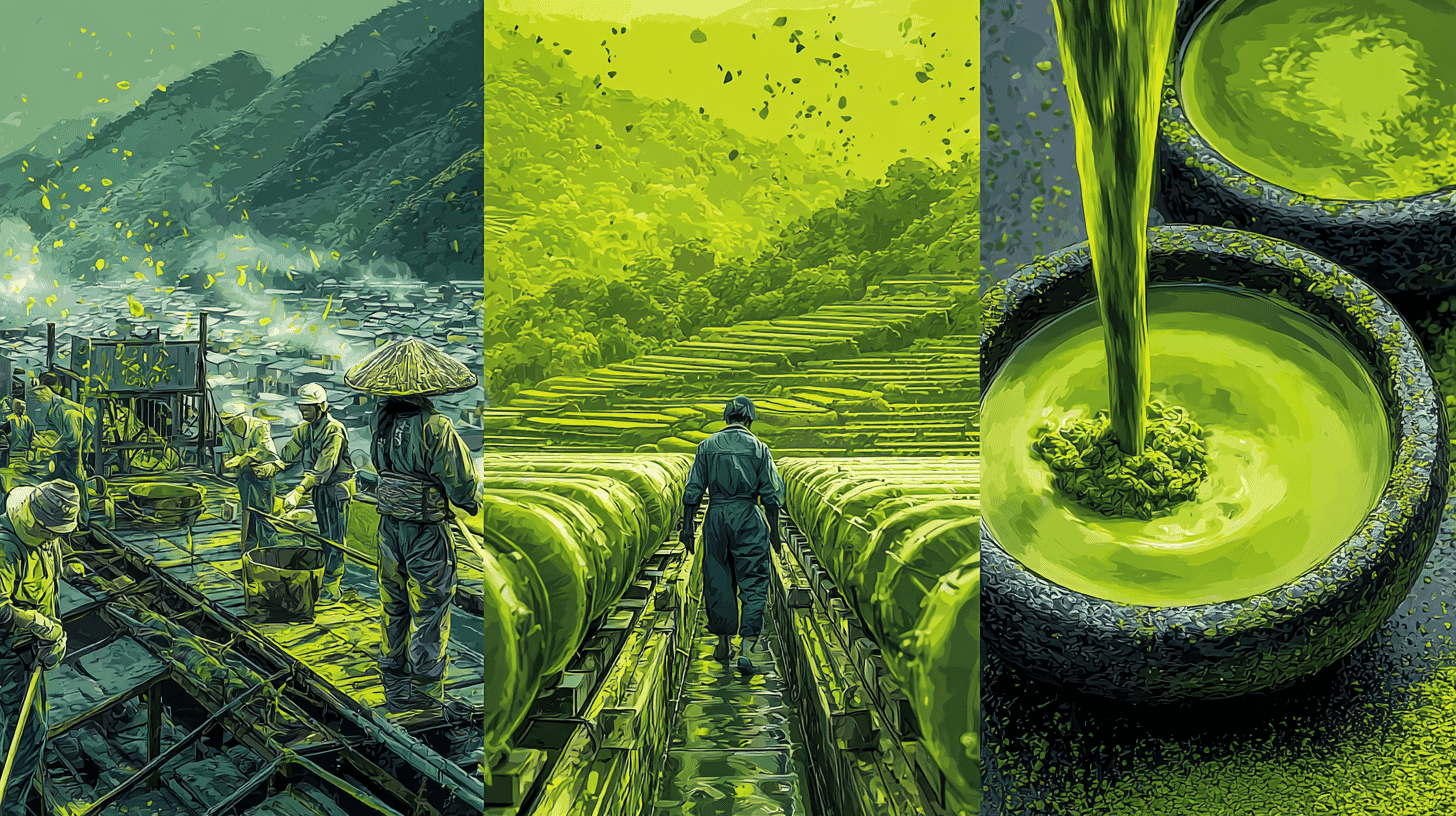
Japan's tencha (matcha raw material) production doubled in just four years to 5,336 tons, and it's still not enough. Now Kagoshima is building a $17 million mega-factory, Ibaraki Prefecture is offering subsidies for brand-new entrants, and Shizuoka, Japan's sencha heartland, is pivoting to matcha. Here's an inside look at the matcha production arms race sweeping across Japan.
Tencha Production Doubled in Four Years, Still Not Enough
Tencha is the specialized tea leaf that becomes matcha. Unlike regular green tea, it's grown under shade covers that block sunlight, steamed without rolling, dried flat, and then stone-ground into the fine powder the world knows as matcha.
According to Japan's national tea producers' federation, domestic tencha production surged from 2,736 tons in 2020 to 5,336 tons in 2024, roughly doubling in just four years. Yet tencha still accounts for only about 7.3% of Japan's total tea output, nowhere near enough to satisfy the exploding global appetite.
Japan's green tea exports hit a record ¥36.4 billion (approximately $240 million) in 2024, with the vast majority being powdered green tea, primarily matcha. The United States is the top buyer, followed by Europe and Southeast Asia.
Kagoshima: A $17 Million Bet on America's Matcha Appetite
The boldest move comes from Kagoshima Prefecture, Japan's southern tea powerhouse.
In March 2025, JA Group Kagoshima announced a $17 million (2.6 billion yen) plan to build the prefecture's largest matcha processing facility at the Kagoshima Tea Distribution Center. The plant will be capable of producing 300 tons of matcha annually, with completion targeted for November 2027. An additional 1,600-ton tencha storage facility is planned for the same year, bringing total investment to roughly $23 million (3.5 billion yen).
"The global matcha boom continues, and right now, America is our top priority," said JA Kagoshima's chairman Hirofumi Yunoki at the press conference.
Kagoshima has the credentials to back up such ambition. The prefecture overtook Kyoto as Japan's number-one tencha producer in 2020, and by 2023 accounted for nearly 40% of national output at 1,585 tons. In 2024, it also surpassed Shizuoka to become Japan's top crude tea producer for the first time ever, and extended that lead in 2025 with 30,000 tons.
But there's a structural problem. Most of Kagoshima's tencha has historically been shipped to processing facilities in Kyoto and Shizuoka, where it's ground into matcha and sold under established brands like "Uji Matcha." Kagoshima has been the raw material supplier, not the brand owner. This new factory is a direct bid to change that equation.
Ibaraki: A Dark Horse Enters the Race
Meanwhile, Ibaraki Prefecture, a region in the Kanto area north of Tokyo with no history in matcha production, is making a surprising entry.
For fiscal year 2026, Ibaraki allocated 400 million yen (roughly $2.6 million) in subsidies, covering up to two-thirds of the cost to build tencha processing facilities. The prefecture currently has zero "tencha furnaces", the specialized drying equipment essential for matcha production. A complete setup costs $1.3–2 million (200–300 million yen), which has been a prohibitive barrier for local producers.
"Matcha demand is high worldwide, and our local producers are receiving inquiries," said the prefecture's agricultural promotion division. "We want to fully support top-runner matcha producers and create ripple effects for Ibaraki's entire tea industry."
Ibaraki has existing tea brands like Sashima-cha and Okukuji-cha, but they lack national recognition. The matcha push is seen as a potential game-changer for the prefecture's tea brand visibility.
Shizuoka's Pivot: From Sencha Kingdom to Matcha Contender
Japan's traditional tea capital, Shizuoka, is also undergoing a fundamental shift.
In April 2025, Japan's Ministry of Agriculture issued a new "Tea Industry Promotion Basic Policy" that explicitly called for shifting the industry's focus from domestic consumption to exports, specifically promoting conversion from sencha to tencha and expansion of organic cultivation.
The economic logic is compelling. Tencha commands roughly 2.6 times the price of sencha (an average of roughly $21/kg for tencha versus $8/kg for sencha). For aging farmers watching their tea fields shrink, Shizuoka's plantation area has declined about 32% from its peak, switching to tencha offers a path to economic viability.
However, industry voices have raised concerns about going "all-in on matcha." The Ministry acknowledged that "production of traditional, high-quality sencha remains equally important" and stressed the need for balance across tea types.
The Pecking Order: How Traditional and New Producers Coexist
Japan's matcha landscape is organizing into distinct tiers.
Uji (Kyoto) remains the unchallenged pinnacle, the spiritual home of matcha, commanding premium prices for ceremonial-grade powder used in tea ceremonies. Nishio (Aichi Prefecture) dominates the commercial-grade segment, supplying confectioneries and beverage manufacturers with consistent, high-quality matcha.
Kagoshima and newcomers like Ibaraki are targeting a different market: the massive "food-grade" segment fueling matcha lattes, smoothies, and desserts worldwide. This grade doesn't require ceremonial quality but demands stable, large-volume supply, exactly what Kagoshima's industrial-scale facilities can deliver.
The result is an emerging division of labor: Uji for prestige and culture, Nishio for commercial reliability, Kagoshima for export scale, and Ibaraki for proximity to Tokyo and freshness-focused niche production.
The Risks: Quality Concerns and International Competition
Rapid expansion carries real risks.
Tea industry veterans in Kagoshima warn that quality cannot be taken for granted. Tencha requires shade-grown cultivation, a technique where tea bushes are covered to block sunlight for weeks before harvest, producing the characteristic deep green color and umami flavor. Mastering this technique takes years, and new entrants may struggle to match established producers' quality.
There's also the international threat. As Japanese matcha prices rise, cheaper alternatives from China and Vietnam are positioning themselves as substitutes. Products labeled "matcha" overseas already include a wide range of quality levels, many nowhere close to authentic Japanese standards. Establishing internationally recognized quality standards has become an urgent priority.
The global matcha market was valued at approximately $4.17 billion in 2025 and is projected to reach $6.35 billion by 2034, growing at 11.1% annually. Competition for this market is intensifying not just among Japanese prefectures, but on a global scale.
The Big Picture: Japan's Tea Industry at a Crossroads
What's unfolding is nothing less than a once-in-a-generation transformation of Japan's tea industry.
Domestic consumption has been declining for decades, and the production base is shrinking due to aging farmers and lack of successors. Yet the global matcha boom represents the most powerful tailwind the industry has seen in modern history. Prefectures across Japan are scrambling to ride this wave through capital investment, crop conversion, and brand building.
The critical question is whether this production race benefits Japanese consumers too. As we reported previously, the matcha boom has caused bancha (coarse tea) prices to surge 600%, and everyday bottled green teas like Oi Ocha have already raised prices. If more farmers switch from sencha to tencha, the shortage of leaves for everyday Japanese tea could worsen.
Combined with the broader picture of the global matcha boom, Japan may be shifting from "the country that sells matcha to the world" to "the country swept up by the world's matcha appetite."
Has your country experienced an agricultural export boom that reshaped domestic food culture or prices? What do you think about Japan's matcha production race? Share your thoughts in the comments!







Global Discussion
13 comments