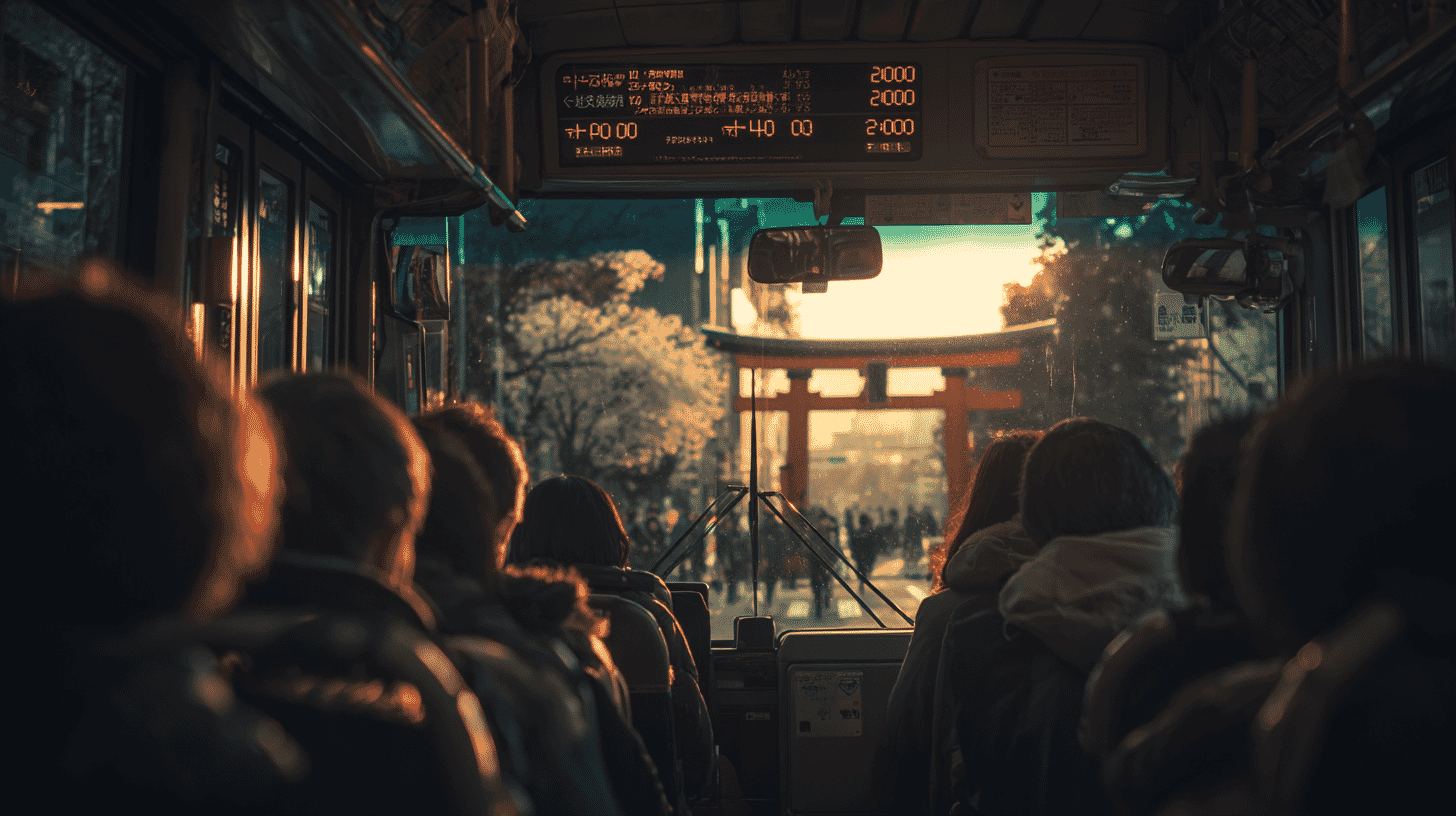
🚌 Imagine waiting at a bus stop in one of the world's most beautiful cities, and watching bus after bus pass by, too packed to board. That's daily life for Kyoto residents, outnumbered 40-to-1 by the 56 million tourists who flood their city each year. Now Kyoto is fighting back with Japan's first-ever dual pricing system for public transit: ¥200 for locals, up to ¥400 for everyone else.
What Is Kyoto's Dual Pricing Bus Fare?
On February 25, 2026, Kyoto Mayor Koji Matsui made a groundbreaking announcement in the city assembly. The city plans to introduce a two-tier fare system for its municipal buses: Kyoto residents will see their flat-zone fare drop from the current ¥230 (about $1.50) to ¥200 ($1.30), while non-residents, including tourists, will pay ¥350 to ¥400 ($2.30–$2.60).
If approved, this would create a fare gap of up to double between residents and visitors, marking the first large-scale dual pricing system on public transit anywhere in Japan. The city aims to launch the system by fiscal year 2027.
Mayor Matsui emphasized that the higher fare is not meant as a punishment. Rather, it's designed to help balance tourism with everyday life for Kyoto's 1.43 million residents.
Why Kyoto Needs This Now
The driving force behind this policy is overtourism, a term that describes the negative effects of excessive tourist numbers on local communities and infrastructure.
In 2024, Kyoto welcomed 56.06 million visitors, including a record-breaking 10.88 million international tourists. To put that in perspective, the city's population is just 1.43 million. That means roughly 40 tourists visit for every single resident over the course of a year.
The most visible impact is on the city's bus system. Routes heading to popular destinations like Kiyomizu-dera Temple and Kinkaku-ji (the Golden Pavilion) are perpetually packed. Residents trying to commute to work or get to medical appointments regularly find themselves unable to board, watching multiple full buses pass by. Tourists with large suitcases take up significant space, compounding the problem.
A 2024 city survey found that 79.9% of Kyoto residents said they were inconvenienced by public transit overcrowding and tourist misbehavior. This frustration was a key issue in Mayor Matsui's 2024 election campaign, where he pledged to introduce differentiated pricing.
How Will It Work?
The system will use Japan's My Number Card, a government-issued digital ID, linked to a transit IC card (similar to London's Oyster or Tokyo's Suica). Residents who register their My Number Card will automatically receive the discounted fare when they tap their IC card on the bus.
On February 18, 2026, the Ministry of Land, Infrastructure, Transport and Tourism (MLIT) and Kyoto City conducted a joint trial using a system developed by MLIT. They confirmed that tapping a transit IC card at the bus fare machine could instantly identify whether the rider is a resident. Mayor Matsui said payments went through smoothly and that the trial "advanced the resolution of key challenges."
Several challenges remain. Private bus companies operating in Kyoto, such as Kyoto Bus and Keihan Bus, need to be brought on board. If only the municipal bus system adopts dual pricing, passengers might simply switch to private lines, disrupting their business. The city plans to negotiate a city-wide rollout and may use revenue from an upcoming accommodation tax increase to help fund private operators' system upgrades.
For non-residents who commute into Kyoto regularly for work or medical care, the mayor promised relief measures, noting that commuter pass prices would remain unchanged.
The Legal Hurdle
Japan's Road Transportation Act prohibits "unjust discriminatory treatment" of specific passengers in fare-setting. This was a significant obstacle.
When Mayor Matsui first campaigned on dual pricing in 2024, the national transport ministry demanded a "rational justification." The breakthrough came when Japan's Tourism Agency included "deregulation of fare-setting" in its 2023 overtourism countermeasures package.
Kyoto plans to submit a fare revision ordinance to its city assembly during fiscal 2026 and seek MLIT approval to launch by fiscal 2027.
How Other Cities Are Tackling Overtourism
Kyoto isn't the first place to charge tourists differently, but it may be the first to do so on public transit.
Venice, Italy began charging day-trippers an access contribution (Contributo di Accesso) in 2024. Entry to the historic centre costs €5 if booked at least four days ahead, or €10 if booked closer to the visit. The scheme covered 29 days in its first year, 54 in 2025 and 60 in 2026. The first year generated approximately €2.4 million, though critics long debated whether it actually reduced crowds.
Bali, Indonesia introduced a 150,000 rupiah (about $10) tourist levy in 2024. The island still saw a record 7.05 million international visitors in 2025. Bali is now weighing stricter measures, including proof of financial means from visitors.
India's Taj Mahal has long charged foreign tourists over 20 times what Indian nationals pay. Barcelona, Spain has repeatedly raised its tourist tax, and in 2024, residents staged protests, including spraying water at tourists, to voice their frustration with overcrowding.
However, dual pricing on public transportation is virtually uncharted territory worldwide. Unlike museum entry fees, public transit is essential daily infrastructure, making fare differentiation far more complex and politically sensitive. Kyoto's experiment is being watched closely as a potential global model.
A Growing Trend Across Japan
Kyoto isn't alone in Japan. Himeji Castle in Hyogo Prefecture has announced plans to raise admission for international visitors, while Sapporo TV Tower in Hokkaido offers discounted rates for local residents.
Tourism scholar Takeshi Kigawa of Wakayama University calls this "a natural progression for a country becoming a tourism powerhouse," emphasizing that tourism must translate into tangible benefits for residents. However, Ryo Nishikawa, an associate professor of tourism policy at Rikkyo University, warns that if visitors feel discriminated against, it could damage Japan's international reputation in the long run.
Can the "Kyoto Model" Change the Game?
This dual pricing system is about more than just bus fares. It represents a fundamental shift in how tourist cities think about the relationship between visitors and residents. By channeling tourist revenue directly into fare reductions for locals, Kyoto is making the benefits of tourism tangible and visible to the people who live with its daily impacts.
From a financial perspective, the city's bus system has been under severe strain, running deficits for three consecutive years following the pandemic, while facing rising fuel and labor costs. Higher tourist fares would help stabilize operations and fund fleet expansion and better wages for bus drivers.
If the "Kyoto Model" succeeds, it could become a blueprint for overtourism-stricken cities worldwide. The countdown to 2027 has begun.
Update (July 2026): Venice, the closest precedent, closed its 2026 season on July 26. The Comune di Venezia reported that the access contribution brought in more than €5 million across the 60 chargeable days from April 3, with over 650,000 paid vouchers issued. Officials said a preliminary analysis showed early signs that crowding on the busiest days had softened compared with previous years, while cautioning that the finding would be examined properly in the trial's final report. After three seasons, it is the first concrete hint that the charge may be affecting congestion and not just revenue.
Kyoto plans to submit its fare revision ordinance to the city assembly during fiscal 2026; as of late July it had not yet been tabled.
Should your city charge tourists differently for public transit? Is dual pricing a smart solution to overtourism, or does it cross the line into discrimination? We'd love to hear your thoughts, tell us how things work where you live!




Global Discussion
16 comments