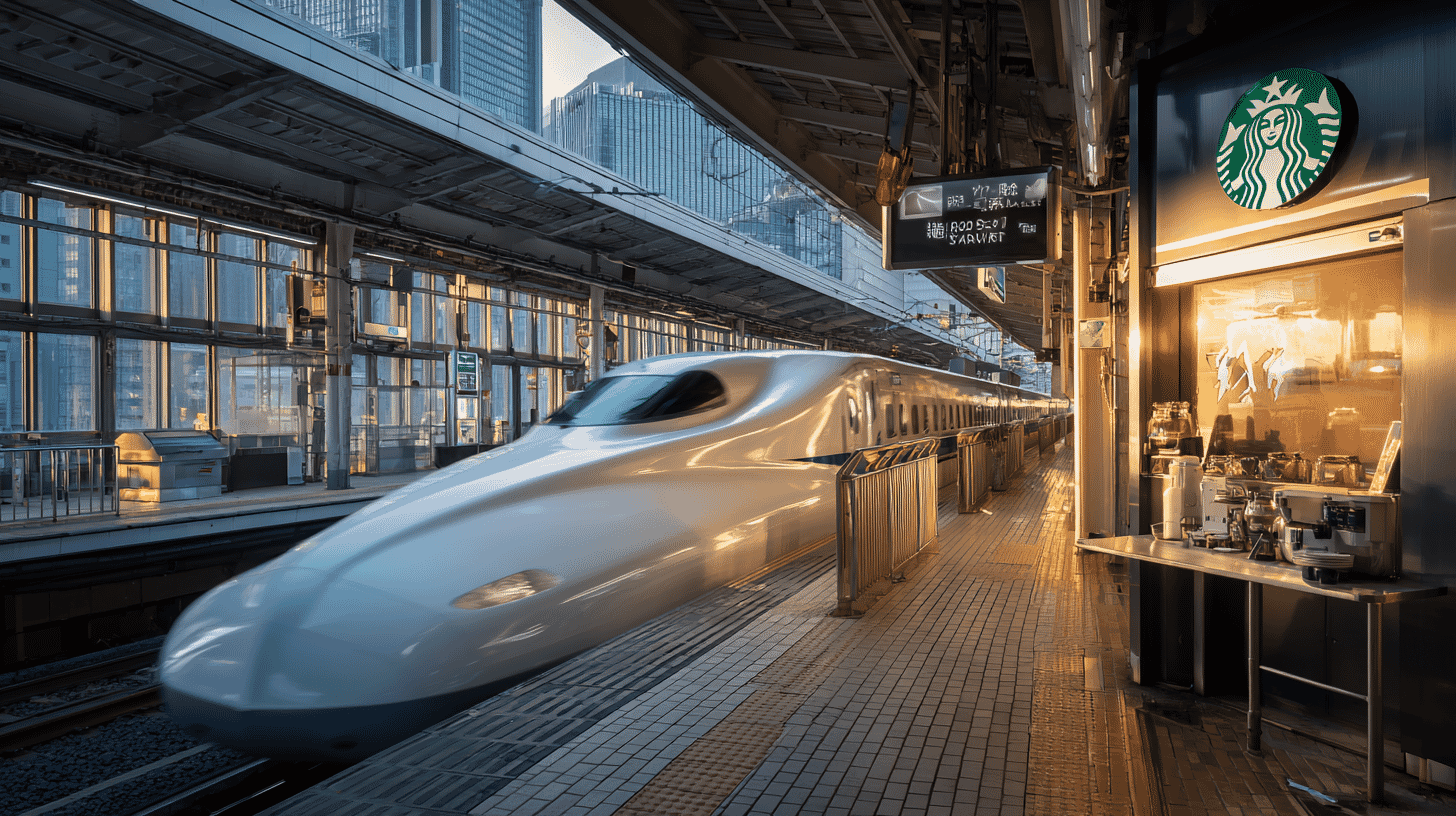
Grabbing a Starbucks right on a bullet train platform, seconds before boarding a 285 km/h train to Osaka: that became reality at Shin-Yokohama Station in late 2025. Barely five months later it closed for renovations, not because it failed, but because it was too popular. Here's the story behind Japan's most unusual coffee stop.
The First (and Only) Starbucks on a Shinkansen Platform
On November 21, 2025, Starbucks Coffee Japan opened its first-ever branch directly on a Shinkansen bullet train platform at Shin-Yokohama Station in Yokohama. Located on the westbound platform for trains heading to Nagoya, Kyoto, and Osaka, the tiny shop occupied just 13.9 square meters (about 150 sq ft), roughly the size of a large walk-in closet, in a space that once housed a kiosk.
The concept was "Brewed to Go." Designed for travelers with only minutes to spare before departure, the store offered a stripped-down menu: just five varieties of brewed drip coffee (three hot, two iced) and packaged snacks like cookies and pretzels. Orders were placed through a touchscreen panel with fully cashless payment, no cash, no Starbucks cards, no mobile pre-ordering.
But this wasn't just a vending machine in disguise. Two staff members ("partners" in Starbucks speak) were always on hand, greeting customers with questions like "Where are you heading today?" and sending them off with "Have a wonderful journey!" It was quintessentially Japanese, blending efficiency with warmth.
Too Popular for Its Own Good
On March 27, 2026, Starbucks announced that the shop would temporarily close on April 25 for renovations; it reopened about two months later, on June 24, 2026. The reason for the shutdown? Overwhelming demand that far exceeded the company's own projections.
Starbucks stated that the response opened their eyes to opportunities for improvement, and that they would return with an upgraded experience. Given the store's tiny footprint and limited menu, the renovations likely aim to expand capacity and possibly introduce more drink options.
The speed of this decision is remarkable. Opening in November and greenlighting renovations by March suggests the concept was an immediate hit, likely from day one. Reports from opening day noted that the equipment needed maintenance breaks due to unexpectedly heavy use.
Why Shin-Yokohama?
Major Tokaido Shinkansen stations like Tokyo, Shinagawa, Nagoya, and Shin-Osaka already have Starbucks branches inside their ticket gates. But Shin-Yokohama, despite being a stop for all Nozomi express trains, had no Starbucks within its Shinkansen gates. The nearest one required exiting to the station building, impractical when your train departs in five minutes.
The choice was also strategic. Shin-Yokohama is smaller and simpler than Tokyo Station, making it an ideal testing ground. If a compact platform shop could thrive here, it could work anywhere along the route. Starbucks has indicated it's considering expanding the concept to other Shinkansen stations from 2026 onward.
Japan's "Ekinaka" Culture Explained
To understand why a Starbucks on a train platform makes perfect sense in Japan, you need to know about ekinaka (駅ナカ), literally "inside the station." Japanese train stations have evolved far beyond simple transit hubs into full-fledged commercial centers.
Tokyo Station's "GranSta" mall houses over 100 shops selling bento boxes, sweets, fashion, and souvenirs, all without leaving the station. Shinjuku, Shibuya, and Shinagawa stations have similar commercial ecosystems. For millions of Japanese commuters and travelers, the station isn't a place you pass through, it's a place you spend time in.
Shinkansen travel has its own rituals. Passengers buy ekiben (station bento boxes) to enjoy on board, pair them with canned beer or green tea, and watch Mount Fuji pass by through the window on the Tokyo-to-Osaka route. Adding Starbucks coffee to this experience felt like a natural next step.
The price of a brewed coffee at the platform shop starts at around $2.90 (437 yen), roughly in line with regular Starbucks pricing in Japan, though the platform store uses "special location pricing" that's slightly higher than standard.
What the Renovation Changed
When it reopened on June 24, 2026, Starbucks emphasized speed over selection. The company introduced proprietary equipment to accelerate coffee extraction and strengthened its operations, aiming to move customers from order to cup even faster in the narrow window before departure. The store's tight 13.9-square-meter footprint and drip-coffee-focused menu stayed essentially the same.
Espresso drinks like lattes and Frappuccinos, and Mobile Order & Pay support, were not part of the reopening announcement. On a Shinkansen platform, getting a single cup out quickly mattered more than widening the menu.
What's Your Station Like?
Japan's station culture is deeply tied to a country where trains are the backbone of daily life. European terminal stations like London St Pancras or Paris Gare du Nord have shops and cafés, and some transit hubs worldwide offer decent food options. But a full-service Starbucks right on a high-speed rail platform? That's a distinctly Japanese innovation.
What kind of shops and cafés does your local train station have? Could you grab a coffee on the platform before boarding? Share your experience in the comments, we'd love to hear how stations work in your part of the world.
References
- https://stories.starbucks.co.jp/press/2026/pr2026-0327-2/
- https://soranews24.com/2026/04/06/starbucks-japan-closing-only-shinkansen-platform-branch-for-popularity-triggered-renovations/
- https://travel.watch.impress.co.jp/docs/news/2065035.html
- https://travel.watch.impress.co.jp/docs/news/2064829.html



Global Discussion
13 comments