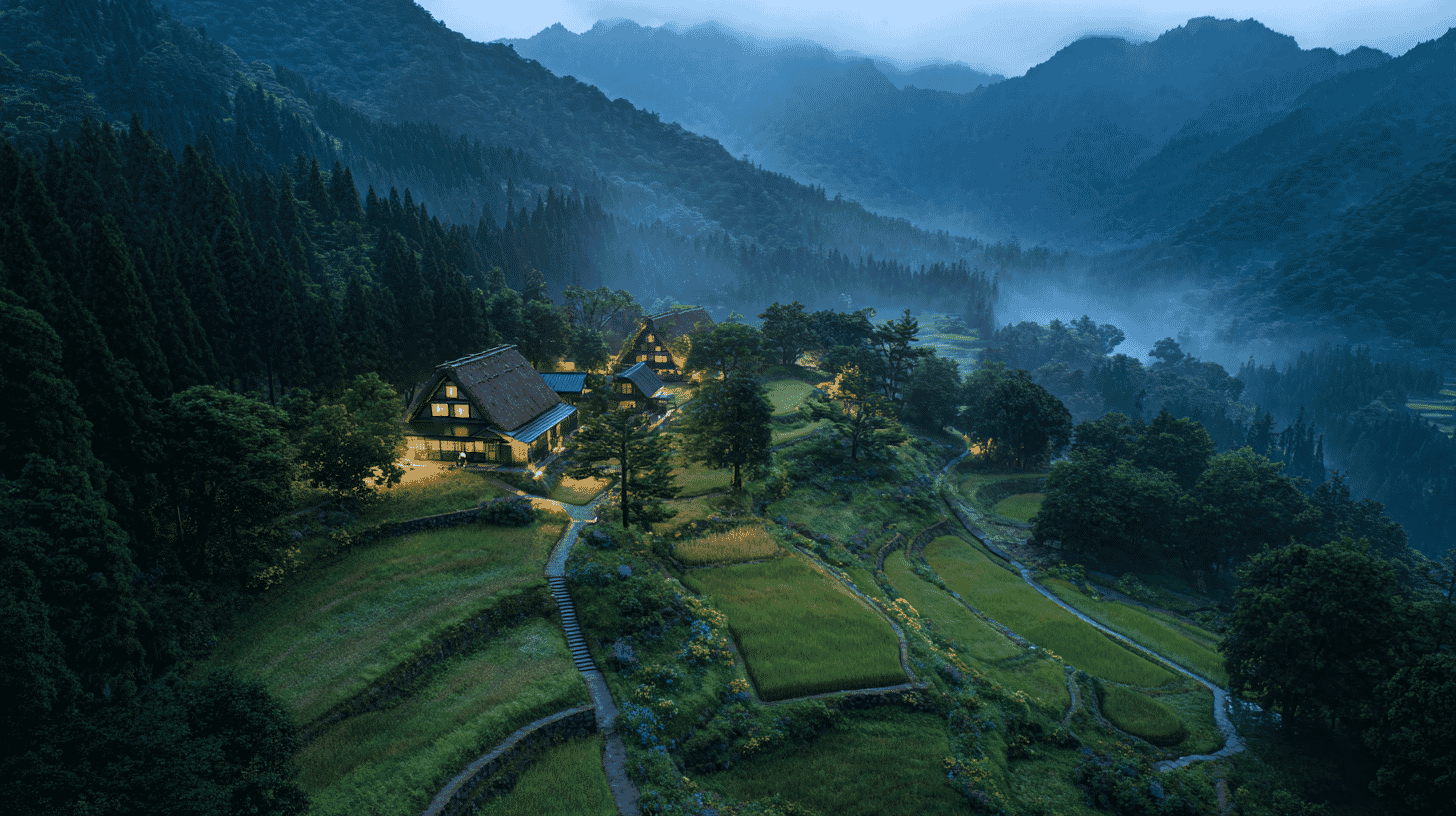
Forget renting a house. In Japan, you can now rent an entire village. In a remote mountain hamlet in Niigata Prefecture, where just 2 people live year-round, a 30-year-old architect has turned the whole settlement into a bookable accommodation. Guests sleep in a 200-year-old farmhouse, cook with spring water and wild vegetables, and have an entire landscape of rice terraces, forests, and snow fields as their personal retreat. Welcome to Japan's first "Ichimura-gashi," a whole-village rental.
A Village on the Brink
Ichinono is a small settlement tucked into the mountains about 30 to 40 minutes by car from JR Itoigawa Station in Niigata Prefecture, at an altitude of roughly 400 meters (1,300 feet). The hamlet sits in one of Japan's heaviest snowfall zones, winter accumulation can top 5 meters (16 feet).
At its peak, Ichinono was home to around 40 households and even had its own elementary school. Today, only one household, two people, lives there year-round. Most of the thatched-roof farmhouses stand empty. Some residents stay only during warmer months, retreating to the city when winter buries the village.
It's a textbook example of what Japan calls a genkai shūraku (限界集落), or "marginal settlement", a community where more than half the population is over 65 and the settlement faces extinction. According to the latest joint survey by Japan's Ministry of Land, Infrastructure, Transport and Tourism and the Ministry of Internal Affairs (April 2024 data), over 40% of settlements in Japan's depopulated regions have crossed that threshold, up from 29% just five years earlier. More than 3,600 communities are projected to eventually disappear.
The Architect Who Chose to Stay
Ibuki Nagata, 30, is an architect from Toyohashi, Aichi Prefecture, who came to Itoigawa in 2023 as a member of Japan's Chiiki Okoshi Kyōryokutai (地域おこし協力隊), a government-backed "Regional Revitalization Cooperator" program that places young volunteers in rural areas for up to three years.
During his tenure, Nagata discovered Ichinono and was captivated by its pristine landscape, cultural heritage, and the warmth of its remaining residents. When his cooperator term ended, he didn't leave. Instead, he founded Dentō (伝燈), a company whose name combines "transmit" (伝) and "illuminate" (燈), reflecting his mission to pass on the village's legacy.
Working alongside co-founder Munenori Matsuo, also an architect, Nagata spent six months renovating an abandoned farmhouse that had sat empty for eight years. The building, over 200 years old, was restored to something close to its original state, the modern modifications made by previous occupants were stripped away, revealing the original kayabuki (thatched) roof structure, doma (earthen-floor) kitchen, and irori (sunken hearth).
Only the bathroom, toilet, and kitchen were updated to modern standards. The result: a dwelling named Dōmichi (堂道), after the household's traditional yagō (屋号), the family nickname used when multiple households in a village shared the same surname.
What "Whole-Village Rental" Actually Means
Many rural accommodations in Japan offer ittō-gashi (一棟貸し), whole-building rentals. Nagata's concept goes far beyond that. At Dōmichi, the building is where you sleep, but the village is where you stay.
The accommodation is limited to one group per day, with a capacity of 8 guests (larger groups by arrangement). The base rate is ¥23,000 (roughly $145) plus ¥14,000 per person ($88) per night, including dinner and breakfast. Check-in is at 3:00 PM, check-out at 11:00 AM. Transfers from Itoigawa Station are available.
What sets this apart is the role of the denshōnin (伝承人), "tradition bearers" or village guides who shape each guest's experience. Before arrival, guests share how they'd like to spend their time, and the denshōnin designs a custom itinerary using the village's full resources.
Year-round activities include village walks, bonfire-making, grass cutting, and drawing water from natural springs. Seasonal options rotate through the calendar: rice planting and wild vegetable foraging in spring, flowing sōmen noodles and watermelon splitting in summer, rice harvesting in autumn, and igloo building and snow play in winter.
Meals are collaborative, not served. Guests cook alongside the denshōnin and local residents using ingredients sourced entirely from the surrounding area, terraced-field rice, local vegetables, foraged mountain herbs and mushrooms, fish from the Sea of Japan, and the village's own spring water.
Early Results: International Guests and Repeat Bookings
Since a soft opening around April 2025, Dōmichi has welcomed guests from across Japan and from overseas, including visitors from Iceland, Austria, and the United States. Repeat bookings have already started arriving, with some guests requesting return visits timed to specific agricultural seasons.
The majority of domestic guests come from the Greater Tokyo area. Thanks to the Hokuriku Shinkansen, Itoigawa Station is about 2 hours from Tokyo, making this deep-mountain experience surprisingly accessible for a weekend trip.
Japan's Vanishing Villages by the Numbers
Ichinono's story is one thread in a much larger national crisis. Japan's population peaked in 2008 and has been declining since, with the trend accelerating sharply. The country's birth rate hit a record low in 2024, with fewer than 690,000 babies born, 14 years ahead of government projections.
The impact on rural communities is devastating. Between 2015 and 2019 alone, 164 settlements across Japan were completely depopulated, their last residents either died or moved away. A 2024 report by the Population Strategy Council identified 744 municipalities (over 40% of all local governments) as being at risk of extinction by 2050.
The implications go far beyond demographics. When a village disappears, centuries of accumulated knowledge vanish with it, architectural traditions, agricultural techniques, local dialects, festival customs, and culinary practices that exist nowhere else.
How It Differs from Italy's €1 Houses
The most internationally famous approach to rural depopulation is Italy's "case a 1 euro" program, where towns in Sicily, Sardinia, and elsewhere sell abandoned houses for a symbolic €1 to attract new residents.
While media-friendly, the €1 house model has significant limitations. Buyers typically face renovation costs of €20,000–€50,000, strict deadlines, and penalty fees for incomplete work. Employment opportunities in these remote towns are scarce, and many buyers struggle to establish viable livelihoods. Critics note that the program generates media buzz but often fails to produce lasting repopulation.
Ichinono's model takes a fundamentally different approach. Rather than asking outsiders to relocate permanently, it creates what Japanese planners call kankeijinkō (関係人口), "connected population." Through short-term stays that evolve into repeat visits, guests develop meaningful relationships with the village, its residents, and its landscape. They become stakeholders in the settlement's survival without the commitment barriers of permanent relocation.
Similar depopulation challenges exist across Southern Europe, South Korea, and parts of rural North America. Spain's España vaciada ("emptied Spain") movement has drawn attention to hundreds of abandoned villages in the interior. Portugal's Aldeias de Xisto (Schist Villages) program has rehabilitated stone hamlets in the mountainous interior as tourism destinations, perhaps the closest European parallel to what Ichinono is attempting.
A New Template for Marginal Settlements?
Nagata envisions the ichimura-gashi model as a replicable template for struggling settlements across Japan. The key elements, a renovated heritage building as anchor, village-wide experiential programming, tradition-bearer guides, and agricultural corporation support for landscape maintenance, could theoretically be adapted to other communities.
An agricultural corporation has been maintaining Ichinono's terraced rice paddies at no profit, ensuring the landscape remains intact even as residents have dwindled. This combination of external organizational support and entrepreneurial tourism initiative creates a more resilient structure than either could achieve alone.
The question is whether this model can sustain itself economically while maintaining authenticity. At around $230 per person per night (for a solo guest; less per person for groups), the pricing positions Dōmichi in the experiential luxury segment, comparable to high-end ryokan but offering something genuinely unique.
What's Happening in Your Country?
Japan's experiment in turning a dying village into a living accommodation raises questions that resonate globally. Rural depopulation is not a uniquely Japanese phenomenon, from Appalachian hollows in the United States to abandoned pueblos in Spain's interior to shrinking villages across Eastern Europe and East Asia, communities everywhere are grappling with how to sustain places that economic gravity pulls people away from.
What approaches has your country tried? Are there programs to revitalize rural villages, repurpose abandoned buildings, or attract new residents to depopulated areas? We'd love to hear about the strategies, successful or otherwise, being tried where you live.






Global Discussion
15 comments