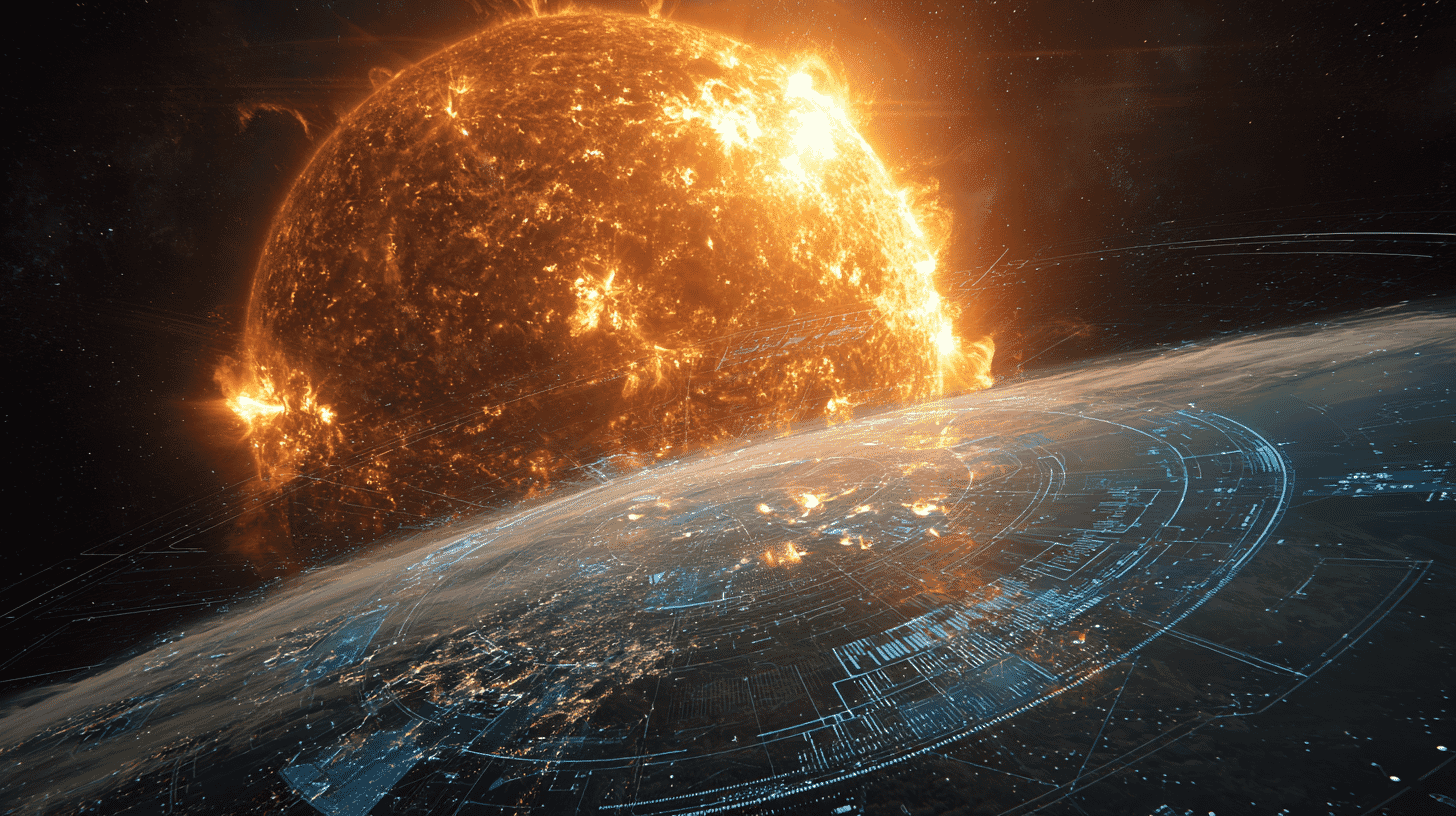
A single "sneeze" from the Sun can knock out your smartphone signal, throw GPS off course, and trigger massive blackouts. Predicting solar flares has always been about knowing "when" they'll happen, not "how dangerous" they'll be. Fujitsu's explainable AI "Kozuchi XAI" takes on that barrier, delivering a prediction technology that explains "why" a flare is dangerous, backed by scientific evidence.
The Threat Solar Flares Pose to Modern Society
A solar flare is a massive explosion on the Sun's surface. When the high-energy particles and coronal gas released by these explosions reach Earth, they can have serious impacts on our daily lives.
Specific effects include:
- GPS accuracy degradation: Car navigation and aircraft positioning systems develop errors
- Communication disruptions: Satellite and shortwave radio functions temporarily fail
- Power infrastructure damage: Excessive currents flow through transmission lines, damaging transformers
- Health risks to astronauts: Direct exposure can result in lethal radiation doses
In February 2022, SpaceX lost 40 out of 49 Starlink satellites due to solar flare effects. In 1989, 6 million people in Quebec, Canada experienced a 9-hour blackout.
Currently, the Sun is entering its "solar maximum" phase in its approximately 11-year activity cycle, with NASA officially announcing this in October 2024. Experts predict this active period will continue for another 1-2 years, increasing the risk of major flare events.
Limitations of Conventional AI Prediction and the Emergence of "Explainable AI"
AI technology has already been deployed for solar flare prediction, but a significant challenge remained: the "black box problem."
Traditional deep learning-based AI can derive predictions from vast amounts of data, but cannot explain "why" it reached that prediction. For decisions involving astronaut lives and critical infrastructure protection, predictions without evidence were impractical to implement.
Dr. Kanya Kusano, Professor Emeritus at Nagoya University and Project Professor at the Institute for Space-Earth Environmental Research (ISEE), points out: "Traditionally, solar flare predictions relied on human experience and knowledge. This approach struggles to predict sudden events."
Furthermore, solar flares have a characteristic where "scale and danger level don't strongly correlate." A large-scale flare doesn't necessarily release massive amounts of high-energy particles, while conversely, a medium-scale flare can trigger serious radiation events. This complexity has made prediction even more challenging.
Fujitsu "Kozuchi XAI": An Innovative Approach
Fujitsu's "Fujitsu Kozuchi XAI" is an explainable AI technology that mimics the scientific discovery process. Its core technology, "Wide Learning," replicates the thought process of scientists who repeatedly formulate and verify hypotheses.
Technical Features
1. Effective with Limited Data Traditional deep learning requires massive datasets, but large-scale solar flares, like earthquakes, are "rare phenomena." Wide Learning can comprehensively discover important hypotheses even from limited data.
2. Visualization of Evidence Beyond just prediction results, it presents which factors contributed to the prediction, such as flare location, duration, brightness, and occurrence history, as scientific evidence.
3. Similar Case Presentation The system selects the most similar cases from past solar flare data, allowing operators to reference them alongside probability predictions.
Research Results
In joint research between Fujitsu and Nagoya University's Institute for Space-Earth Environmental Research (ISEE), 57 features from solar flares occurring from 2010 to June 2017 were used for training. The results confirmed prediction accuracy equal to or better than conventional methods, while also being able to explain the prediction rationale.
Application to Lunar Exploration: Joint Research with JAXA
In February 2025, Fujitsu and Tokai National Higher Education and Research System (Nagoya University and Gifu University) launched joint research with JAXA on "Development of Solar Radiation Advance Prediction Technology for Lunar and Mars Exploration Using Explainable AI Technology."
This research was selected for the "Moon to Mars Innovation" program promoted by JAXA's Space Exploration Innovation Hub, with a research period scheduled until March 2026.
Research Objectives
The lunar surface lacks the protective atmosphere and magnetic field that Earth has, making the risk of exposure to solar energetic particles extremely high. If a major solar flare occurs while astronauts are conducting extravehicular activities, they need to evacuate to shielded facilities within 30 minutes.
Aiko Nagamatsu, Technical Domain Manager at JAXA's Space Exploration Innovation Hub, states: "Space weather forecasting is positioned as a priority issue that space agencies worldwide must solve first in space exploration."
Contribution to the Artemis Program
The research outcomes are aimed at the international lunar exploration program "Artemis" led by NASA. Efforts toward practical implementation are underway, including feedback to data analysis specifications for the space radiation dosimeter that JAXA is developing.
Expansion to Social Infrastructure Protection
Beyond space exploration, this technology is expected to be applied to protect terrestrial social infrastructure.
Japan's Ministry of Internal Affairs and Communications published a "worst-case scenario" in 2022 for when a once-in-a-century scale solar flare occurs. The contents are shocking:
- Smartphones, TVs, and radios intermittently unusable for 2 weeks
- Taxi and train radio communications intermittently disrupted for 2 weeks
- Wide-area blackouts
If predictions can be made in advance, measures such as planned blackouts and planned service suspensions can minimize damage. In 1994, a researcher who detected flare occurrence from solar observation data sent emails worldwide, enabling a Chicago power company to prevent transformer damage ahead of a geomagnetic storm that arrived 2 days later.
Future Prospects and Challenges
In April 2025, Fujitsu established a new research domain called "Space Data Frontier." The "space weather" field, including solar flare prediction, is positioned as one of its two main pillars.
Challenges for the future include:
- Improving real-time capability: Since only about 8 minutes pass from flare occurrence to X-ray arrival, faster prediction and warning systems are needed
- Strengthening international cooperation: Space weather is a global challenge requiring shared observation data and standardized prediction models across nations
- Social implementation: Creating mechanisms to provide research results in formats that airlines, power companies, and telecommunications operators can actually use
In Japan, the fusion of space development and AI technology is being used to confront "civilization-evolution disasters" like space weather. What measures or research are being conducted in your country regarding solar flares and space weather?
References
- https://www.fujitsu.com/global/about/resources/news/press-releases/2025/0203-01.html
- https://www.fujitsu.com/global/about/resources/news/press-releases/2024/0314-01.html
- https://global.fujitsu/en-global/insight/tl-space-weather-prediction-20250513
- https://www.swpc.noaa.gov/
- https://www.itmedia.co.jp/aiplus/articles/2601/28/news092.html





Global Discussion
16 comments