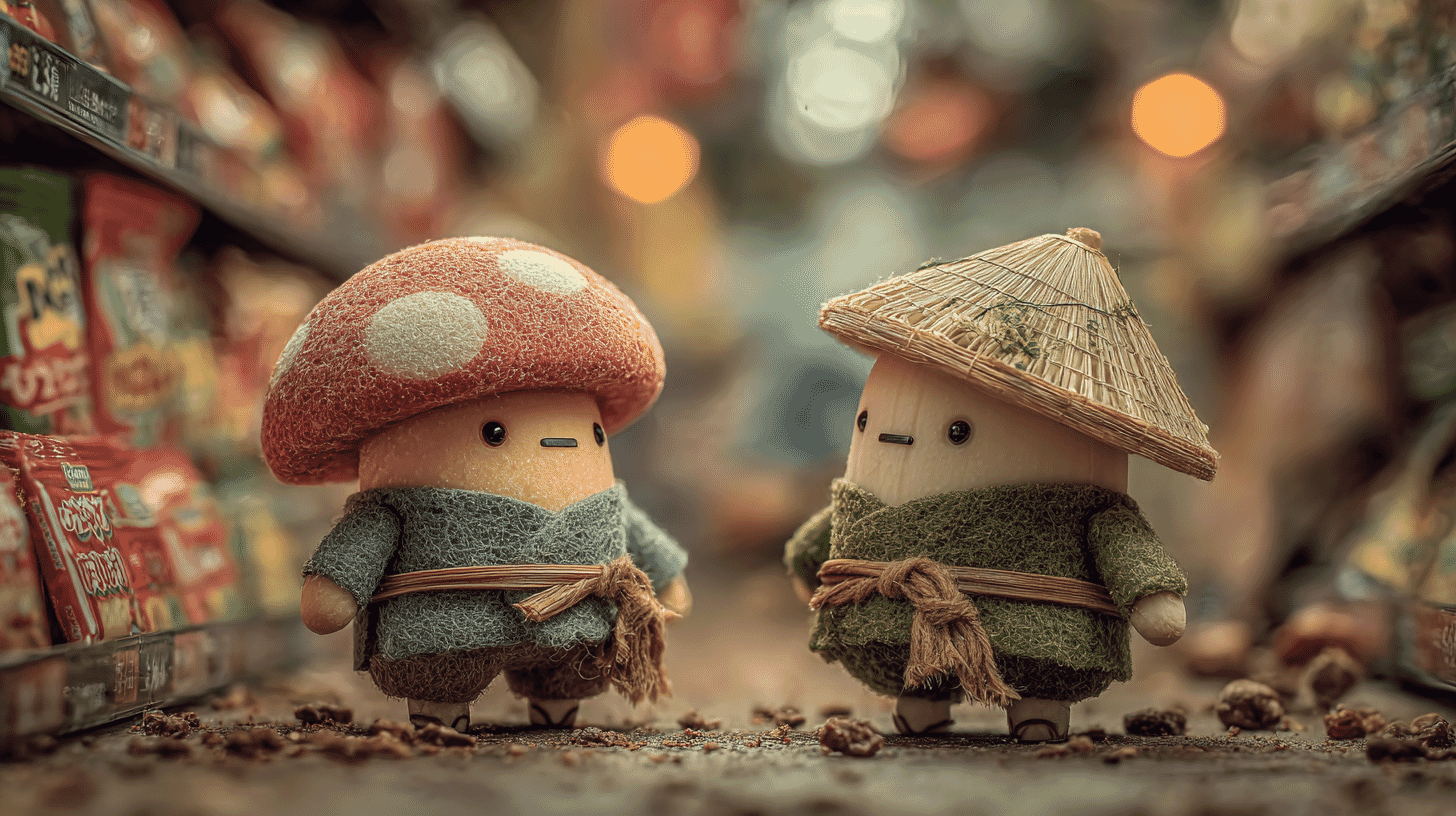
🍫 Japan is famously polytheistic. Eight million gods coexist in harmony, and Shinto, Buddhism and Christianity share the same spiritual zip code without much trouble. There is exactly one holy war that splits the country: Kinoko no Yama versus Takenoko no Sato. Which chocolate snack is better? Here is the full, gloriously absurd report on Japan's greatest snack battle.
What Are "Kinoko no Yama" and "Takenoko no Sato"?
These are two chocolate snack products made by Meiji, one of Japan's largest confectionery companies. You will find them side by side in virtually every convenience store and supermarket across the country. Think of them as Japan's answer to the Coke vs Pepsi debate, except with way more passion and occasional threats to end friendships.
Kinoko no Yama ("Mushroom Mountain") was born in 1975. Shaped like tiny mushrooms, the cap is made of two layers of chocolate while the stem is a crunchy cracker. The origin story is delightfully casual: Meiji engineers were trying to repurpose the production line for their Apollo chocolate when someone stuck a cracker into an Apollo piece and said, "Hey, that looks like a mushroom!" Five years of development later, Kinoko no Yama was born.
Takenoko no Sato ("Bamboo Shoot Village") followed in 1979 as the younger sibling. Shaped like bamboo shoots, the base is a crumbly cookie topped with chocolate. The naming logic was charmingly simple: if mushrooms belong on the mountain (yama), then bamboo shoots belong in the village (sato). Both names evoke the idyllic Japanese countryside, satoyama, which was the deliberate design concept during Japan's rapid economic growth period, when people yearned for a connection to nature.
Cacao prices have pushed both products up in recent years and trimmed the contents, and fans remain fiercely loyal anyway. Kinoko no Yama also went abroad early: it has been sold in the United States since 2007 under the name CHOCOROOMS.
How the War Began
The two snacks have always shared shelf space, sitting side by side like rival generals eyeing each other across a border. This proximity naturally sparked consumer debates: "Which one tastes better?"
The rivalry simmered through the 1980s in schoolyards and living rooms, but it truly exploded with the rise of the internet. On 2channel (Japan's original anonymous forum, like an early Reddit) and later Twitter (now X), "Kinoko faction vs Takenoko faction" threads became a staple. Asking someone "Are you Kinoko or Takenoko?" in Japan carries roughly the same social risk as asking about their political views, possibly more. The conflict has a name: Kinoko-Takenoko Sensō, the Mushroom-Bamboo Shoot War. A snack argument has been catalogued like a documented military campaign.
Meiji Joins the Battle: National Elections
In a masterstroke of marketing, Meiji officially entered the fray by organizing national popularity votes.
2001, The First "Kinoko-Takenoko General Election" Kinoko no Yama's sales had been slipping. Meiji's solution? Form political parties. The "Kinoko Party" and "Takenoko Party" campaigned for consumer votes. Takenoko won, but the real winner was Meiji: Kinoko no Yama's sales bounced right back. Marketing textbooks should have a chapter on this.
2018, the National Election Voting ran from February 26 to July 31 and drew huge participation. Takenoko took 6,931,220 votes to Kinoko's 6,761,773, with 2,238,204 going to the "Both Party" (centrists exist even in snack wars). The winning margin was 169,447. The Takenoko Party's headline manifesto pledge was to co-develop a new product with retired wrestling champion Saori Yoshida, a declared Takenoko partisan. You do not want the world's strongest woman as your opponent.
2019, the third election and the peace treaty After four months of voting, the New Kinoko Party, led by Arashi's Jun Matsumoto, took 6,021,986 votes against 4,565,799 for the New Takenoko Party under Akihiro Miwa. Kinoko had won its first victory in three attempts, by roughly 1.45 million votes, leaving the overall record at two wins to one in Takenoko's favor. The two parties then signed a No-Side Agreement, a rugby term for the handshake after the final whistle, formally ending about 40 years of conflict. Or so they thought.
2020, The "National Survey" During the COVID pandemic, Meiji decided it was no time for fighting and reframed the debate. Instead of asking "Which do you prefer?", they measured the "depth of love" for each snack. The result: 46 of 47 prefectures reported stronger love for Takenoko no Sato. Only Fukushima Prefecture held out for Kinoko no Yama. Why Fukushima? Nobody has explained it.
The War Goes Digital: Video Game Crossovers
This conflict has spilled into the gaming world with spectacular results.
On June 18 and 19, 2016, Nintendo's Splatoon ran a Splatfest pitting Kinoko against Takenoko. Final score: 349 to 351, a two-point margin that would trigger a recount in any real democracy. The interesting part is the breakdown. Kinoko players actually won more matches, 52% to 48%, but Takenoko drew 63% of the popular vote against 37%. Kinoko fought better and lost on numbers.
The rhythm game Taiko no Tatsujin and the mobile RPG Granblue Fantasy have run comparable head-to-head collaborations.
What Actually Makes Them Different?
The fundamental divide comes down to what lies beneath the chocolate.
Kinoko no Yama features a cracker (a crispy biscuit-like base) with a generous chocolate cap. The chocolate and cracker stay distinctly separate in your mouth, creating a "two-stage" eating experience. Kinoko also secretly contains more chocolate per piece than its rival, a fact Kinoko partisans brandish like a battle flag.
Takenoko no Sato uses a cookie base with a crumbly, melt-in-your-mouth texture. The chocolate and cookie blend together, creating a unified, harmonious flavor profile that Takenoko supporters describe as "perfection."
In short: Kinoko is the separation school, Takenoko the fusion school. That difference in snack architecture has sustained five decades of argument.
2025: The 50th Anniversary and Global Expansion
In 2025, Kinoko no Yama turned 50, and Meiji pulled out all the stops.
The standout was a taste test across 20 countries with about 1,000 participants, in which 14 countries came out for Kinoko no Yama. Takenoko dominates at home; abroad, the mushroom wins. The reversal became the campaign's hook.
The anniversary commercial, which began airing on May 20, 2025, featured comedian Ryota Yamasato, whose surname contains both yama (mountain) and sato (village), and who was born in 1977, neatly between the two launch years. In the ad, the self-proclaimed Takenoko supporter is fed Kinoko no Yama by a team of researchers and converts on the spot.
On October 14, designer Junko Koshino staged a runway show, JUNKO KOSHINO Kino-Colle 2026 S/S COLLECTION, in Shibuya. The project used cacao husk, the unused part of the cacao bean, as a dye, part of a sustainability push Meiji announced in March 2025. Koshino closed the show by promising that her next collection would be for Takenoko no Sato, which turns 50 in 2029.
A run of Kinoko no Yama wireless earbuds sold out on release and got picked up by media abroad on looks alone.
Why This War Will Never End
The No-Side Agreement was signed. The treaty is on record. The war continues anyway, for three reasons.
Nobody gets hurt. Unlike political or religious conflicts, this debate is the ultimate "peaceful war." No matter who wins, everyone laughs. It functions perfectly as an icebreaker with strangers, a team-building exercise at work, and reliable social media engagement.
There is no right answer. Taste is subjective. Data and logic cannot settle it, so the argument runs indefinitely, and people enjoy that.
Meiji is good at this. From national elections to gaming crossovers to fashion shows, Meiji has used the rivalry to lift both brands at once. Two products from the same company competing should cannibalize sales. Here it does the opposite.
What About YOUR Country's Snack War?
In Japan, "Kinoko or Takenoko?" has divided the country for half a century. Every culture has its own version.
Coke vs Pepsi. McDonald's vs Burger King. Vegemite vs Marmite. Dogs vs cats. Is there a food rivalry in your country that tests friendships at the dinner table?
(For the record, this author belongs to the Both Party, which in Japan makes you the most put-upon minority of all.)





Global Discussion
15 comments