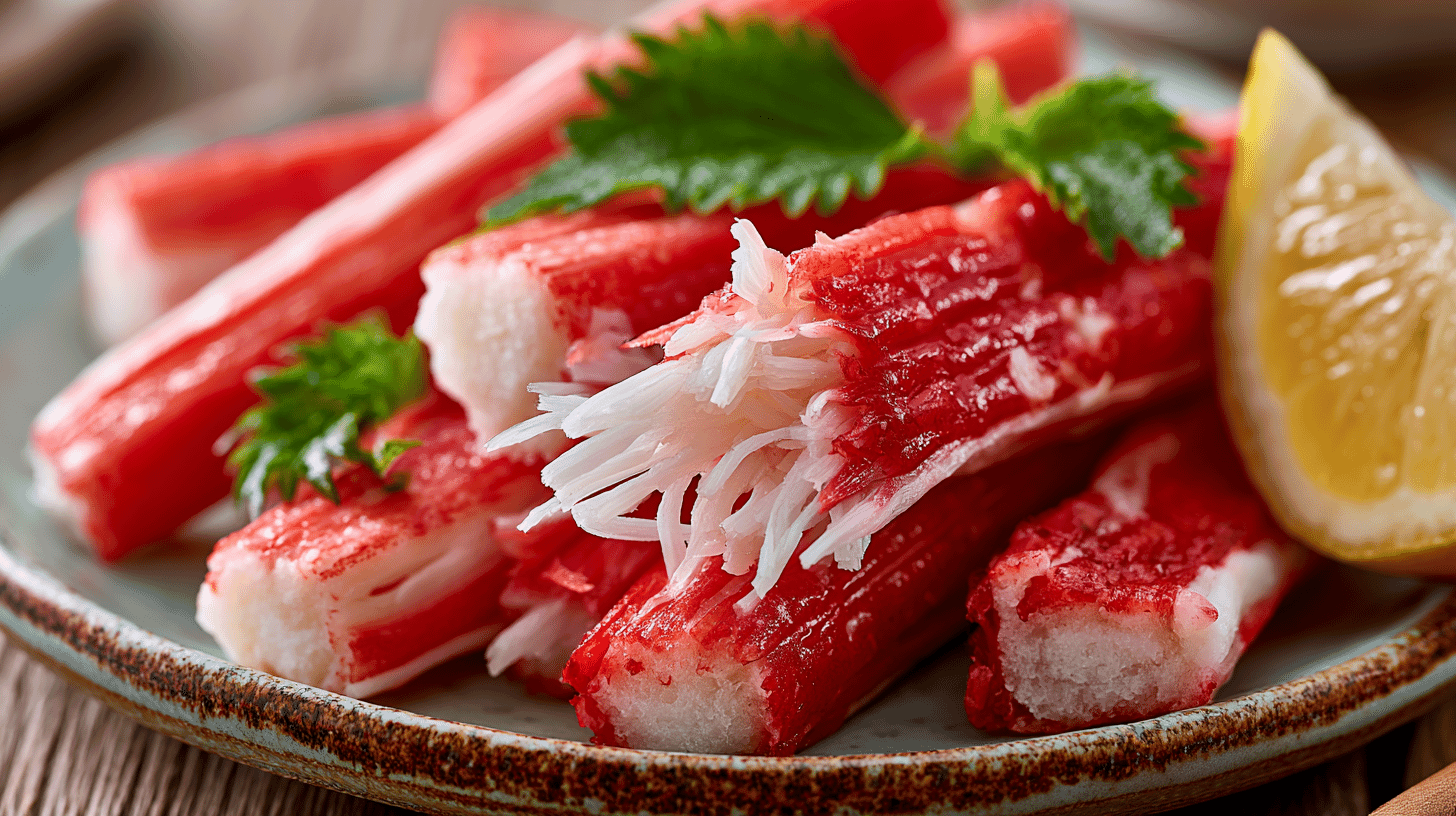
🦀 That red-and-white crab-flavored stick in your salad or California roll? Trace it back far enough and you land in a small town on Japan's Noto Peninsula. And for something that looks so simple, it's surprisingly hard to copy.
Born from a failed batch of fake jellyfish
The first company to turn crab sticks into a commercial product was Sugiyo, a maker of fish paste in Nanao, Ishikawa Prefecture, in business since 1640. The origin is odd: Sugiyo was trying to build an artificial jellyfish after imports of the real thing, prized in Chinese cooking, dried up amid China-Japan tensions in the late 1960s. That project flopped, but a byproduct of the tinkering was a flaky fish paste that tasted and shredded like crab leg. It launched in 1972 as "kaniashi," the ancestor of every crab stick sold today.
Early buyers dismissed it as a fake, and Japanese food writers now group it with instant ramen and retort curry as one of the country's three great postwar food inventions. One decision shaped everything that followed: Sugiyo never patented it. Rivals were free to pile in, the technique spread across the industry, and it eventually went global. A Japanese invention became a world food precisely because no one locked it up.
The crab-stick economy, by the numbers
Estimates vary by research firm, but the global surimi market sat somewhere around $4 to $7 billion in 2025, and crab sticks make up roughly half of all surimi products. Asia-Pacific accounts for well over 60 percent of both production and consumption, with Europe next.
Europe's biggest consumer is France, where about 80 percent of surimi products are crab sticks and per-person intake tops half a kilogram a year, on par with Spain. It isn't shelved as an exotic "Japanese fish cake" either, but as a default ingredient for salads and apéritif platters.
Japanese makers are still pushing outward. Fujimitsu, founded in 1887 in Nagato, Yamaguchi Prefecture, exports crab sticks and cheese-stuffed fish cakes to seven countries and territories, mostly across East Asia. Chairman and president Masashi Fujita steered the company abroad after taking the top job in 2002, and kanikama exports from the Nagato plant began in 2013. Crab sticks now make up more than 60 percent of its exports, and the company wants to lift overseas revenue from under 2 percent of sales today to 10 percent within five years.
Harder to copy than it looks
Anyone can make surimi. The tricky part is finishing it so it reads as crab leg.
Frozen surimi is broken up and kneaded with salt, which gets the fish proteins to bind and builds that signature springiness. The seasoned paste is sieved to remove skin and small bones, then cooked into thin sheets. A noodle-cutting machine slices those sheets into fine threads, a bundler gathers the threads into a stick, and the surface is dyed red. Shred, bind, bundle, color: that sequence is what produces the pull-apart fibers of a crab leg.
Sugiyo cracked the leaf-vein fiber structure of snow crab around 1990, then in 2004 released Kaoribako, a premium line that narrowed the gap with the real thing. For the 2023 Kaoribako Kiwami, the company says it scientifically compared real snow crab against its own product and worked through more than a hundred ingredients one by one. The "secret," in other words, isn't a single trick but decades of accumulated trial and error.
A second bit of engineering is aimed squarely at exports. Fujimitsu developed crab sticks that keep at room temperature, for markets where cold-chain logistics are thin. A product you can shelve without refrigeration is an unglamorous advantage, but it's what opened doors in Taiwan and Hong Kong.
Riding the fish-and-protein wave
The idea that eating fish is good for you has gone global, and kanikama fits neatly into it as a cheap, low-fat, high-protein option. In the United States it's settled in as a game-day snack and is treated as "seafood" rather than a Japanese specialty. Where hot-pot cooking is common, makers also pitch shelf-stable oden sets packed with fish-cake ingredients.
But as the market widened, so did the roster of who actually makes the stuff. Major producing countries now include Thailand, China, Vietnam, and Lithuania. The crab sticks in your local supermarket may well have come out of a plant in France or Lithuania. The food Japan invented, then handed to the world patent-free, is now made all over it.
In Japan, kanikama is a fridge staple, and the high end has crept startlingly close to real crab. What about the pack in your supermarket: is it Japanese-made, or has it become a local product where you live?




Global Discussion
4 comments