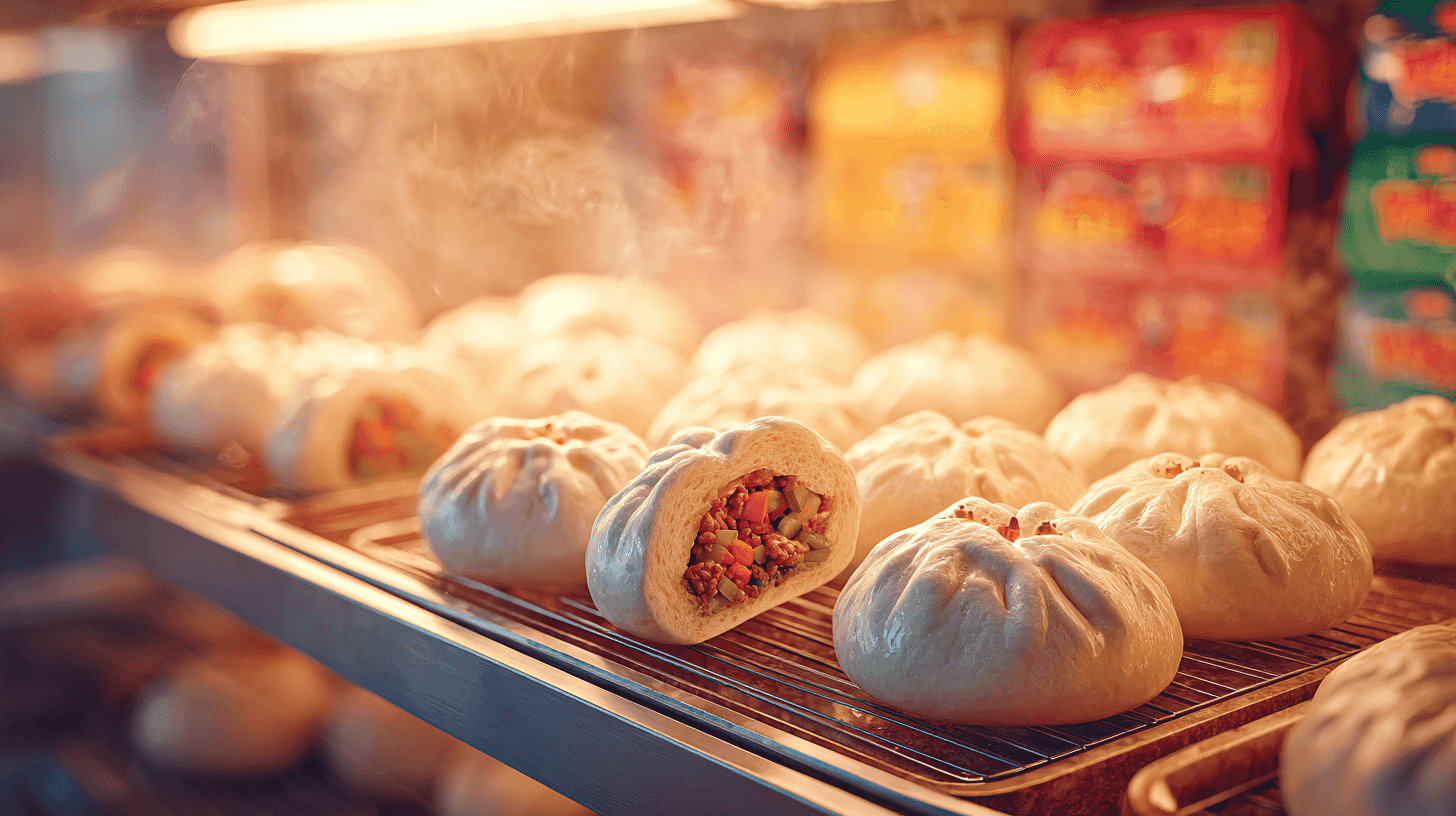
Those steaming buns at Japanese convenience store counters are undergoing a dramatic transformation. What was once a simple 100-yen winter snack has evolved in three remarkable directions: supersized portions, sweet dessert varieties, and international flavors. In a market worth 60 billion yen annually, with convenience stores commanding 70% market share, Seven-Eleven, FamilyMart, and Lawson are locked in fierce competition. Here's your front-line report on Japan's chukaman revolution.
From Chinese Baozi to Japanese Convenience Store Icon
The original chukaman traces back to Chinese "baozi" (包子), a type of dim sum made from wheat flour dough mixed with water, salt, and yeast, wrapped around fillings like pork, then steamed. Legend has it that Zhuge Liang, the famous strategist from China's Three Kingdoms period (around 220 AD), invented these buns.
Chukaman arrived in Japan through Yokohama and Kobe's Chinatowns during the Taisho and Showa eras. When convenience stores began spreading across Japan in the late 1970s, these warm buns became a winter staple, kept steaming in display cases at checkout counters. Around 2000, major chains began serious product development, and today Japan offers varieties you simply cannot find anywhere else in the world.
The Size Wars: Meeting Consumer Demand for Substantial Snacks
The most notable trend in the 2025 chukaman market is "supersizing."
Lawson responded to customer feedback wanting "hearty, juicy nikuman" by increasing both filling and dough portions compared to last year. Their featured product showcases chunky pork pieces with onions, bamboo shoots, and shiitake mushrooms cut to deliver satisfying texture, all wrapped in fluffy dough.
Seven-Eleven's "Oiri Butaman" (Big Pork Bun) weighs approximately 164 grams and features the twisted top typically seen at specialty nikuman shops. The slightly sweet, chewy dough pairs perfectly with the light soy-flavored meat filling packed with pork and onion umami. This "gourmet bun" category commands prices exceeding 200 yen.
FamilyMart's "Gokuuma Kurobuta-man" uses 100% domestic Kurobuta black pork with coarsely ground mince that delivers bold meat texture and sweet onion notes. Having sold over 60 million units, it recently received the Grand Prix at the 82nd Japan Food Selection Awards.
Sweet Chukaman: The Rise of "Warm Desserts"
Another major trend is the emergence of sweet, dessert-style chukaman.
FamilyMart's "Morinaga Supervised Butter-Scented Hotcake-man" has been the #1 selling sweet chukaman for four consecutive years. Its fluffy, hotcake-like dough contains a two-layer structure: slightly salted butter filling and Morinaga cake syrup, recreating the taste of warm hotcakes with butter and syrup.
Lawson's "Morihan Supervised Matcha Chocolat-man" stands out with its colorful appearance. About half of purchasers are women in their 30s to 50s, with peak sales from late afternoon to evening, clearly positioning it as a "warm sweet treat." A second edition, "Daigakuimo-man" (Candied Sweet Potato Bun), launched in September 2025, with a third planned for January 2026.
FamilyMart's "Koi! Ichigo Chocolat-man" (Rich! Strawberry Chocolate Bun) features pale pink dough inspired by strawberries, filled with chocolate made partly with Belgian couverture and sweet-tart strawberry sauce. The sauce contains over 30% fruit pulp, delivering an authentic strawberry experience, perfect for Valentine's season.
International Flavor Adventures: Korean and Taiwanese Cuisine in Bun Form
Beyond traditional Japanese and Chinese flavors, exciting new tastes have emerged.
Seven-Eleven's "Taiwan Lurou-man" draws inspiration from Taiwan's beloved soul food, lu rou fan (braised pork rice). Its aromatic spices and meltingly tender filling transport you to a Taipei night market.
FamilyMart's "Umakara Cheese Dakgalbi-man" adapts the popular Korean dish for the steamed bun format, targeting customers craving spicy food during warmer months.
The limited-edition "Taiwan Minchi-man," supervised by Misen Main Store, birthplace of Taiwan Ramen in Japan, offers authentic flavor with chili and garlic accents.
Celebrity Chef Collaborations: Adding Prestige and Value
Recent years have seen active collaborations with famous chefs and popular restaurants.
FamilyMart's "Ryuji's Ultimate Recipe: Kakuni-man," supervised by cooking researcher Ryuji, features slow-braised pork belly with restrained sweetness and prominent soy and ginger notes, wrapped in chewy aged dough.
Chef Yuji Ajiki's "Earl Grey Apple Fromage" combines textured sweet apple filling with Hokkaido cream cheese in tea-flavored dough, more patisserie than convenience store.
These "chef-supervised" and "famous restaurant" partnerships have made consumers more accepting of 200+ yen price points.
Regional Eating Customs: Vinegar-Soy, Mustard, or Plain?
Interestingly, Japan has regional variations in how people eat chukaman.
From the Chugoku region to northern Kyushu, convenience stores include small packets of vinegar-soy sauce and karashi mustard with purchases. This originates from Chinese customs of dipping in black vinegar, substituted with vinegar-soy since black vinegar wasn't available in Japan at the time.
Kansai also has a tradition of providing karashi mustard, and some eat their buns with vinegar-soy or Worcestershire sauce. However, in central and eastern Japan, most people eat nikuman without any condiments.
These diverse food customs speak to the depth of Japanese chukaman culture.
Each Chain's Strategy and Future Outlook
Seven-Eleven, FamilyMart, and Lawson each take distinct approaches to the chukaman market.
Seven-Eleven's "Fluffy × Chunky" concept combines rice flour-infused soft, moist dough with satisfying ingredient texture. Their partnership with Shinjuku Nakamuraya ensures premium quality.
FamilyMart champions "Even More Delicious," partnering with Imuraya on unique fermentation methods and aging processes. They actively pursue buzzworthy products through celebrity chef collaborations and sweet varieties.
Lawson focuses on "Exciting Products," differentiating through colorful sweet buns and unique offerings like Natural Lawson's exclusive "Green Curry-man."
Future trends may include health-conscious options with reduced calories and sodium, regional limited editions showcasing local flavors, and expanded frozen and packaged products optimized for microwave preparation.
What About in Your Country?
In Japan, Chinese baozi has evolved into something uniquely Japanese, from pizza-man to hotcake-man to Taiwan lurou-man, varieties that transcend their "Chinese" origins entirely. As affordable warm snacks priced between 100-200 yen available at any convenience store, they've become indispensable to Japanese winter life.
Does your country have similar steamed buns or baozi-style foods? What fillings and flavors are popular? Do you have a convenience store culture where you can grab warm snacks on the go?






Global Discussion
16 comments