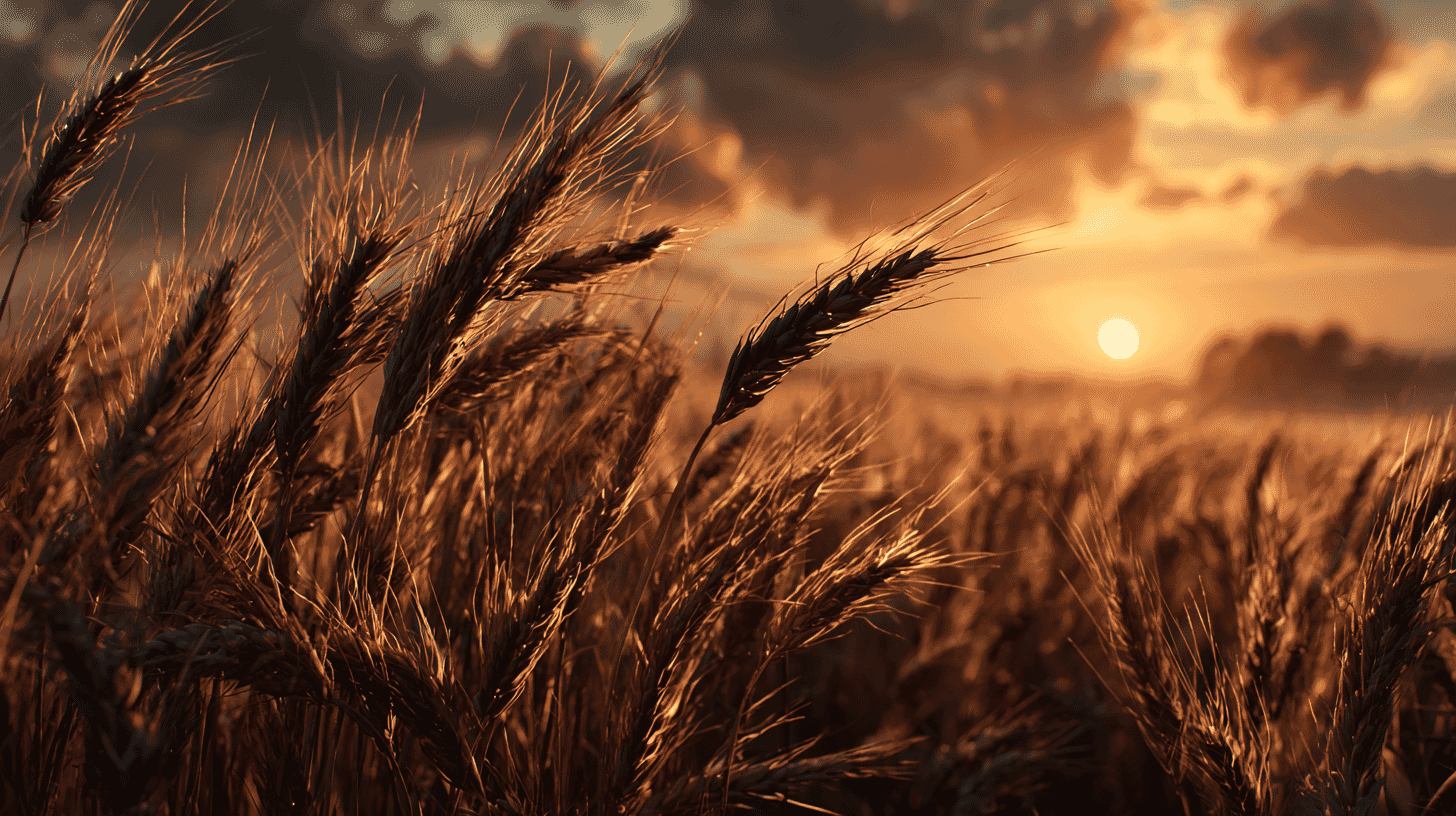
Bread, udon, ramen, okonomiyaki, pizza, cake, cookies, 85% of the wheat that fuels Japan's food culture is imported, and roughly 40% of it comes from a single country: the United States.
To protect this "85% import lifeline," Japan's Ministry of Agriculture and U.S. Wheat Associates signed a Memorandum of Cooperation (MOC) in October 2025. On April 22, 2026, they held their very first meeting under that framework.
In an era when food security has become geopolitics itself, Ukraine war, Strait of Hormuz crisis, North American droughts, this is a frontline report on US-Japan food diplomacy.
A "Wheat Summit" in Tokyo, April 22
On Wednesday, April 22, 2026, from 9:00 to 11:00 AM, Japan's Ministry of Agriculture, Forestry and Fisheries (MAFF) hosted the first meeting under the "Memorandum of Cooperation on Stabilizing US Wheat Supply to Japan."
Attendees from the US side included Mr. Pelman, Chairman of U.S. Wheat Associates (USWA), and Mr. Spier, USWA President & CEO. From the Japanese side: Mr. Yamaguchi, Director-General of MAFF's Crop Production Bureau, and Mr. Yamaguchi, Director of the Crop Production Policy Department. The Flour Millers Association of Japan and the National Federation of Flour Mill Cooperatives also attended as related organizations.
The agenda was simple: Japan shared its current wheat demand outlook, and the US side reported on crop conditions and logistics. Both sides agreed to keep holding these meetings regularly, alternating between countries.
The press release on MAFF's website was a brief, dry document of about 400 Japanese characters. But behind that quiet announcement lies the structural fragility of Japan's food security, and the heavy weight of the diplomacy required to compensate for it.
Why a Bag of Flour Becomes a Diplomatic Issue
Why does wheat warrant a government-level memorandum? The answer lies in Japan's wheat self-sufficiency rate.
Japan produces only about 15–16% of the wheat it consumes. That means 85% must be imported. For a crop legally designated as a "major food" under Japan's Basic Act on Food, Agriculture and Rural Areas, this is an extraordinarily low ratio. Compare it to rice, where Japan is essentially 100% self-sufficient, and the vulnerability becomes clear.
And imports are concentrated in just three countries:
- United States: ~40–44%
- Canada: ~38%
- Australia: ~18–20%
These three countries account for nearly 100% of Japan's wheat imports. Furthermore, Japan's imported wheat is narrowed down to just five varieties, three from the US (Western White, Hard Red Winter, Dark Northern Spring), one from Canada (Western Red Spring 1CW), and one from Australia (Standard White). It's a fixed, narrow procurement structure.
You could call this "over-dependence on three countries." Or you could call it "a custom-tailored procurement system built specifically for Japanese palates over 70 years." Both are true.
What this MOC does is formalize, at the government level, the pipeline with the largest of those three suppliers.
Why an MOC, and Why Now: Three Crises
Three major risks have converged in recent years to push this MOC into existence.
① Ukraine War Exposed the "Geopolitics of Grain"
Russia's February 2022 invasion of Ukraine upended the global wheat market. The two countries together accounted for roughly 30% of global wheat exports. Prices spiked to a record $523.7/ton in March 2022, and Japan's government wheat sale prices surged accordingly, triggering wave after wave of bread and noodle price hikes.
The illusion that "food is unrelated to politics" was completely shattered.
② Climate Volatility in Major Production Regions
Extreme weather is hitting all three of Japan's main suppliers. In March 2026, freezing temperatures and dry conditions in the US Plains threatened winter wheat, and Chicago wheat futures hit a 9-month high of $6.14/bushel. In Australia, farmers are reducing planted acreage due to fertilizer cost uncertainty.
"None of the big three is safe" is becoming the new normal.
③ Hormuz Strait Crisis Hit Logistics Costs
The 2026 conflict between the US/Israel and Iran disrupted shipping through the Strait of Hormuz. This affected oil, fuel, and, critically, fertilizer exports. Higher input costs for American farmers are quietly translating into higher bread prices for Japanese consumers.
A war in the Middle East raises the cost of a loaf of bread in Tokyo. The chain is invisible but real.
These cascading risks convinced both governments that ad-hoc, company-level dialogue was no longer sufficient. A formal framework was needed. That framework is the MOC.
What the MOC Actually Does
Signed on October 2, 2025, the MOC is non-legally-binding but defines three concrete pillars of cooperation.
① A formal dialogue framework
What used to be ad-hoc conversations between MAFF, flour millers, and USWA is now a joint, official framework with all parties at the table. At least one meeting per year, alternating between countries. The April 22 meeting was the first.
② Cooperation when problems arise
When transport delays, safety issues, or quality problems occur (or threaten to occur), the US side will provide rapid information sharing and recovery responses, while Japan will communicate any changes in procurement specifications. This pillar reflects lessons from the December 2025 incident in which trace amounts of soybean were found in US wheat shipments to Japan, a serious issue because soybeans are a major allergen in Japan.
③ Co-development of varieties suited to Japan
Joint research and development of wheat varieties optimized for the Japanese market. American wheat is largely a commodity product, but Japanese baking, udon, and confectionery applications demand specific quality attributes. Variety-level cooperation is essential.
A 70-Year Relationship: Modern Frictions
The USWA-Japan partnership stretches back nearly 70 years to the post-WWII reconstruction era. Japan's top four flour milling companies, Nisshin Seifun, NIPPN, Showa Sangyo, and Masuda Flour Milling, account for over 80% of domestic flour sales, and most of their raw material is American wheat.
Symbolically, in July 2025, USWA's newly appointed CEO Mike Spier and Chairman Jim Pellman made their first overseas mission to Japan. They visited the top four millers, the largest baking company, and the Seifun Museum (the historic original site of Nisshin Milling). At MAFF, they expressed gratitude for "nearly 70 years of successful cooperation."
But December 2025 brought modern friction: the soybean admixture issue. A delegation from MAFF and the Japan Flour Millers Association visited the US West Coast to discuss reducing trace soybean contamination. Brittany Hurst Marchant, Executive Director of the Idaho Wheat Commission, noted that the Japanese delegation's choice to come directly rather than shift to competitor origins demonstrated the strength of the relationship.
In other words, even a long-standing partnership is now feeling the strain of climate, geopolitics, and quality management. Tacit understanding alone is no longer enough, an explicit framework is required.
The Bigger Picture: Japan's Food Security
This MOC is one piece of a much larger problem. Japan's overall food self-sufficiency on a calorie basis is just 38%, the lowest in the G7. Compare:
- Canada: 258%
- France: 129%
- United States: 127%
- Germany: ~95%
- United Kingdom: 72%
- Japan: 38%
Japan is an outlier.
And it gets worse. Beyond direct food imports, Japan's "input dependency" is severe:
- Phosphorus and potassium fertilizer raw materials: nearly 100% imported
- Nitrogen self-sufficiency: just 4–5%
- Main suppliers: China, Morocco
This means even rice, nominally 99% self-sufficient, cannot maintain current yields without imported fertilizer inputs. It's a strange paradox: "domestic food, imported fertilizer."
In this context, ensuring stable wheat supply becomes a baseline requirement for protecting Japanese kitchens. The MOC institutionalizes that baseline.
Domestic Wheat: The Fight Back
Japan isn't standing still. Hokkaido has led development of bread-quality domestic varieties like "Yumechikara" and "Haruyokoi," breaking the old assumption that "domestic wheat = udon only." Production reached 1.1 million tons in 2021 and 2023.
Yet self-sufficiency remains around 15%, and domestic wheat's share of Japanese bread is only about 8%. Closing the gap with imports on cost and quality will take time. Under the revised Basic Act and food security strategy, domestic production is set to expand, but escaping import dependence is a long-term project.
Prices Just Reversed Higher: But That's Beside the Point
Government wheat sale prices had been trending downward for some time. The October 2025 price was set at ¥61,010/ton (~$385), a 4.0% reduction and the fifth consecutive decrease. But the April 2026 period reversed course, rising 2.5% to ¥62,520/ton (~$393) and ending the run of cuts.
But this is a story about short-term supply and demand, not about long-term structural stability. The MOC isn't aimed at price levels. It's aimed at ensuring that wheat keeps reaching Japan no matter what happens.
Conclusion: Quiet Diplomacy Is the Real Food Security
The April 22 meeting produced no flashy announcements, no media frenzy. But this kind of "boring annual dialogue" is what food security actually looks like.
Don't wait for a crisis to make the call. Maintain the relationship in peacetime. Share situations. Detect early warning signs. It's unglamorous, but it's the only way to protect a staple food that's 85% imported.
The next MOC meeting will be held in the United States. The location hasn't been announced, likely USWA headquarters in Washington, D.C., or one of the major production states. A year from now, what issues will the two delegations bring to the table? It's worth watching.
Where does YOUR country import wheat from?
Some countries, like Japan, rely heavily on three suppliers. North African and Middle Eastern countries have historically depended on Russia and Ukraine. European countries are largely self-sufficient within the EU. Wheat procurement geography varies enormously around the world.
Where does the wheat in your bread and noodles come from? How is your country debating food security amid climate change and geopolitical risk? Let us know in the comments.
References
- https://www.maff.go.jp/j/press/nousan/boeki/260422.html
- https://www.maff.go.jp/j/press/nousan/boeki/251002.html
- https://www.maff.go.jp/j/press/nousan/boeki/250910.html
- https://www.seifun.or.jp/pages/99/
- https://uswheat.org/wheatletter/u-s-wheat-farmers-japanese-millers-reaffirm-long-lasting-relationships-during-reciprocal-trade-missions/
- https://capitalpress.com/2025/12/23/u-s-wheat-leaders-japan-officials-address-soybean-admixture-concerns/
- https://www.feedandgrain.com/grain-supply-chain/grain-trade-export/news/15774589/us-and-japan-strengthen-wheat-trade-ties-amid-quality-concerns
- https://cstation.kodansha.co.jp/sdgs/article/7436
- https://www.importjapan.info/food/wheat/overview_wheat.html
- https://kokocara.pal-system.co.jp/2024/03/18/komugi/



Global Discussion
14 comments