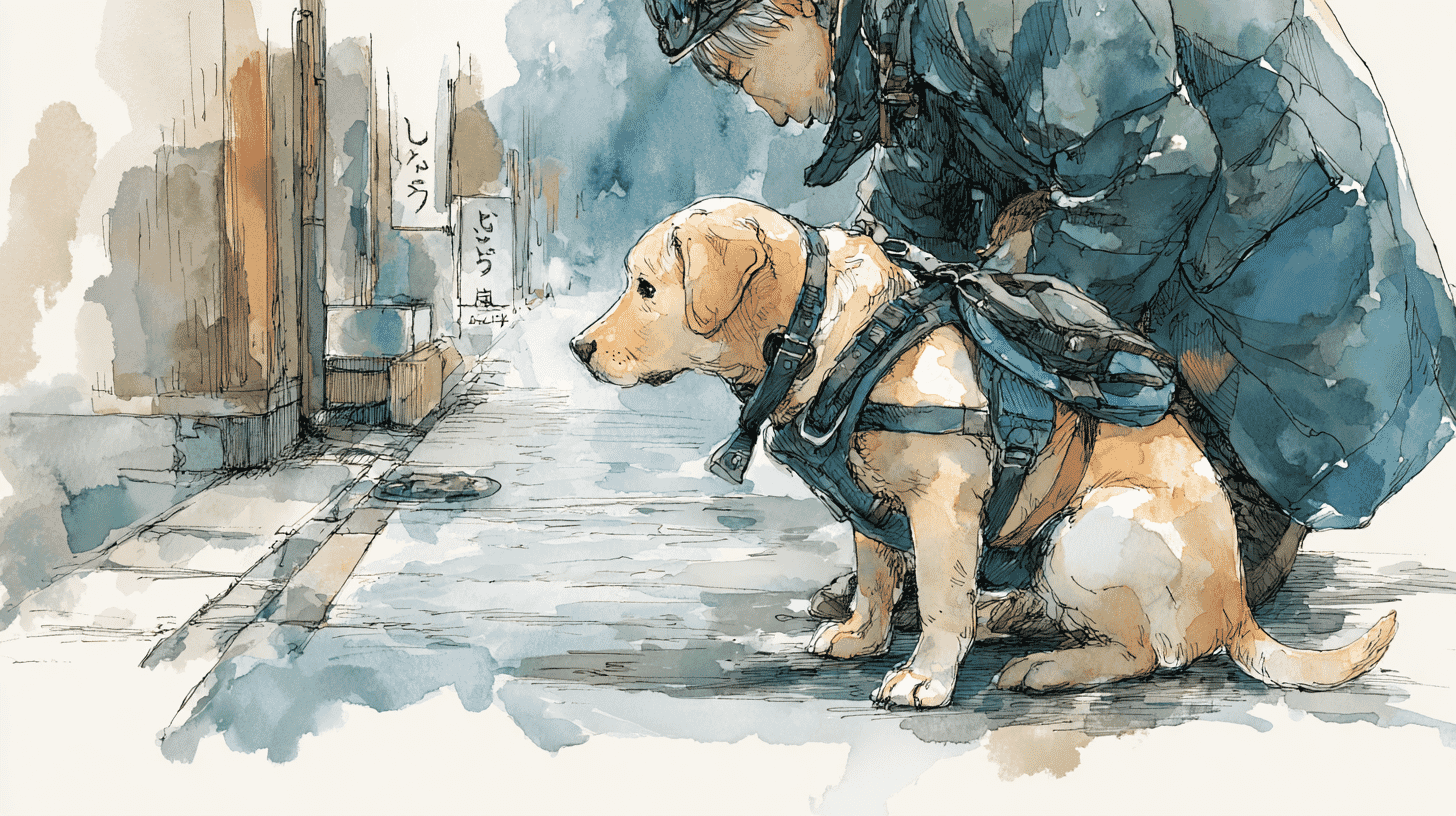
"Just approaching a guide dog can put a visually impaired person's life at risk." A fall accident on a quiet street in western Japan has sparked national debate. An off-leash small dog approached a working guide dog, causing the visually impaired handler to fall. Now she is suing for about ¥1.7 million ($10,650) in damages. Japan has only 768 working guide dogs, while an estimated 3,000 visually impaired people are still waiting for one. Yet many dog lovers, often the most well-meaning people, unknowingly break the rules of how to behave around them. A 2018 survey by the Eye Mate Association found 70.6% of guide dog users wished bystanders would simply not touch their dogs. Here's a comprehensive guide to what you must never do, what the lawsuit reveals, and how this compares to other countries.
What happened in Ehime, the danger of "letting your pet say hi"
According to court documents, in June 2023, a woman in her 50s with a visual impairment was walking home with her Labrador retriever guide dog in the city of Imabari, Ehime Prefecture. An off-leash Chihuahua approached. The guide dog stopped abruptly. The woman lost her balance and fell, suffering bruises and sprains to her hips, hands, and feet.
In May 2024, she sued the Chihuahua's owner for approximately ¥1.7 million ($10,650) in damages, including medical fees and emotional distress.
The defendant admitted to walking the dog without a leash but countered that "my dog only tried to sniff the guide dog, and came back when I called." The defendant also claimed the woman simply sat down and was never injured. Court-mediated settlement attempts at the Imabari branch of the Matsuyama District Court failed. The case now centers on negligence and causation.
In an interview with the Yomiuri Shimbun, the plaintiff stated: "If you fall on a public road, there's a risk of being hit by a car. It's a matter of life and death." She added, "I want people to understand how dangerous it is to interfere with a guide dog while it's working."
The point: This is not "two dogs greeting each other." It's interference with a visually impaired person's mobility, and potentially with their life. A working guide dog focuses entirely on the safety of its handler.
How many guide dogs are there in Japan?
According to Japan's Ministry of Health, Labour and Welfare, 768 guide dogs were active across Japan as of October 2025. Meanwhile, Japan has more than 300,000 visually impaired residents, with an estimated 3,000 of them on waiting lists for a guide dog.
In other words, only about one in four hopeful applicants has a working partner.
One reason is cost. Raising one guide dog requires ¥5–6 million (roughly $31,400–$37,650), and most of that comes from donations. The number of working guide dogs in Japan has been declining since peaking in 2009: 928 in 2019, 796 in 2024, and now 768 in 2025.
Per million people, Japan's guide dog penetration is far below that of the UK, the US, France, and other Western countries. Every single working dog you see on a Japanese street is a precious resource.
7 things you must never do
Here's what major guide dog organizations in Japan, the Japan Guide Dog Association, Hyogo Guide Dog Association, and Eye Mate Association, consistently ask the public to avoid.
1. Do not touch or pet (70.6% of users wish you wouldn't)
In a 2018 survey by the Eye Mate Association, the top request from guide dog users was simple: "Please don't touch the guide dog", 70.6% of respondents.
When the harness (the U-shaped handle on the dog's body) is on, the dog is working. Petting breaks its concentration. The handler may miss a step, miss a curb, or in the worst case, walk into traffic.
2. Do not call out, talk to, or whistle at the dog (67.2% wish you wouldn't)
"What a good boy!" or whistling, even with the best intentions, pulls the dog's attention away. In the same Eye Mate survey, 67.2% asked people not to talk to the dog.
If you want to say something kind, say it to the handler, not the dog.
3. Do not stare
Guide dogs are extremely friendly by nature. A stare gets noticed. The dog may start wagging its tail, trying to make eye contact, or looking around. Some users report their dog will keep wagging its tail at someone watching from across a train car.
4. Do not offer or even show food
Guide dogs are trained not to eat outside. There are two reasons: avoiding distraction, and managing toilet schedules. Handlers carefully control feeding and water timing to prevent the dog from needing to relieve itself during work. An unexpected snack can cause an accident in the middle of a journey.
5. Do not photograph or post to social media
Camera shutter sounds and flashes distract the dog. More importantly, posting unauthorized photos online reveals where the user lives and walks, creating real privacy and safety risks. Japanese law does not grant portrait rights to animals, but guide dog organizations strongly advise against photographing working dogs.
6. Do not let your pet approach (the heart of the Ehime case)
This is what the lawsuit is fundamentally about. Even if your dog is on a leash, do not let it approach a guide dog "to say hi." Guide dogs are not pets, and dog-to-dog socialization is interference, not friendliness.
If you're walking your own dog, the kind thing to do is to say out loud: "There's a dog here." That single sentence helps the handler understand what their guide dog is reacting to.
7. Do not suddenly grab the harness, the handler's arm, or the handler's shoulder
Even with the best intentions, tapping a stranger on the back, or grabbing their arm to "help them," is startling and disorienting. Always speak first. Wait for a response. Then ask permission.
What you can do to help
The default is simple: watch quietly, do nothing. But there are situations where speaking up genuinely helps.
- At a crossing without an audio signal, where the user seems unsure: speak the light. "It's red." "It just turned green."
- When someone seems lost or hesitant: ask, "Do you need any help?"
- In crowded stations or bus stops: gently offer to describe the situation.
If you guide them, the standard method is "sighted guide", stand half a step ahead on their free side and let them hold your elbow or shoulder. Narrate what's coming: "We're turning right." "There's a step here."
And one detail people often forget: say goodbye when you leave. A simple "I'll head off here" matters. Without sight, it's impossible to tell when a helper has walked away.
Guide dogs cannot read traffic lights
A surprising fact: guide dogs cannot reliably distinguish red from green traffic lights. (Dogs are red-green colorblind.)
So how do users cross? They listen. Audio signals, traffic flow, the sound of cars stopping, these are the cues. The user makes the decision and gives the dog the "forward" command.
This means at a quiet intersection without audio signals, just having a fellow pedestrian quietly say "It's red" or "It's green now" can be enormously helpful.
Access denial is still common, 48% of users have been refused entry
According to a 2025 nationwide survey by the All-Japan Guide Dog Association Federation, 48% of guide dog users have been denied entry to a facility at some point. The most common reasons given were "no animals/dogs allowed" (61.6%) and "concerns about other customers with allergies or fear of dogs" (46.1%).
But this is generally illegal. Japan's Service Dog Act of 2002 (Act on Assistance Dogs for Physically Disabled Persons) requires public-facing facilities to admit assistance dogs except in narrow exceptions. Since April 2024, an amendment to the Disability Discrimination Resolution Act has made "reasonable accommodation" by private businesses a legal obligation, not just an aspiration.
There are no penalties under the Service Dog Act, but the Federation's follow-up survey found that 77% of users felt no positive change one year after the amendment took effect. The law is on paper. It hasn't fully reached the front lines.
How this compares internationally, "Harness on, hands off"
The "don't disturb a working dog" rule is universal, though enforcement varies.
- United States: The Americans with Disabilities Act (ADA) guarantees service dog access. The standard etiquette: "Don't pet, talk to, or feed a working dog."
- Canada (CNIB): The campaign slogan is direct, "Harness on means hands off."
- United Kingdom: Guide Dogs UK runs ongoing public education on not distracting working dogs.
- Germany, France: Public access for service dogs is protected by law.
Rules look similar across countries, but actual public awareness, and access denial rates, differ widely. Japan's 48% denial rate is high by any international standard.
The bottom line, "watching" is the best help
Encountering a guide dog requires no special skill. Quietly watching and doing nothing is, paradoxically, the most considerate action possible.
If the handler appears to need help, address the person, not the dog: "Do you need any help?" That single sentence, multiplied across millions of small interactions, reshapes the world for Japan's 768 guide dogs and the thousands more people waiting for one.
The Ehime court has not yet ruled, but the plaintiff's message, that distracting a working guide dog is genuinely dangerous, deserves to be heard regardless of the verdict.
How is it in your country? When people see a guide dog or service dog in public, do they know not to pet it? Are access denials common where you live? Let us know in the comments.
References
- https://news.yahoo.co.jp/articles/8a5b454f7e993d88e5c0d85bf4a2d0248a45259a
- https://www.moudouken.org/about-guide-dog/guide-dog-street/
- https://www.moudouken.net/knowledge/howtohelp/
- https://www.gd-rengokai.jp/custom_contents/cms_rwd/linkfile/zenkokuchosa2025.pdf
- https://www.gov-online.go.jp/article/201002/entry-9103.html
- https://www.cnib.ca/en/guide-dog-etiquette





Global Discussion
14 comments