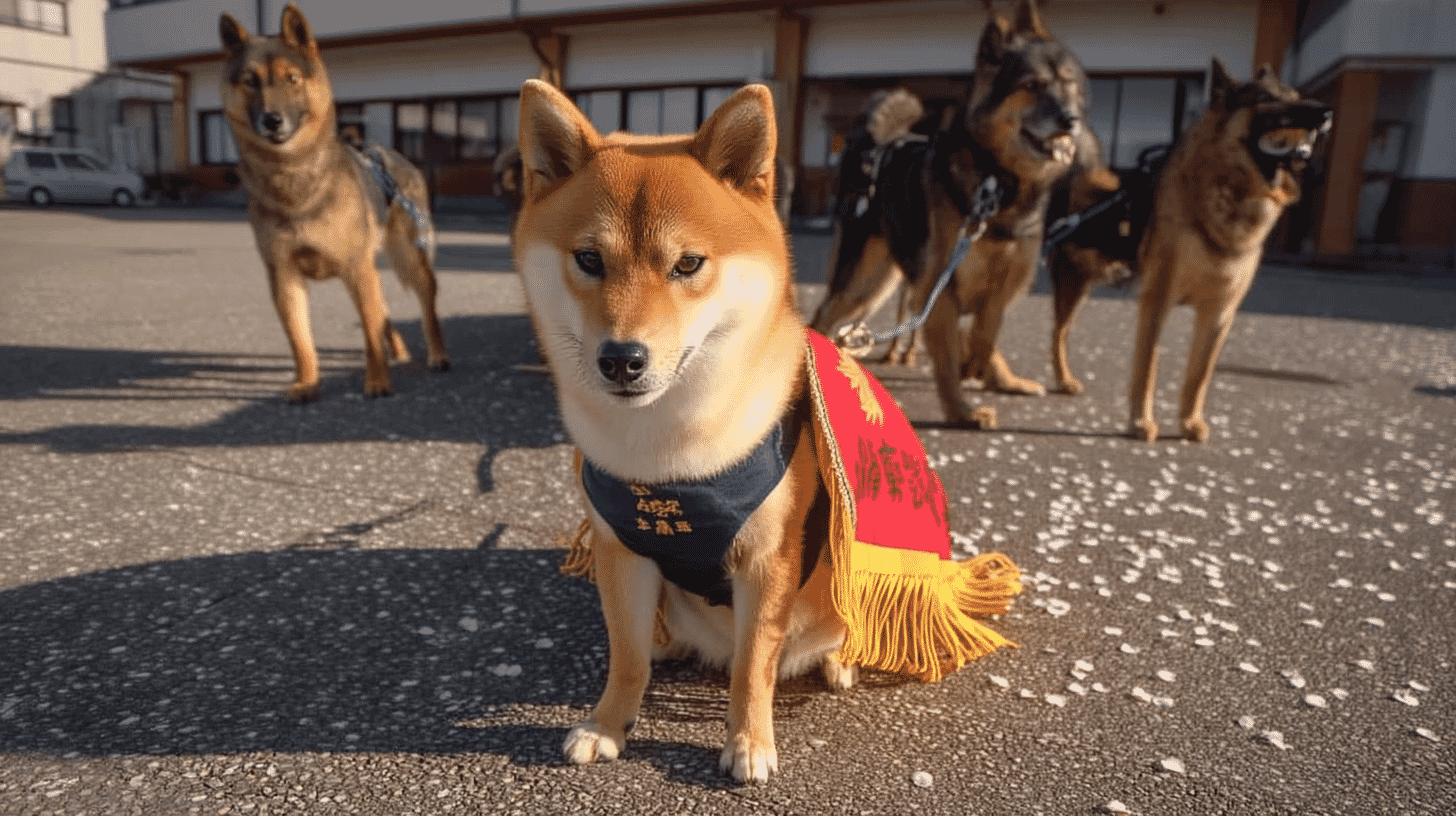
At a police dog commissioning ceremony in rural Japan, a tiny figure stood among towering German Shepherds, wearing an oversized gown and looking undeniably proud. Meet Tsubu, a two-year-old female Shiba Inu who just became Gifu Prefecture's first-ever Shiba police dog. Her handler says she's proved that "any dog can make it," and the internet can't get enough of her.
A Small Dog, A Big Milestone
On April 6, 2026, the Ibi Police Station in Gifu Prefecture held its annual commissioning ceremony for police dogs. A record 15 dogs received their official appointments that day, 11 German Shepherds, 3 Labrador Retrievers, and one Shiba Inu named Tsubu.
Tsubu's formal name is Suzuhime, but everyone calls her Tsubu (which roughly translates to "little grain" in Japanese). Her handler, 26-year-old Aki Tokoro, first noticed Tsubu's exceptional energy and focus during dog run sessions at the Hashima Police Dog Training Center in Ono Town. Sensing potential, Tokoro began training her for police work.
In November 2025, Tsubu took the contracted police dog examination, a rigorous field test measuring scent detection ability, concentration, and coordination with her handler. She had to locate hidden evidence items using nothing but her nose. She passed with flying colors.
"Shiba Inu are an agile and exceptional breed," said Ibi Station Chief Takanori Morikami. "I'm expecting great things."
After the ceremony, a reporter tried asking Tsubu about her feelings on the new job. She yawned. But when Tokoro called out "Let's do our best!" Tsubu locked eyes with her handler and barked a firm "Woof!", clearly ready for duty.
How Police Dogs Work in Japan
Japan's police dog system has two categories. "Directly managed dogs" (chokatsu-ken) are owned and housed by the police. "Contracted police dogs" (shokutaku keisatsu-ken) live with civilian handlers and report for duty when called. Remarkably, about 90% of Japan's police dogs are contracted civilian dogs, meaning most K-9 officers go home to regular families after their shifts.
Their primary missions are searching for missing persons and tracking criminal suspects. Dogs' sense of smell is estimated to be thousands to tens of thousands of times more sensitive than humans', allowing them to follow trails invisible to any person.
Traditionally, seven breeds are considered suitable for police work in Japan: German Shepherd, Doberman, Airedale Terrier, Boxer, Collie, Golden Retriever, and Labrador Retriever. However, Gifu Prefecture's police force does not restrict breeds, instead prioritizing ability over pedigree, a policy that opened the door for Tsubu.
Why Small Police Dogs Are Gaining Ground
Tsubu's appointment isn't just a feel-good story. Small-breed police dogs offer practical advantages that large dogs simply can't match.
Seitaro Naka, a civilian police dog trainer at the Iga Daiichi Dog School in Mie Prefecture, highlights several key benefits.
Discretion matters. When a large German Shepherd arrives at a scene, everyone knows a police search is underway. A small dog can work far more inconspicuously, which is important for privacy-sensitive operations and keeping investigations under the radar.
Access to tight spaces. Small dogs can squeeze into narrow alleys, crawl under buildings, and navigate rubble that would block a larger dog. For search-and-rescue or evidence recovery, this can be the difference between finding something and missing it entirely.
Lower costs. Maintaining a German Shepherd for police work costs roughly 70,000–80,000 yen per month (about $440–$500) for food and training combined. Small breeds run about 50,000–60,000 yen ($315–$375), a meaningful difference for volunteer handlers who cover expenses themselves.
Tsubu isn't alone in this trend. At Gifu Kita Police Station, a Miniature Schnauzer named Tetra (male, age 5) became Gifu's first small-breed contracted police dog three years ago and was just reappointed this year. Nationwide, Chihuahuas and Miniature Dachshunds serve as police dogs, and in Saitama Prefecture, a Toy Poodle once successfully located a missing elderly person, proving that nose power trumps body size.
The Shiba Inu: From Hunter to Internet Icon
To the global internet, Shibas are the goofy, stubborn stars of countless memes. But long before any Shiba went viral, the breed was developed as a hunting dog in Japan's mountainous terrain. The word "shiba" literally means "brushwood", referring to the low bushes these dogs would dart through to flush out game for hunters.
Shibas possess sharp noses, quick reflexes, independent decision-making ability, and intense focus when locked onto a target. These are exactly the traits police work demands. On the flip side, Shiba owners know all too well about "kyohi-shiba" (refusal Shiba), the breed's legendary stubbornness, particularly their habit of planting all four paws and refusing to budge mid-walk. This trademark defiance has itself become social media gold, with millions of views on videos of Shibas staging impromptu sit-in protests on sidewalks.
Physically, Shibas weigh about 17–22 pounds (8–10 kg) and stand 14–16 inches (35–41 cm) tall. They're the smallest of Japan's native dog breeds, but their compact, muscular build packs surprising endurance and athleticism.
Japan's Native Dog Breeds
Japan is home to six native dog breeds, all designated as natural monuments by the Japanese government.
The Akita Inu is the most internationally famous, largely thanks to Hachiko, the loyal dog who waited at Shibuya Station for his deceased owner for nearly 10 years. Akitas are large dogs (65–110 lbs / 30–50 kg) originally bred for bear hunting. Celebrity fans include Richard Gere, who starred in a Hollywood adaptation of Hachiko's story.
The Kai Ken comes from Yamanashi Prefecture and sports a distinctive brindle coat called "tora-ge" (tiger fur). Known for the saying "ichidai isshu", one lifetime, one master, Kai Ken are fiercely loyal to a single owner.
The Kishu Ken from Wakayama and Mie Prefectures is a medium-sized breed with a striking white coat, historically used for wild boar hunting.
The Shikoku Ken from Kochi Prefecture has a wolf-like appearance and retains some of the most primitive traits among Japanese breeds. They're rugged, independent, and not for novice dog owners.
The Hokkaido Ken gained nationwide fame in Japan as the "Otou-san dog" (Dad dog) from SoftBank's long-running TV commercials. Originally bred by the indigenous Ainu people, Hokkaido Ken are built for harsh northern climates and are bold enough to confront brown bears.
Where to Meet Shiba Inu in Japan
Visiting Japan and want to hang out with Shibas? Several spots across the country let you do exactly that.
Harajuku Mame-Shiba Café (Tokyo), Located on Takeshita Street, this was Tokyo's first mame-shiba (miniature Shiba) specialty café. The retro-styled interior and friendly pups have made it hugely popular with both Japanese visitors and international tourists. Admission is about $5.70 (900 yen) for adults, drink included. A second location operates in Asakusa near Senso-ji Temple.
Azuki-Shiba no Sato (Akihabara, Tokyo), Here you can meet the world's smallest Shiba variety, the "azuki-shiba," along with mame-shiba. It's in the heart of Akihabara's electronics district, making it an easy add-on to an otaku pilgrimage.
One Room (Ota Ward, Tokyo), A fully private, reservation-only experience where one group at a time gets 50 minutes with a mame-shiba. Activities include walks, feeding, brushing teeth, and basic training, designed to simulate what it's like to actually live with a Shiba. Starting at about $50 (8,000 yen) on weekdays.
Regional options include mame-shiba cafés in Kyoto's Arashiyama district and Osaka's Dotonbori (which also features a calico cat café next door), plus Yufuin in Oita Prefecture on the island of Kyushu.
The Doge Connection
No article about Shibas would be complete without mentioning the meme that launched a thousand cryptocurrencies. The "Doge" meme, which exploded around 2013, featured a photo of a Shiba named Kabosu, owned by Japanese kindergarten teacher Atsuko Sato. Kabosu's quizzical expression, paired with broken-English captions like "such wow" and "much amaze," became one of the most recognizable memes in internet history.
Kabosu passed away in May 2024 at the age of 18. In her honor, an official Doge-themed manhole cover was installed in her hometown of Sakura City, Chiba Prefecture. The Dogecoin cryptocurrency, frequently promoted by Elon Musk, also uses a Shiba as its logo, cementing the breed's place in digital culture.
Against this backdrop, Tsubu's story adds a new dimension: the breed famous for looking adorably clueless is, in fact, a capable working dog with centuries of hunting heritage. The meme face meets real-world competence.
A New Era for Police Dogs
Tsubu's appointment symbolizes a broader shift in Japan's approach to police dogs, one that values ability over appearance and embraces the unique strengths that different breeds bring to the table. From Toy Poodles finding missing seniors to Miniature Schnauzers tracking suspects, Japan's K-9 units are proving that the right nose matters more than the right size.
In Japan, unconventional dog breeds are increasingly stepping into working roles. What about in your country, do any surprising breeds serve as police dogs, search-and-rescue dogs, or therapy dogs? We'd love to hear your stories.



Global Discussion
13 comments