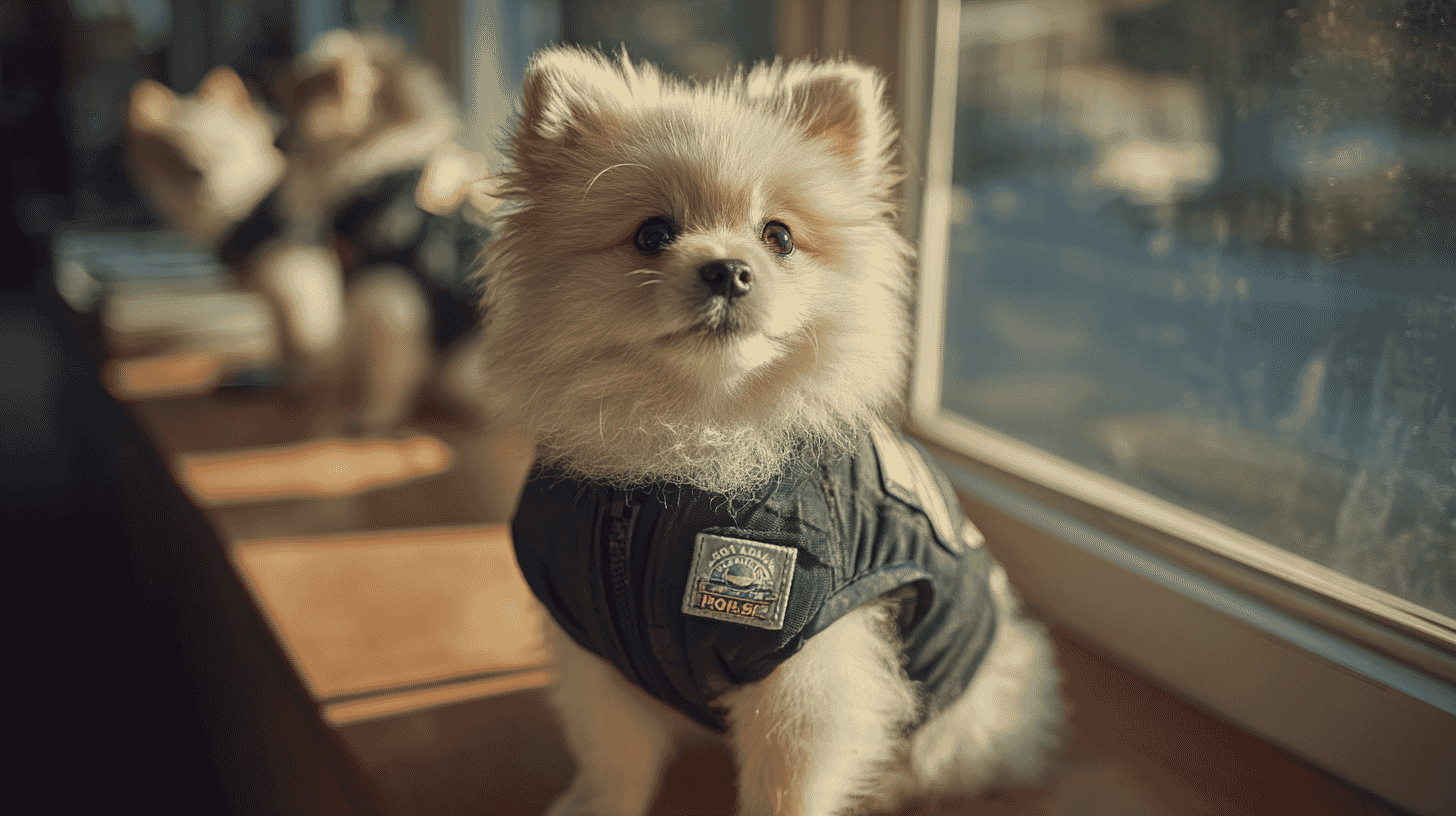
We recently told you about Tsubu, the Shiba Inu who became Gifu Prefecture's first Shiba police dog, but apparently Pomeranians refuse to be outdone. Imagine a ceremony hall lined with 51 police dog candidates: German Shepherds, Golden Retrievers, powerful muscular breeds all waiting for their test. And right there among them, a 3-kilogram (6.6 lb) fluffy white ball of fur. Meet Haku, the 2-year-old Pomeranian who just became Miyazaki Prefecture's first-ever Pomeranian police dog. Surrendered by his original owner and passed from a pet shop to a training kennel, Haku aced his exam in his first year, something even veteran trainers call rare. First a Shiba, now a Pom. The internet is melting. And honestly, so are we.
One Tiny Fluffball, One Official Badge
On April 13, 2026, Japan's Hinata Police Station in Miyazaki Prefecture held its annual commissioning ceremony for contracted police dogs. Among the new recruits was a 2-year-old Pomeranian named Haku, weighing just a few kilograms but packing serious skills. It's the first time a Pomeranian has been appointed as a police dog in Miyazaki.
The qualifying exam was held in December 2025. A staggering 51 dogs, German Shepherds, Golden Retrievers, and other "classic" police breeds, competed in disciplines like scent trails, odor discrimination, and area searches. Thirty-eight dogs passed. Haku qualified in the "scent trail" category: following a route that an escaped-suspect stand-in had walked, then locating dropped evidence by smell alone.
The station's deputy chief gave Haku a firm vote of confidence: "He passed the exam, so there's no issue. We're absolutely counting on him." There's a practical upside too, when large dogs are deployed in residential areas, they can intimidate locals and signal that an investigation is underway. A small, adorable Pomeranian? Nobody feels threatened. "We'll deploy the right dog for the right situation," the deputy chief explained.
"Passing in Year One Is Extremely Rare"
Haku lives not at the police station but at Ito Police and Pet Dog Training Kennel, about 5 kilometers (3 miles) away. His handler is Hikaru Takekoshi, 50, the kennel's director and a certified police dog instructor.
Haku's backstory is part of why this resonates so strongly in Japan. "He was originally born in a pet shop," Takekoshi explains. "He was adopted by a private family, but due to certain circumstances they couldn't keep him. That's how he came to us."
Adopted from a family that had to let him go, Haku could have easily remained just another small companion dog. But Takekoshi noticed something special during early training. "He has real grit, focus, and the ability to sustain that focus. I thought he had what it takes to be a police dog."
So she entered him in the qualifying exam in his very first year of training, an almost unheard-of timeline. "Dogs that pass on their first attempt in year one are really rare," she says.
On exam day, Haku surprised everyone. One of the sub-tests is "obedience under pause", stay in a resting position for five full minutes. During practice, Haku often got distracted and broke position. But on the big day?
"While other dogs were breaking their stays, Haku held his position for the full five minutes. Examiners were walking around him and he didn't budge. It was incredible focus. This is a dog who shows up when it matters."
From fluffball to disciplined professional in five minutes flat. Not bad, Haku. Not bad at all.
Off Duty: Maximum Chaos, Maximum Cute
At his commissioning ceremony, Haku looked every bit the serious officer. Back at the kennel, though? Different story.
"He's a total wild child!" Takekoshi laughs. "He has energy, stamina, and endurance that rival the big dogs. But he's also incredibly smart, obedient, adaptable. It really drives home that it's not about breed or age. It's about the individual dog."
Her favorite stories involve Haku's kennel friendships. When Purin-chan, another Pomeranian being fostered short-term, arrives at the kennel, Haku sprints to greet her at ridiculous speed. He also regularly plays with Chikuwa-kun, a toy poodle buddy. And yes, he gets along with the big dogs too.
During our interview, around 11:30 AM, Takekoshi reported on Haku's current status: "He played hard all morning, ate his meal, and now he's taking a nap." Training sessions happen in the afternoon, usually just 5 to 30 minutes of focused work. "Longer isn't better. Short bursts of intense focus work best for him." The life of a professional, balanced properly.
Japan's Quiet Small-Breed Police Dog Revolution
Haku's appointment isn't a one-off. Over the past decade, Japan has quietly become a global leader in deploying small-breed police dogs.
The Japan Police Dog Association officially recognizes seven breeds: German Shepherd, Doberman, Labrador Retriever, Golden Retriever, Collie, Boxer, and Airedale Terrier. These are the "classic" K-9 breeds you'd expect to see in any country. But many Japanese prefectures have dropped breed restrictions for contracted (hybrid-status) police dogs in order to "secure the most capable working dogs available."
This opened doors that would have stayed closed elsewhere. Momo-chan, a 3-kilogram Chihuahua in Nara Prefecture, became internationally famous in 2010 as possibly the smallest police dog ever. And as we mentioned at the top, in April 2026, a Shiba Inu named Tsubu became Gifu Prefecture's first Shiba police dog. Now Haku joins the club as Miyazaki's first Pomeranian. First a Shiba, then a Pom, 2026 is shaping up to be the year of the small-breed K-9.
Why are small dogs increasingly appealing for police work? A few practical reasons:
- Privacy during searches. Large dogs signal "investigation happening here" to the whole neighborhood. Small dogs are discreet.
- Mobility. They can squeeze under floors, into wreckage, down narrow alleys.
- Low intimidation. In tourist areas, shopping streets, and residential zones, a visible K-9 that doesn't scare people is genuinely useful.
- Cost efficiency. Food, housing, and transport are simply cheaper for a 3 kg dog.
But the real takeaway is Takekoshi's quiet insight: every dog is an individual. Breed and age matter less than temperament and drive.
Why Trainers Do It Despite Tiny Stipends
Here's a detail that often surprises international readers: Japan's contracted police dog handlers receive only a few thousand yen per year in compensation, roughly $5 to $30 per deployment (at about ¥158 to the US dollar). Food, training facilities, and equipment come almost entirely out of the handler's own pocket.
Why do they do it? Because for trainers like Takekoshi, reuniting missing seniors with their families, or helping investigators find a crucial clue, is worth more than any paycheck. Watching a dog nobody wanted transform into a community hero, that's the real reward.
Haku hasn't been deployed to an actual case yet. When and how he'll be used is decided jointly by the crime scene investigation unit and the handler. But somewhere in Miyazaki's near future, a lost grandfather or grandmother will be found by a tiny white fluffball in a proud little vest. And that thought makes us ridiculously happy.
Photos from the ceremony show Haku wearing an oversized police bib, looking up with big dark eyes as if to ask "is this okay?", and somehow, that tiny dog who was once given up by his family is now standing up for his community.
The story is starting to pick up traction internationally. Early posts about Haku on X and Instagram are drawing reactions from disbelieving, and delighted, commenters: "A POMERANIAN?! Not a German Shepherd?! I love Japan." Combined with ongoing overseas coverage of Tsubu the Shiba, there's a real sense that the world is paying fresh attention to Japan's small-breed police dog culture.
Japan is quietly rewriting what a "working dog" can look like. No breed is too small. No background too unconventional. The badge goes to whichever dog earns it.
So tell us, what unexpected working dogs exist in your country? Any tiny heroes doing big jobs? We'd love to hear what's it like where you are.




Global Discussion
14 comments