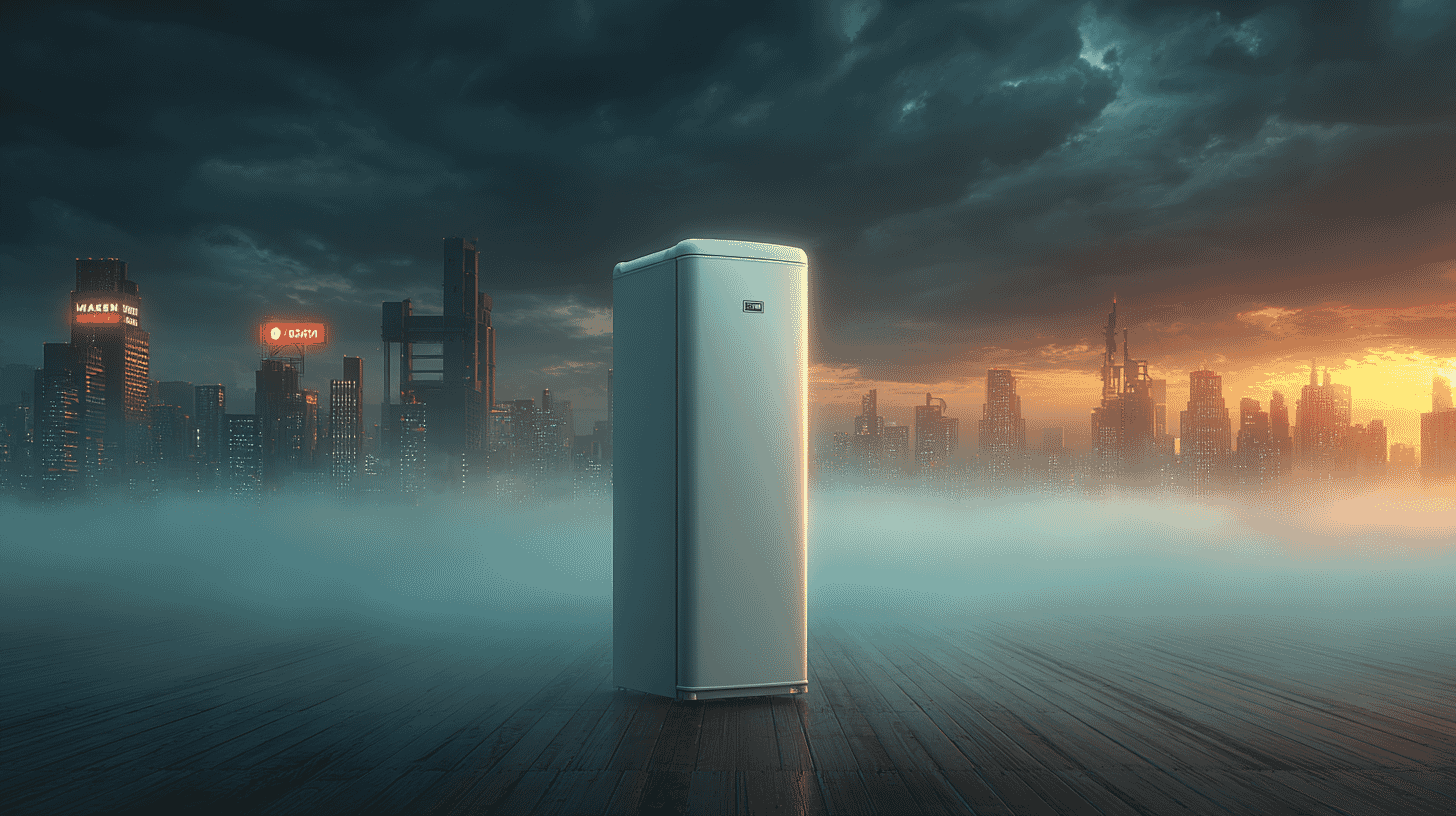
Another iconic Japanese home appliance brand just changed hands. Hitachi (yes, the 115-year-old industrial giant) is selling its refrigerator, washing machine, and vacuum cleaner business to a domestic electronics retailer for 110 billion yen (about $692 million). It's the same playbook GE used with Haier, and Philips used with a Chinese PE firm, just with a Japanese twist this time. Why do the world's legacy electronics giants keep walking away from the products that made their names famous?
What Just Happened: A $692 Million Deal
On April 21, 2026, Nojima Corporation, one of Japan's largest home appliance retail chains, announced that it will acquire the consumer appliance business of Hitachi Global Life Solutions (Hitachi GLS), a wholly owned subsidiary of Hitachi, Ltd. The total deal value is approximately 110 billion yen (~$692 million USD), with completion targeted by March 2027.
The structure follows a well-worn template familiar to anyone who has watched Western industrial conglomerates shed consumer businesses over the past decade. Hitachi GLS will spin off its appliance business into a newly created entity, and Nojima will acquire 80.1% of its shares through a special purpose company. Hitachi keeps the remaining 19.9%. That "80.1%" is not a coincidence, it is the exact same equity split used when Toshiba sold its white goods business to China's Midea back in 2016.
There's also an international dimension. Hitachi's overseas appliance business has been run since 2021 through a joint venture with Turkish appliance giant Arçelik, called Arçelik Hitachi Home Appliances (AHHA). That entity gets folded into the deal too: Nojima's new company will buy out Arçelik's 60% stake in AHHA and combine it with Hitachi's 40%, turning it into a wholly-owned subsidiary. Domestic and overseas appliance operations will sit under one roof for the first time in years.
Hitachi GLS reported revenue of roughly 367.6 billion yen (~$2.31 billion) for the fiscal year ended March 2025. For Nojima, which has grown through acquisitions (mobile reseller ITX in 2015 at ~85 billion yen, Conexio in 2023 at ~85 billion yen, and laptop maker VAIO in January 2025), this is the largest deal in the company's history.
Hitachi's Logic: Completing the Pivot to Digital
Why is Hitachi walking away from a business that has carried its brand into millions of Japanese kitchens and laundry rooms for decades? The short answer: Hitachi is no longer a home-appliance company, and hasn't been for a long time.
In its fiscal year ending March 2009, Hitachi posted a final-loss of approximately 787 billion yen (~$4.95 billion), among the largest losses ever recorded by a Japanese corporation at the time. That shock triggered an aggressive "select and concentrate" strategy that has played out over the fifteen years since:
- 2011: Sold hard-disk subsidiary HGST to Western Digital for about $4.3 billion
- 2012: Ended in-house production of its "Wooo" brand flat-panel TVs
- 2022: Sold 26% of Hitachi Construction Machinery shares to an Itochu-JIP consortium
- February 2026: Itochu raised its stake in Hitachi Construction Machinery to 33.4%, giving it effective veto power
The resources freed up by these divestitures have been poured into Hitachi's industrial, infrastructure, energy, and IT businesses, and especially into Lumada, the company's digital platform that combines operational technology (OT) know-how with IT, AI, and cloud services to optimize industrial operations for enterprise customers.
Hitachi's consolidated revenue for the fiscal year ended March 2025 was roughly 9.78 trillion yen (~$61.5 billion). Against that total, the 367.6 billion yen appliance business represents just about 3.8% of the group. Commoditized, low-margin, buffeted by exchange rates and raw material prices, and locked in a losing price war with Chinese and Korean rivals, it is, in corporate-strategy terms, exactly the kind of business a conglomerate pivoting to "digital industry" wants to offload. This deal is the final piece of that 15-year pivot.
Nojima's Logic: When a Retailer Becomes a Manufacturer
So why does a home appliance retailer want to own a white goods manufacturer? To understand this, you need to understand a structural shift happening inside Japanese electronics retail.
Japan's big-name appliance makers have been narrowing their product lines in recent years, cutting back on low-end "budget" SKUs and doubling down on premium models with high margins. That has left a gap in the market, consumers who want a simple, affordable, single-function appliance right now, and Japanese big-box retailers have been rushing to fill it with private brands:
- Yamada Holdings is developing over 100 SPA (specialty retailer of private label apparel model) items and aims for over 340 billion yen in private-label revenue by fiscal 2030
- Bic Camera consolidated three private brands into "BIC IDEA" in early 2026, targeting 100 billion yen in private-label revenue by August 2030
- Edion has expanded its "e angle" house brand
What Nojima is doing now is leapfrogging the entire private-brand race in one move. Instead of commissioning OEM products, it's buying an entire 100-year-old brand, along with its R&D centers, patents, supply chain, and top-shelf positions in Japan's refrigerator and washing machine rankings. According to Nikkei, the strategy is to step away from thin-margin discount selling and pursue growth through high-value-added products instead.
Combined with Nojima's acquisition of VAIO laptops in January 2025, the resulting group will span PCs, mobile, and white goods, creating a rare Japanese retailer that also makes the things it sells.
This Story Is Not Unique: Meet GE and Philips
If you only follow Japan, the steady exodus of Japanese electronics giants from consumer products can look like a uniquely Japanese failure story. It's not. The same pattern has played out across the developed world, and the two most famous examples are GE and Philips.
GE → Haier (2016, $5.6B)
General Electric, whose home appliance lineage stretches back more than 100 years, sold that business to China's Haier for $5.6 billion in 2016. The reasoning was nearly identical to Hitachi's: GE wanted to become, in the words of then-CEO Jeff Immelt, "the world's leading Digital Industry company," and consumer appliances no longer fit. GE-branded fridges and ranges still fill American kitchens today, but the owner is Chinese.
Philips → Hillhouse (2021, €3.7B)
Dutch giant Royal Philips sold its domestic appliances business (kitchen, coffee, garment care, home care) to Hillhouse Investment, a global private equity firm, for approximately €3.7 billion (~$4.4 billion) in 2021. Philips used the proceeds to double down on its transformation into a pure-play health technology company. The carved-out company rebranded itself Versuni in 2023 and continues to use the Philips brand under a 15-year license.
The common thread across all three cases (GE, Philips, and now Hitachi) is a judgment that commoditized consumer appliances no longer belong inside a conglomerate whose real value creation has shifted to industrial software, healthcare, energy, or AI.
The Long Japanese Retreat From Consumer Electronics
Here's the pattern, laid out as a timeline. It's hard to read this list without concluding that Japan's traditional electronics giants have spent the past 15 years systematically walking away from the products they used to dominate:
| Year | Company | Business | Buyer |
|---|---|---|---|
| 2011 | Hitachi | HDDs (HGST) | Western Digital (US, $4.3B) |
| 2012 | Hitachi | In-house TV production (Wooo) | Shifted to overseas OEM |
| 2016 | Sharp | Entire company | Foxconn (Taiwan) |
| 2016 | Toshiba | White goods (TLSC) | Midea (China, 80.1%, $473M) |
| 2016 | Toshiba | Medical devices | Canon ($5.9B) |
| 2017 | Toshiba | TVs (REGZA) | Hisense (China) |
| 2018 | Toshiba | PCs (dynabook) | Sharp ($36M) |
| 2018 | Pioneer | TVs | TCL (China) |
| 2026 | Sony | TVs (BRAVIA business) | TCL (China) |
| 2026 | Panasonic | TV manufacturing and sales | Skyworth (China) |
| 2026 | Hitachi | White goods | Nojima (Japan, 80.1%, $692M) |
Note the bottom of the list. Within a few months of each other in 2026, three of the most famous names in Japanese electronics (Sony, Panasonic, and Hitachi) have each announced a major retreat from consumer hardware categories they helped invent.
The One Thing That Makes This Deal Different
Scroll back up that table. Every single prior sale on this list (Toshiba to Midea, Sharp to Foxconn, Sony TVs to TCL, Panasonic TVs to Skyworth, Philips appliances to Hillhouse) saw a foreign buyer take control. Chinese manufacturers, Taiwanese EMS giants, global private equity.
Hitachi-to-Nojima is different. Both sides are Japanese. Brands, jobs, engineering centers, and supply chains stay within the country. If you walk into a Japanese electronics store after the deal closes, the Hitachi refrigerator will be sitting right where it always was, with the same logo on the door.
But economic power has shifted in a way that matters: from the company that makes things to the company that sells them. A retailer, armed with decades of point-of-sale data and direct customer feedback, now gets to decide what the engineers at Hitachi's former appliance labs will design next. For Japan's consumer electronics industry, this might just be the new normal.
Does "Japanese Brand" Still Mean Anything Globally?
Here's the question this deal leaves on the table, especially for international readers.
Names like Hitachi, Toshiba, Panasonic, and Sony used to be shorthand for world-class quality in the 1980s and 1990s. Today, many of those same names are:
- Licensed to Chinese manufacturers (Haier, Midea, Hisense, TCL, Skyworth)
- Owned by Taiwanese companies (Foxconn bought Sharp)
- Restructured through private equity (Hillhouse carved out Versuni from Philips)
- And now, being bought by domestic Japanese retailers (Nojima + Hitachi GLS)
The product inside the box is increasingly designed with AI, assembled in Shenzhen or Guangdong, and shipped by contract manufacturers. "Made in Japan" is no longer accurate for most of these products; even "Designed in Japan" is a stretch for many. "Branded by Japan" is closer to the truth.
The reason Hitachi fridges and Panasonic hair dryers still sell well in shopping malls from Jakarta to Dubai is largely inherited brand equity from three decades of genuinely outstanding engineering. The open question is how much longer that inheritance lasts without new investment behind it.
What's It Like in Your Country?
In Japan, the names "Hitachi," "Toshiba," and "Panasonic" still trigger associations with reliability and long-lasting quality for many older consumers, while younger buyers increasingly see them as "my parents' brand" or slightly dated. The cultural residue of a manufacturing empire is still there, but it's fading.
What about where you live?
- Are your country's traditional electronics or appliance makers also exiting consumer markets?
- How has the balance of power between manufacturers and retailers shifted in the past decade?
- Has your perception of Chinese and Korean appliance brands changed over the past ten years?
Let us know in the comments.
References
- https://news.yahoo.co.jp/articles/f6b53d53987ab70b7b07064dba8f6030120254ad
- https://www.nikkei.com/article/DGXZQOUC211E60R20C26A4000000/
- https://kaden.watch.impress.co.jp/docs/news/2103201.html
- https://www.hitachi.com/en/press/articles/2026/01/0129b/
- https://www.ge.com/news/press-releases/ge-agrees-sell-appliances-business-haier-54b
- https://www.philips.com/a-w/about/news/archive/standard/news/press/2021/20210902-philips-completes-sale-of-domestic-appliances-business-to-global-investment-firm-hillhouse-investment.html
- https://www.global.toshiba/ww/news/corporate/2016/03/pr3001.html
- https://en.wikipedia.org/wiki/Hitachi




Global Discussion
15 comments