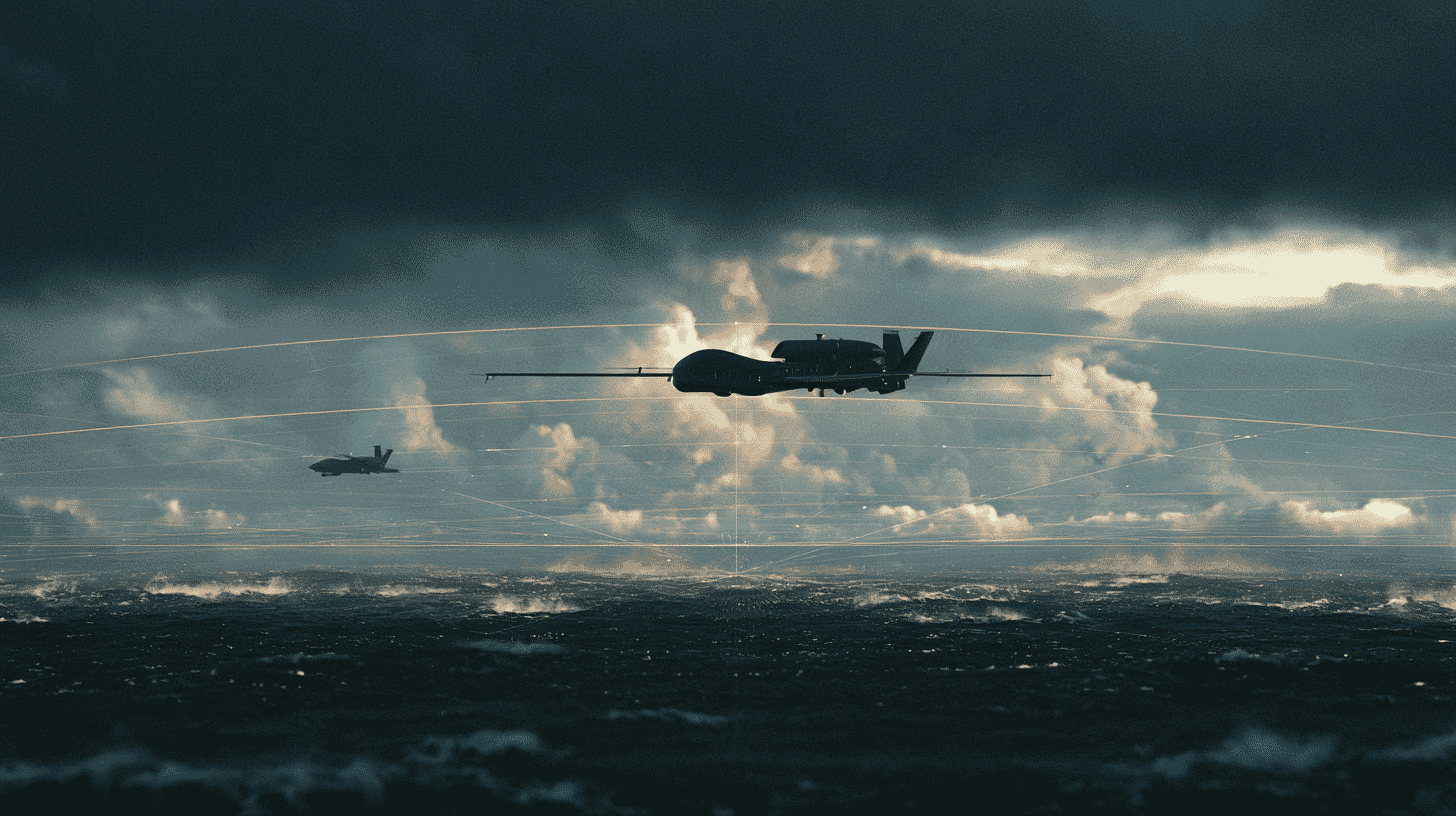
🛡️ On August 25, Japan's defense procurement agency signed a mass-production contract for an interceptor drone: a small aircraft whose entire job is to fly into an incoming kamikaze drone and stop it. What's striking isn't the hardware. It's that the whole process, from public call to signed contract, took about three months, and that of the four aircraft tested at sea, only the Japanese entry came out of it with a contract.
Three months from tender to signature
The Acquisition, Technology & Logistics Agency, known as ATLA, is the procurement arm of Japan's Ministry of Defense. On June 5, 2026, it published the outline of its Interceptor Drone Early Acquisition Program. Proposals were due at 5 p.m. on June 29. Thirty-eight companies applied.
By July 15, ATLA had named four aircraft for testing. Between July 15 and August 6, the Japan Maritime Self-Defense Force put them through trials. On August 25, ATLA announced it had signed a mass-production procurement contract with Terra Drone Corporation of Shibuya, Tokyo, for an aircraft called the Terra B1. Delivery, as of late August, is targeted for around September 2026.
ATLA said on its official X account that this was the fastest it had ever run an acquisition, and that it means to keep pushing speed-first procurement as threats change.
Japanese defense procurement is normally measured in years, sometimes decades. Defense Minister Shinjiro Koizumi personally posted the call for proposals on his own account in June, telling companies that the era now demands the ability to build cheaply, in bulk, and fast. Governments say things like that all the time. This one had machinery behind it: back in February, Koizumi had launched a fast-track procurement model, partly modelled on Ukraine, one of whose stated tenets is a three-month clock from award to the end of testing.
Portugal, Germany, the United States, Japan, and one contract
ATLA's July 15 notice lists all four systems and where each came from, which is unusually specific for a defense document.
Type 1 was the BVQ404 from Beyond Vision of Portugal, brought in by the Japanese firm AirMobility. Type 2 was the QS Interceptor from Germany's Quantum Systems, represented by ANA Trading. Type 3 was the Terra B1 from Terra Drone. Type 4 was the IonStrike from DZYNE Technologies of the United States, handled by Nihon Kaiyo.
Three imports and one home-grown machine. According to Terra Drone, the Terra B1 was the only one to pass the trials. ATLA has not published its reasoning, and it would be unfair to read that as three failures; the agency simply hasn't said. In July it ran the other way. Beyond Vision said its BVQ404 had gone in with the highest evaluation score, as ATLA's first-priority platform for the demonstration. ATLA's own notice just lists four types with no ranking. Whatever happened between the paperwork and the sea, it did not favour the paper leader.
Three of the four had recently fielded or built drones in Ukraine, by Australian Defence Magazine's count, which looks less like coincidence than like the point of the exercise. What the sailors were checking was broader than raw flight performance. Terra Drone says the Maritime Self-Defense Force operated the drones itself and assessed autonomy, usability aboard a ship, and communications and control quality alongside how well they flew. The test articles carried no ammunition or explosives.
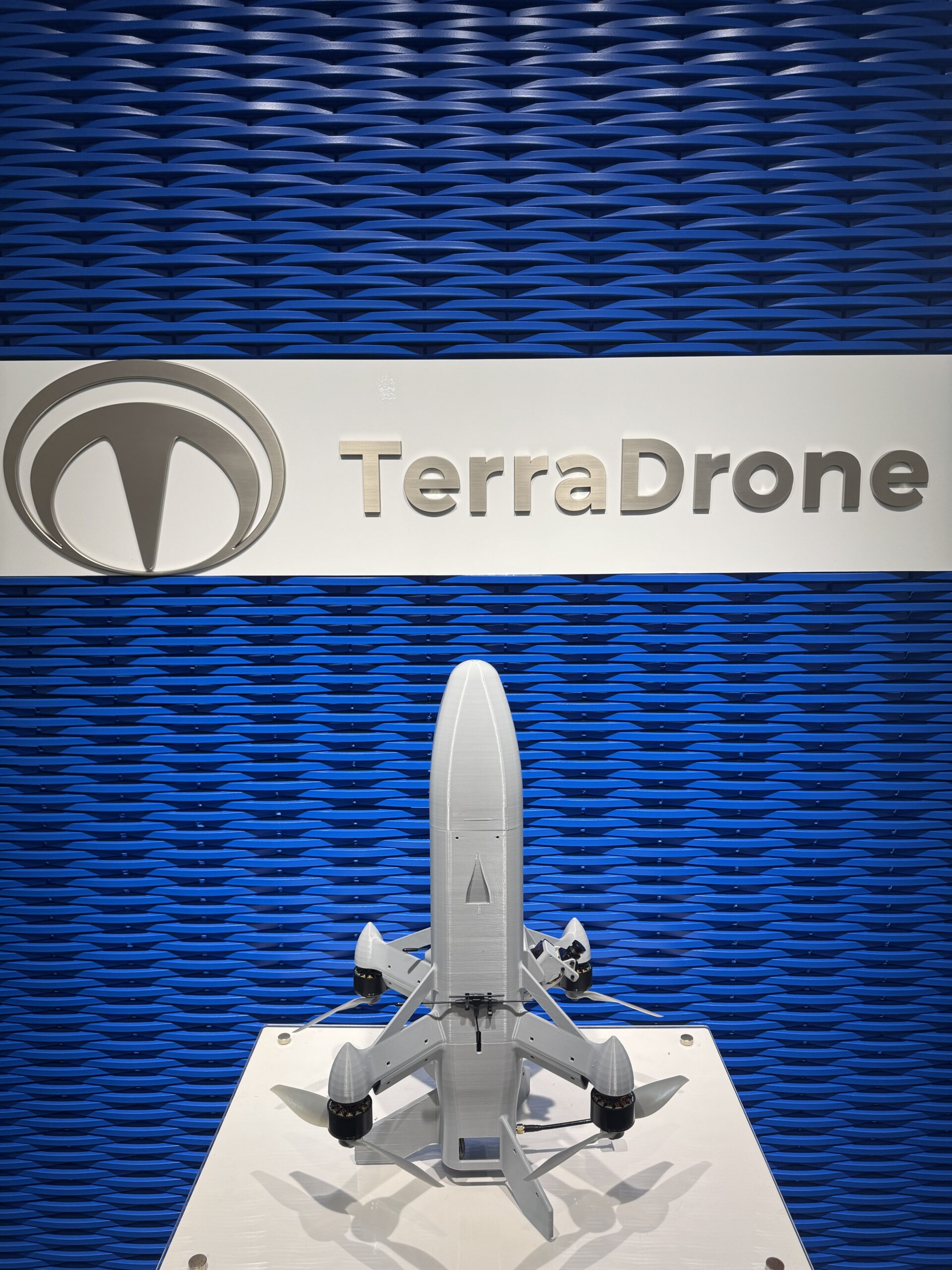
Source: Terra Drone Corporation press release
What "domestic" actually means here
Terra Drone spent most of its life as an industrial drone services company, doing survey work, infrastructure inspection and agriculture. It announced its move into defense equipment in March 2026, and then assembled a weapons line by buying one.
On March 31, through its Dutch subsidiary Terra Inspectioneering, the company took a strategic stake in Amazing Drones, a firm based in Kharkiv and founded with the involvement of Ukrainian engineers and military personnel. In June it went further. The stake was moved to a new Estonian entity called Terra Defense Europe, which now holds 50 percent and is the largest shareholder, and Terra Drone seconded a majority of the board, making Amazing Drones a consolidated subsidiary. On the same day, a second Ukrainian company, Winny Lab, was consolidated too.
Terra Drone says its short-range Terra A1 reaches 300 km/h against a Shahed commonly cited at over 200 km/h, covers 32 kilometers, flies for 15 minutes, and runs on electric propulsion that keeps it quiet and cool. The company says a Terra A1 shot down a Shahed in April 2026.
ATLA's paperwork lists the Terra B1's manufacturer as Terra Drone, Japan, and the company calls it a domestically produced interceptor. Past that point, the reporting splits. Militarnyi, a Ukrainian defence outlet, described the Terra B1 as an Amazing Drones design put forward by Terra Drone. Australian Defence Magazine called it a new Terra Drone platform and tied the selection instead to the Terra A1's first deployment in Ukraine in mid-April. Terra Drone itself has published no lineage at all; its August release says only that it combines what it learned in real operating environments including Ukraine with Japanese production and regulatory footing.
Whichever account is right, the line runs through Ukraine either way, through Amazing Drones or through the A1 that flew there. "Domestic" here does not mean invented in a Japanese lab. It means a design shaped by an actual air war, brought under Japanese ownership, and built on Japanese production lines.
The clause buried in the tender
ATLA's June solicitation defines an interceptor drone with unusual precision: an uncrewed aircraft under 600 kilograms flying below roughly 18,000 feet at around 250 knots, built specifically to engage long-range one-way attack UAVs of the Shahed or Harpy type. Bidders had to supply effective range, endurance, guidance method across the initial, midcourse and terminal phases, how many aircraft one operator could control at once, launch and recovery procedure, and what happens when the link drops.
Then there are two lines that tilted the field before anything flew.
Bidders had to be able to disclose system software and other technical information to the government, and to disclose whatever Japan's domestic defense industry would need in order to connect the drone to other equipment. Separately, if the aircraft was an import, the bidder had to document how long export and import licences would take, under what conditions, with supporting evidence attached. All submissions were to be in Japanese.
None of that bars a foreign supplier. But stack it up. A system that can be opened to Japanese contractors, shipped without waiting on another government's export approval, and manufactured locally starts the race several meters ahead of one that can't.
Terra Drone's stated plan after the contract reads almost like an answer sheet to those requirements: start mass production, build out domestic production and procurement, strengthen a supply chain covering parts, batteries, communications gear and control units, and stand up maintenance, resupply and training. That unglamorous list, batteries and comms modules and ground stations, is the real substance of the phrase "reducing dependence on Chinese drones."
Why the navy goes first
Terra Drone says the Maritime Self-Defense Force is the starting point, with the Air and Ground forces to follow.
A destroyer at sea is a point target with no hardened shelters behind it and no depth of territory to trade for time. Its air defense magazine is also finite in a way a land base's isn't, and once the launchers run dry the ship has to leave. Firing a surface-to-air missile worth millions at a drone that cost tens of thousands is acceptable once and unsustainable a hundred times over, which is the arithmetic that has been playing out around the Red Sea and the Middle East for the past two years.
ATLA's own document frames the program as improving the defense of garrisons, bases and vessels, and Terra Drone lists shipboard and critical-infrastructure integration among its next steps. For an island country whose fleet is its forward edge, starting at sea is not a strange choice.
Where the rest of the world already is
Japan is arriving late to a race Ukraine effectively started, and the numbers from there are already on the record.
Wild Hornets' Sting interceptor costs around $2,500 and, on the group's own count as of March 2026, had accounted for 3,900 drones since it entered service in May 2025. Ukraine's National Security and Defence Council puts national output at 100,000 interceptors over 2025, with more than 20 companies now in the business, and that an interceptor drone brings down a Shahed for roughly a twenty-fifth of what a Western air-defense missile costs.
You cannot simply buy them, though, and for Japan that constraint carries weight. As of March 2026, the makers of the Sting said they were not yet allowed to sell outside the country, and put it plainly: Ukraine's own defense comes first. A weapon that works and cannot be exported is an argument for building your own line.
The United States took a different route. Anduril's Anvil is an autonomous interceptor that destroys small drones by ramming them, and in March 2026 the U.S. Army awarded the company a ten-year enterprise contract with a ceiling of $20 billion. The class is different, though. Anvil is aimed at small quadcopters and light fixed-wing craft, while the Terra B1's stated target is the long-range one-way attack drone. Adjacent problems, not the same one.
Europe is assembling the European Drone Defence Initiative, widely called the drone wall. The European Commission's Readiness Roadmap 2030 puts its initial capacity at the end of 2026 and full functionality at the end of 2027. Germany's Tytan Technologies is standing up a plant near Munich sized for 3,000 interceptors a month and says it wants to be running at that rate by the end of 2026, while Britain's Cambridge Aerospace is pitching the Skyhammer, a 30-kilometer, 700 km/h interceptor built for Shahed-type targets.
Japan is nowhere near those volumes. Terra Drone's chief executive, Toru Tokushige, said in early July that the company is aiming for domestic output in the tens of thousands of interceptors annually, but that is an ambition, not an output figure. What Japan does have, unusually, is a signed production contract rather than a roadmap.
And it isn't running only one track. On August 17, Kyodo News and Nikkei reported that Rakuten will act as the Japan window for the German startup Helsing, supporting delivery of its interceptor drones to the Ministry of Defense, with a Ground Self-Defense Force trial planned by the end of September as of that reporting. Build it here, or import it and localize later: Tokyo is testing both at once.
The next door is export, but the numbers aren't in yet
On April 21, 2026, the National Security Council and the cabinet revised the Three Principles on Defense Equipment Transfers and their operational guidelines, scrapping the "five categories" that had confined exports of finished equipment to rescue, transport, warning, surveillance and minesweeping. Lethal equipment can now, in principle, be transferred to countries that have signed the relevant agreements with Japan. Each case still needs screening, and an export licence from the trade ministry, so the door is open rather than removed. A working Japanese interceptor drone walks straight through it all the same.
Not everyone in Japan is comfortable with that. The export loosening has drawn sustained criticism from opposition lawmakers, who argue that treating global military tension as a growth market sits badly with the country's postwar identity. That argument has not gone away, and this contract will not settle it.
Investors, for their part, were delighted. Terra Drone shares touched their daily limit on August 26, rising 3,000 yen to 17,050 yen, roughly 21 percent, or about $107 a share at the 159 yen to the dollar rate quoted on August 25.
The sober reading is more restrained. Neither the contract value nor the quantity has been disclosed, and the tender asked bidders to price the job in steps of ten aircraft up to fifty, which suggests a first order in the tens of aircraft rather than the thousands. ATLA warned in June that it might not proceed to production at all depending on the results, which tells you how experimental this was. Terra Drone says the effect on this term's consolidated earnings is still being assessed.
A few dozen interceptors are not an air defense network. They are a foothold, and a supply chain that still has to prove itself.
Japan has spent two years watching what cheap drones did to expensive defenses somewhere else, and has now written a contract about it. How is that conversation going where you live: is your country buying interceptor drones, building them, or not talking about it yet?
References
- https://www.mod.go.jp/atla/drone/pdf/r080825_drone.pdf
- https://www.mod.go.jp/atla/drone/pdf/r080608_drone.pdf
- https://www.mod.go.jp/atla/pinup/pinup_r080715.pdf
- https://terra-drone.net/28439
- https://terra-drone.net/27326
- https://www.itmedia.co.jp/news/article/2608/25/2000000772/
- https://www.itmedia.co.jp/news/article/2607/15/1260715124/
- https://www.itmedia.co.jp/news/article/2606/10/1260610081/
- https://www.itmedia.co.jp/news/article/2608/17/2000000568/
- https://www.australiandefence.com.au/news/news/adm-eyes-on-asia-japan-taps-into-ukraine-experience
- https://militarnyi.com/en/news/japan-accelerates-search-for-interceptor-drones-terra-drone-which-cooperates-with-ukrainian-developers-among-candidates/
- https://beyond-vision.com/interceptor-drone-japanese-demo/
- https://www.meti.go.jp/press/2026/04/20260421003/20260421003.html
- https://www.militarytimes.com/news/pentagon-congress/2026/03/11/these-are-ukraines-1000-interceptor-drones-the-pentagon-wants-to-buy/
- https://www.twz.com/news-features/ukrainian-companies-prohibited-from-exporting-shahed-interceptor-drones
- https://www.rnbo.gov.ua/en/Diialnist/7375.html
- https://defensescoop.com/2026/03/14/anduril-20-billion-dollar-army-contract/
- https://thedefensepost.com/2025/03/12/anduril-counter-drone-marines/
- https://defence-industry-space.ec.europa.eu/eu-defence-industry/readiness-roadmap-2030_en
- https://www.defensenews.com/global/europe/2026/06/26/german-counter-drone-startup-tytan-eyes-3000-interceptors-per-month-in-new-factory/
- https://www.armyrecognition.com/news/army-news/2026/uk-cambridge-aerospace-positions-skyhammer-low-cost-interceptor-for-european-air-defence-market








Global Discussion
4 comments