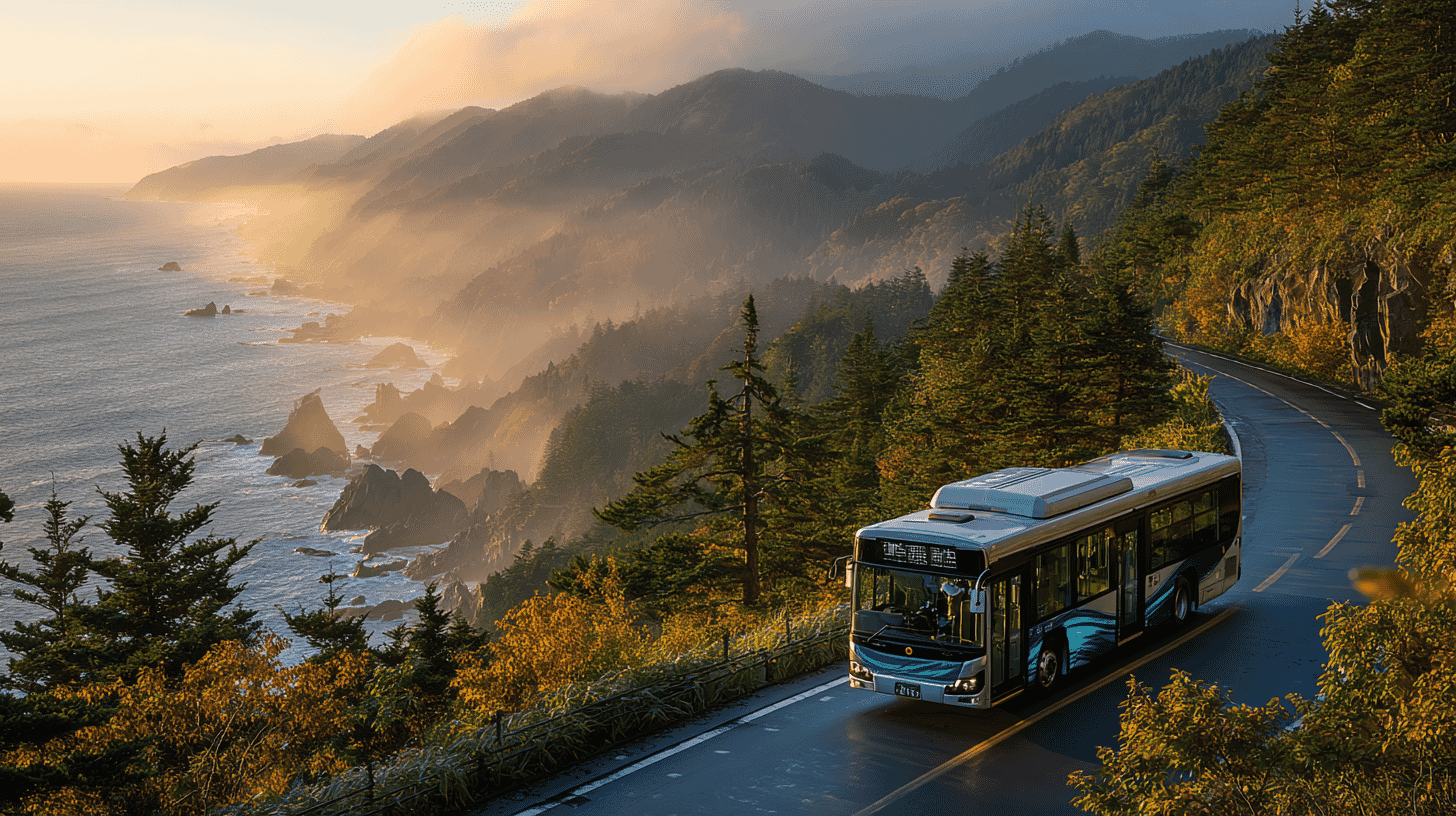
🚌 In China, Baidu's Apollo Go runs over 1,000 fully driverless robotaxis in Wuhan alone. In the U.S., Waymo provides 500,000 paid robotaxi rides every week across ten cities. Compared with that, Japan's autonomous vehicle scene looks quiet. Maybe even a little behind.
But on May 8, 2026, JR East quietly announced something genuinely historic. On the Kesennuma BRT line in Miyagi Prefecture, Level 4 autonomous running began on May 29, at up to 60 km/h (37 mph) over a 15.5 km (9.6 mile) route. Both the speed and the distance are new national records for Level 4 buses in Japan.
It is not flashy. There is no robotaxi app, no surge pricing, no Silicon Valley showmanship. Instead, this is the story of a railway erased by tsunami fifteen years ago, reborn as Japan's most advanced autonomous bus corridor.
The BRT That Used to Be a Railway
To understand why this matters, you need to know what the Kesennuma BRT actually is.
BRT stands for "Bus Rapid Transit," a system found in cities around the world where buses get their own dedicated lanes for faster, more reliable service. The Kesennuma BRT is unusual because it was originally a railway line that got converted into a busway.
In March 2011, the Tōhoku earthquake and tsunami devastated Japan's Pacific coast. The Kesennuma Line in Miyagi Prefecture and the Ōfunato Line in Iwate were among the casualties, stations, tracks, and signal infrastructure were swept away. Rebuilding as a railway would have cost an enormous sum and taken years, with uncertain ridership in towns that had lost much of their population. JR East chose another path: pave over the old rail bed and run buses on it. The Kesennuma BRT opened in 2012.
What was a pragmatic disaster-recovery decision turned out to be, by accident, an almost perfect environment for autonomous driving: a long, narrow corridor with no general traffic, designed for one type of vehicle, and connected to existing public transit.
Why Kesennuma BRT Could Hit "Fastest and Longest"
Here is what JR East announced on May 8, 2026:
| Item | Detail |
|---|---|
| Route | Yanaizu Station to Mizujirigawa AP (one way) |
| Distance | About 15.5 km (national record for Level 4 buses) |
| Top speed | About 60 km/h (national record for Level 4 buses) |
| Operating level | Level 4 (no driver monitoring or intervention required under specified conditions) |
| Period | Fridays and Saturdays, May 29 – July 4, 2026 (now concluded) |
| Approvals | Level 4 vehicle authorization from the Tohoku District Transport Bureau (January 2026); "specified automated operation" permit from the Miyagi Prefectural Public Safety Commission (February 2026) |
| Fare | Free, advance application required |
The trick is not in the bus itself but in what is buried under the road.
About every 2 meters along the BRT-only lane, magnetic markers are embedded in the asphalt. Every 10 meters or so, those markers also carry an RFID tag. A magnetic sensor on the bus reads them in real time and tells the bus exactly where it is on the route, within a margin a satellite signal cannot match.
This matters because the Kesennuma BRT runs along the Sanriku coast through mountainous terrain with frequent tunnels. GPS signals fail in tunnels. The magnetic markers do not, because they sit in the ground. The bus also carries LiDAR and a monocular camera to detect pedestrians or obstacles entering the lane.
The reasons this corridor can do "fastest and longest" come down to two things. First, the dedicated lane keeps general traffic out, which dramatically reduces edge cases. Second, the road itself does part of the work, instead of asking the AI to figure everything out from scratch. That is the heart of Japan's autonomous strategy.
References
The Global Picture: China and the U.S. Are Far Ahead, On a Different Track
It helps to put this in international context.
China is racing to scale robotaxis faster than anyone. Baidu's Apollo Go service has logged over 240 million kilometers of autonomous driving and provided more than 17 million rides globally as of October 31, 2025. Apollo Go is China's largest commercial robotaxi operator, with more than 1,000 fully driverless vehicles deployed in Wuhan alone, 20 million cumulative rides recorded nationally as of February 2026, and active or planned commercial services in Abu Dhabi, Dubai, and Switzerland.
The picture is not entirely smooth, however. On March 31, 2026, over a hundred Apollo Go robotaxis simultaneously froze on the streets of Wuhan, with vehicles stalled on overpasses and elevated roads, trapping passengers for up to two hours. A few weeks later, Beijing suspended all new autonomous driving permits nationwide.
The United States is led by Waymo. Waymo is now providing 500,000 paid robotaxi rides every week across 10 U.S. cities. In less than two years, the company's average weekly paid robotaxi trips have grown tenfold, from 50,000 per week in May 2024 to 500,000 per week today. Waymo says it will lay the groundwork for ride-hailing operations in over 20 additional cities in 2026, including Tokyo and London.
Japan, by these measures, is well behind in robotaxi deployment. The government has set a target of 100+ autonomous mobility services nationwide by FY2027, but the count of routes actually operating at Level 4 is still small. The Hitachi BRT in Ibaraki Prefecture began Japan's first commercial Level 4 mid-size bus operation (6.1 km) in February 2025. The Kesennuma BRT now extends that record to 15.5 km, more than doubling the longest Level 4 route in the country.
References
Why Japan Is Not Trying to Win the Robotaxi Race
A natural question: why is Japan not deploying like Wuhan or Phoenix?
The honest answer is that Japan is solving a different problem.
China and the U.S. are mostly addressing urban transportation demand, cheaper, faster, 24-hour rides for dense cities where consumer demand is large enough to justify aggressive fleet build-outs. Apollo Go and Waymo are optimized for that environment, with very high utilization on a fixed fleet.
Japan's challenge is the inverse: demographic decline and the disappearance of rural transit. Bus companies are structurally unprofitable on most regional routes. Drivers are aging, and the pipeline of new ones has dried up. Industry estimates point to a roughly 30% bus driver shortage by FY2030, which is already forcing service cuts and route closures in cities, let alone the countryside. Japan is not trying to make profitable urban routes more efficient. It is trying to keep barely-viable rural routes alive when there is nobody left to drive them.
Seen this way, the Kesennuma BRT choice makes sense. The dedicated busway is a closed environment created accidentally by disaster recovery, which makes safety much easier to certify. Magnetic markers + RFID is a less elegant solution than camera-and-AI everything, but it works in tunnels, in snow, and in driving rain. For rural routes that cannot afford to fail, that boring reliability is the actual product.
If China and the U.S. are betting on "make the AI smarter," Japan is betting on "make the infrastructure smarter." Which approach wins long-term is still an open question. They may simply be solving for different things.
"A Driver Will Still Be Onboard" Is Not As Strange As It Sounds
One detail that may surprise international readers: even though the Kesennuma BRT is operating at Level 4, a crew member will remain onboard for the foreseeable future.
Level 4 is supposed to mean the system handles everything under defined conditions, with no driver monitoring or intervention required. So why keep a human there?
The answer is that Japan's regulatory framework around "Specified Autonomous Operation" is designed to layer technical capability on top of social acceptance and safety redundancy, and the latter is taken slowly. After what happened in Wuhan in late March 2026, passengers stuck inside frozen robotaxis on highways for two hours, the case for keeping a human in the bus, even when the system technically does not need one, looks less paranoid and more sensible.
JR East has built this caution into the plan. The company aims to extend Level 4 operation to the general-road section between Mizujirigawa AP and Shizugawa Station by FY2028, but it is not rushing. The implicit message is: until the public is genuinely comfortable, a person stays on the bus.
The May 29 to July 4 trial ran only on Fridays and Saturdays, two round trips a day departing at 9:40 and 13:00, free of charge for those who applied at least two weeks in advance. It was as much a public-trust exercise as a technology demonstration. The detour operation between Yanaizu and Shizugawa that covered the test period ends on July 12, with normal service resuming from the first bus on July 13.
Fifteen Years After the Tsunami, A Driverless Bus on the Old Railway
It has been fifteen years since the Tōhoku earthquake. The towns along what used to be the Kesennuma Line and the Ōfunato Line never got their trains back. They got buses on rails-that-are-no-longer-rails, and those buses have been the lifeline of the coastal communities ever since.
Now those same buses, on those same former tracks, have run themselves at 60 km/h over 15.5 km. Not at the scale of Wuhan. Not in the way Waymo conquers Sun Belt cities. But a driverless bus running on a rail line erased by a tsunami is a quietly remarkable kind of recovery story, and one that probably could not happen anywhere else in the world.
JR East says it will keep extending Level 4 down the line through FY2028. The Kesennuma BRT runs 55.3 km in total; only a fraction of that will be autonomous in the near term. But the outline of a future is starting to come into focus: a struggling rural railway-turned-busway, reborn a second time as autonomous transit infrastructure.
What's it like in your country?
China has Apollo Go reshaping Wuhan. The U.S. has Waymo blanketing the Sun Belt. Japan is taking a quieter route through magnet markers and a tsunami-built busway, trying to keep a driverless rural bus running where there is no one left to drive it.
Are autonomous buses common where you live? Have you ridden in a robotaxi yet? How does your country handle transit deserts in rural or post-disaster areas? Tell us in the comments.
References
- https://www.jreast.co.jp/press/2026/20260508_ho02.pdf
- https://trafficnews.jp/post/663687
- https://www.watch.impress.co.jp/docs/news/2107216.html
- https://news.yahoo.co.jp/articles/1d4f164f749b4a4b212d2cde2acfa9abab8a6c38
- https://techcrunch.com/2026/03/27/waymo-skyrocketing-ridership-in-one-chart/
- https://www.automotiveworld.com/news/china-suspends-new-av-permits-after-baidus-mass-outage/






Global Discussion
14 comments