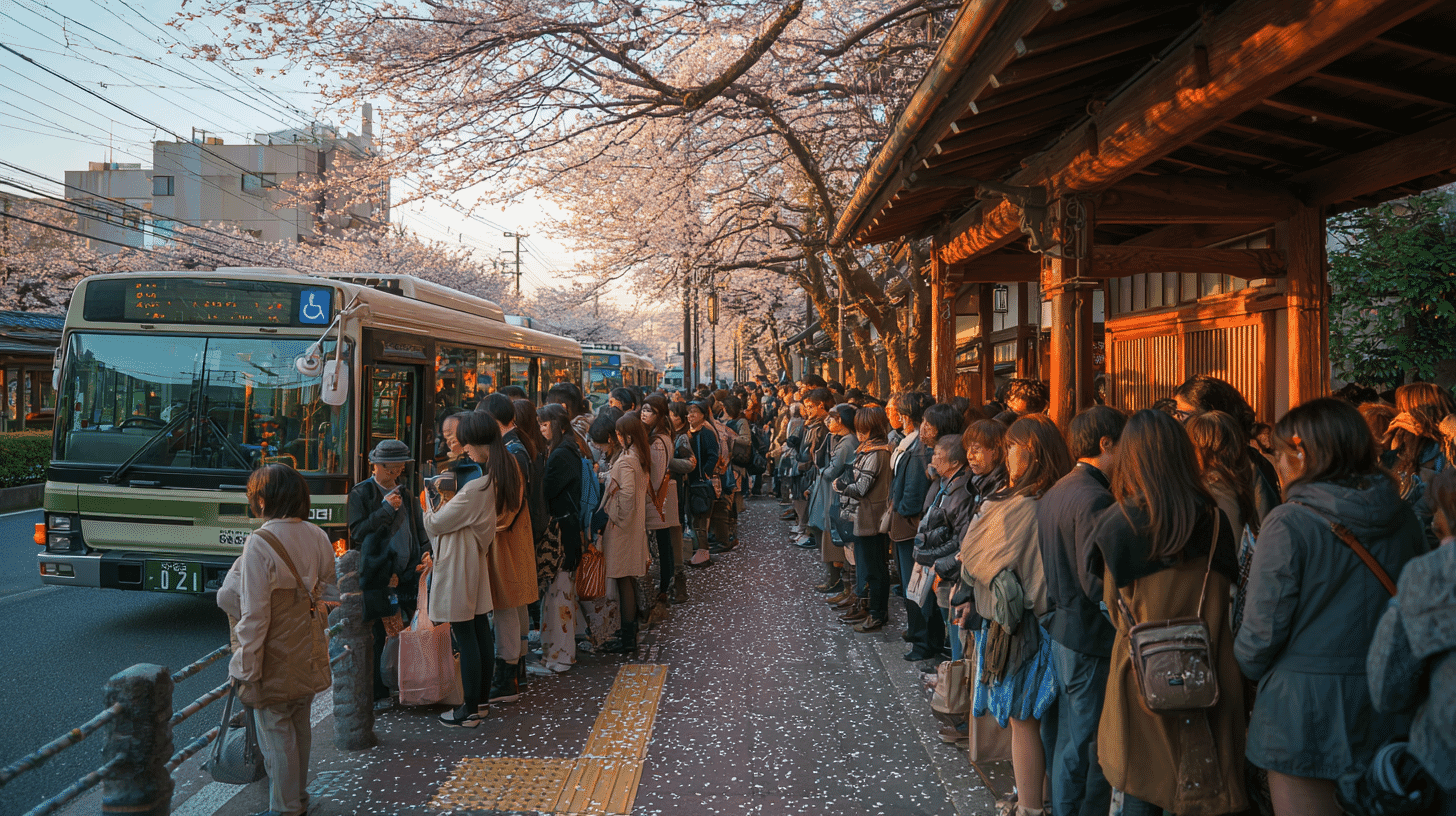
🚌 Have you ever tried to catch a bus in Kyoto? During peak tourist seasons, "too packed to board" and "endless queues at bus stops" are everyday realities. Kyoto City has finally made a decisive move to transform its bus boarding system. By the end of fiscal 2028, city buses will switch to "front boarding with prepayment." Here's our report on the transportation revolution in an ancient capital wrestling with overtourism.

Kyoto City Bus to Change Boarding System After 70+ Years

On January 29, 2026, Kyoto City officially announced a major change to its municipal bus system: switching from the current "rear-entry, front-exit, pay-when-you-leave" system to "front-entry, rear-exit, prepay-when-you-board." Mayor Koji Matsui stated at a press conference that implementation is targeted for the end of fiscal 2028. While the vehicle and bus stop modifications are expected to cost over 1 billion yen (approximately $6.5 million), the city has committed to this decision as a countermeasure against the increasingly severe overtourism problem.

Currently, Kyoto city buses operate with passengers boarding through a door in the middle of the vehicle and paying their fare near the driver when exiting through the front door. This system has been in place for over 70 years but has created persistent issues with passengers crowding toward the front, making it difficult for those at the rear to move through and exit smoothly.

Why Change the Boarding System Now?

Since 2017, Kyoto City has conducted multiple pilot tests of the front-boarding system. Results showed that dwell time at bus stops was reduced by approximately 12 seconds, and passenger flow became noticeably smoother.

Under the new system, passengers will board through the front door, pay their fare immediately, and exit through the middle door. This reduces the distance passengers need to move inside the bus, making it especially easier for elderly passengers and tourists carrying large luggage to disembark.

Overtourism—The Numbers Tell Kyoto's Story

According to a Kyoto University survey, over 80% of Kyoto residents report being "troubled by public transportation congestion." On routes heading to popular destinations like Kiyomizu Temple and Kinkaku-ji (Golden Pavilion), the following situations have become commonplace during tourist seasons:

Passengers waiting at stops cannot board due to overcrowding, sometimes waiting through multiple buses. Packed conditions prevent passengers from reaching the exit in time, causing them to miss their stops. Complaints flood city offices from local residents unable to use buses for commuting. Schedule delays have become chronic, making punctual operation nearly impossible.

The combination of yen depreciation and social media's expanding influence has driven a surge in foreign tourists visiting Kyoto. Photos of beautiful geiko (geisha) and videos of historic streetscapes spread across language barriers, generating unprecedented tourism demand.

The Tourist Express Bus Initiative

In June 2024, Kyoto City launched the "Kanko Tokkyu Bus" (Tourist Express Bus) as part of its overtourism countermeasures. This was a nationwide first utilizing a new national system that allows different fare structures from regular route buses.

The Tourist Express Bus connects Kyoto Station to Gojo-zaka (the nearest stop to Kiyomizu Temple) nonstop in about 10 minutes, and reaches Ginkaku-ji (Silver Pavilion) via Gion and Heian Shrine in approximately 24 minutes. The fare is 500 yen for adults—roughly double the regular bus fare of 230 yen—but passengers with the "Subway & Bus One-Day Pass" (1,100 yen) can ride at no additional cost.

Operating only on weekends and holidays, the express buses depart from Kyoto Station approximately every 7-8 minutes during morning hours. By design, regular commuter passes and senior citizen passes cannot be used, creating a separation between tourist and resident usage. The initiative received the "JCOMM Project Award" in September 2025, recognizing its effectiveness.

The Critical Bus Driver Shortage

Another factor driving the boarding system change is the severe personnel shortage. In September 2024, the Kyoto City Transportation Bureau issued an "Emergency Declaration of Bus Driver Shortage," revealing that routes are being maintained only through drivers working on their days off.

Due to staffing constraints, the March 2025 schedule revision will unavoidably include service reductions and route truncations. Shortening boarding and alighting times has become an urgent priority to maximize transportation efficiency with limited drivers and vehicles.

Challenges and Future Outlook

The transition to front-boarding presents several challenges.

First, bus stopping positions will shift rearward, requiring understanding from nearby residents. This change comes while communities are already bearing burdens from noise and litter left by waiting passengers.

Additionally, fare zones where prices vary by distance traveled will need to maintain the current rear-boarding system. This means different boarding methods for different zones, potentially creating confusion—especially for tourists.

Furthermore, at bus stops near crosswalks or intersections, changing stopping positions may raise safety concerns requiring careful evaluation.

A Challenge Facing Tourist Cities Worldwide

The overtourism that Kyoto faces is a common challenge among the world's popular tourist destinations. In Barcelona, Spain, a mayor campaigning on tourism regulation was elected in 2015, leading to a ban on new accommodation construction in designated areas. Venice, Italy, launched a trial system in 2024 charging entry fees to day-trip tourists.

Kyoto's approach is distinctive in seeking harmony between resident life and tourism through public transportation efficiency and usage separation, rather than excluding tourists. Whether Kyoto can build a "cycle where tourism profits return to the city" will determine its future as a sustainable tourist destination.

In Japan, Kyoto's bus congestion is often cited as the symbol of overtourism. But how does your country or region handle increasing tourist numbers? What measures exist for public transportation crowding, or for coexistence between residents and visitors? We'd love to hear about your experiences.

References

Reactions in Japan

Finally... When morning commute rush overlaps with tourist rush, the 206 line becomes absolute chaos. Front boarding might help a bit. But 2028—isn't that way too late?

I agree 0
I disagree 0

From a driver's perspective, front boarding lets you see fare payment, which is reassuring. But I worry time spent on currency exchange will actually increase with foreign visitors unfamiliar with IC cards.

I agree 0
I disagree 0

Spending 1 billion yen just to change how people board? Use that money to add more buses or improve driver compensation instead.

I agree 0
I disagree 0

Tokyo metropolitan buses already use front boarding with prepayment. Kyoto's long 'rear boarding' culture will cause some resident confusion, but London and Paris also primarily use front boarding. Moving toward international standards makes sense.

I agree 0
I disagree 0

The tourist express bus is truly a blessing. Before, waiting 30 minutes with tour groups heading to Kiyomizu Temple was normal. But it doesn't run on weekdays... What about school trip season?

I agree 0
I disagree 0

My family has lived here for generations, but I've stopped riding Kyoto buses. Subway or bicycle only. It's not the tourists' fault—the city has simply exceeded its capacity.

I agree 0
I disagree 0

What about wheelchair users and people with strollers if we switch to front boarding? They currently board through the middle door with the ramp. Has this been properly considered?

I agree 0
I disagree 0

I commute to Kyoto daily for work and take the bus from the station, but I've given up and just walk now. 25 minutes to Shijo Kawaramachi. At least it's exercise lol

I agree 0
I disagree 0

Explaining 'board from the front and pay first' to foreign tourists is actually easier. The pay-later system is harder to explain. I welcome this change.

I agree 0
I disagree 0

End of fiscal 2028... How many autumn leaf seasons will pass until then? This fall is guaranteed to be hell again.

I agree 0
I disagree 0

Honestly, 500 yen for the tourist express bus isn't expensive for tourists. 13 minutes to Gion is totally worth it. If anything, it's not well-known enough.

I agree 0
I disagree 0

However bus boarding changes, foreign tourists using taxis keep increasing. But we're also short-staffed and often have to decline fares. Kyoto's entire transportation infrastructure is near breaking point.

I agree 0
I disagree 0

Making money as a tourist city then complaining about 'too many tourists' feels strange. You'd be in trouble if they stopped coming.

I agree 0
I disagree 0

I understand senior passes can't be used on the tourist express, but please address the situation where regular buses are too crowded for elderly to board. I'm worried about fall accidents.

I agree 0
I disagree 0

My hometown buses were front boarding with prepayment, so when I moved to Kyoto I was confused—'Why board from the back?' National standardization would be easier for both tourists and residents.

I agree 0
I disagree 0

They've declared a driver shortage emergency but say they'll change the system in 2.5 years? Isn't that too leisurely? Routes might be discontinued before then.

I agree 0
I disagree 0

I tell guests staying at my machiya guesthouse to 'use subway over bus.' Buses offer nice views of Kyoto, but I can't recommend them as things stand.

I agree 0
I disagree 0

Barcelona and Venice address this with accommodation limits and entry fees. Kyoto is trying to solve it through transportation efficiency, but fundamentally, setting visitor capacity limits may be necessary.

I agree 0
I disagree 0

Voices from Around the World

Sarah Mitchell

In the UK, front boarding is standard, so I was genuinely confused when I boarded from the back in Kyoto. The 2028 change will make things much clearer for foreign tourists. Though I'm surprised it takes nearly 3 years.

Thomas Bergmann

From my experience living in Barcelona, solving overtourism isn't easy. Changing how people board buses won't be enough—eventually you'll need entry limits and tourism taxes.

김민준 (Kim Minjun)

As a Korean tourist who has visited Kyoto many times, the bus congestion is indeed terrible, but Kyoto's charm remains unchanged. I think 500 yen for the tourist express bus is a fair price.

Maria Santos

In Brazil, public transport congestion is everyday life. But it's sad to see this happening in a historic city like Kyoto. As tourists, maybe we need to make more effort to travel to less crowded places.

Chen Wei

I admit there are many Chinese tourists. But we visit because we love Japanese culture. The term 'tourism pollution' hurts a bit. I'd appreciate more welcoming approaches.

Emily Watson

From Australia, Japanese bus systems are reliable regardless of the boarding method. Buses coming on time is already impressive. There's crowding, but it's still organized.

Pierre Dubois

Tourist increase is also a problem in Paris, but it's less severe for buses because the metro is well-developed. Isn't the fundamental issue that Kyoto has too few subway lines?

Tanaka Yuki

I'm Japanese living in Canada. When I returned home recently and visited Kyoto, I was shocked by the bus congestion. It's ironic that success as a tourist destination is pressuring residents' lives.

Alessandro Romano

As a Venice resident, I empathize with Kyoto's situation. Our city has started charging entry fees for day-trippers. Perhaps Kyoto should consider similar measures? Transportation alone won't solve this.

Jennifer Nguyen

Vietnamese-American here. Visited Kyoto last fall and had to let 3 buses pass because they were full. Ended up taking a taxi but got stuck in traffic. I don't think front boarding will be the solution.

Hans van der Berg

Tourist increase is a serious problem in Amsterdam too. We've even started campaigns saying 'tourists, don't come anymore.' I think Kyoto is still taking a moderate approach.

李小華 (Li Xiaohua)

Tourist from Taiwan. Japanese buses are convenient whether front or rear boarding because fare boxes give change. In Taiwan, no change is given so you need to prepare exact coins.

Michael O'Brien

Visited Kyoto from Ireland in 2019 and 2024. Congestion had clearly worsened in 5 years. But I was impressed that Japanese people still queue politely even in this situation.

Priya Sharma

Compared to Indian cities, Kyoto's bus crowding is still manageable. Getting on a bus in our country is practically a martial art (lol). But as a tourist destination, I'd hope for a more relaxed experience.

Robert Kim

I work in Silicon Valley, and I feel much of Kyoto's transportation problem could be solved with technology. Real-time congestion info, reservation systems, etc. Analog solutions alone have limits.

Sofia Andersson

In Sweden, many tourist sites have adopted advance reservation systems. Shouldn't Kyoto's famous temples consider entry limits or time-slot reservations? The bus problem is a symptom, not the cause.