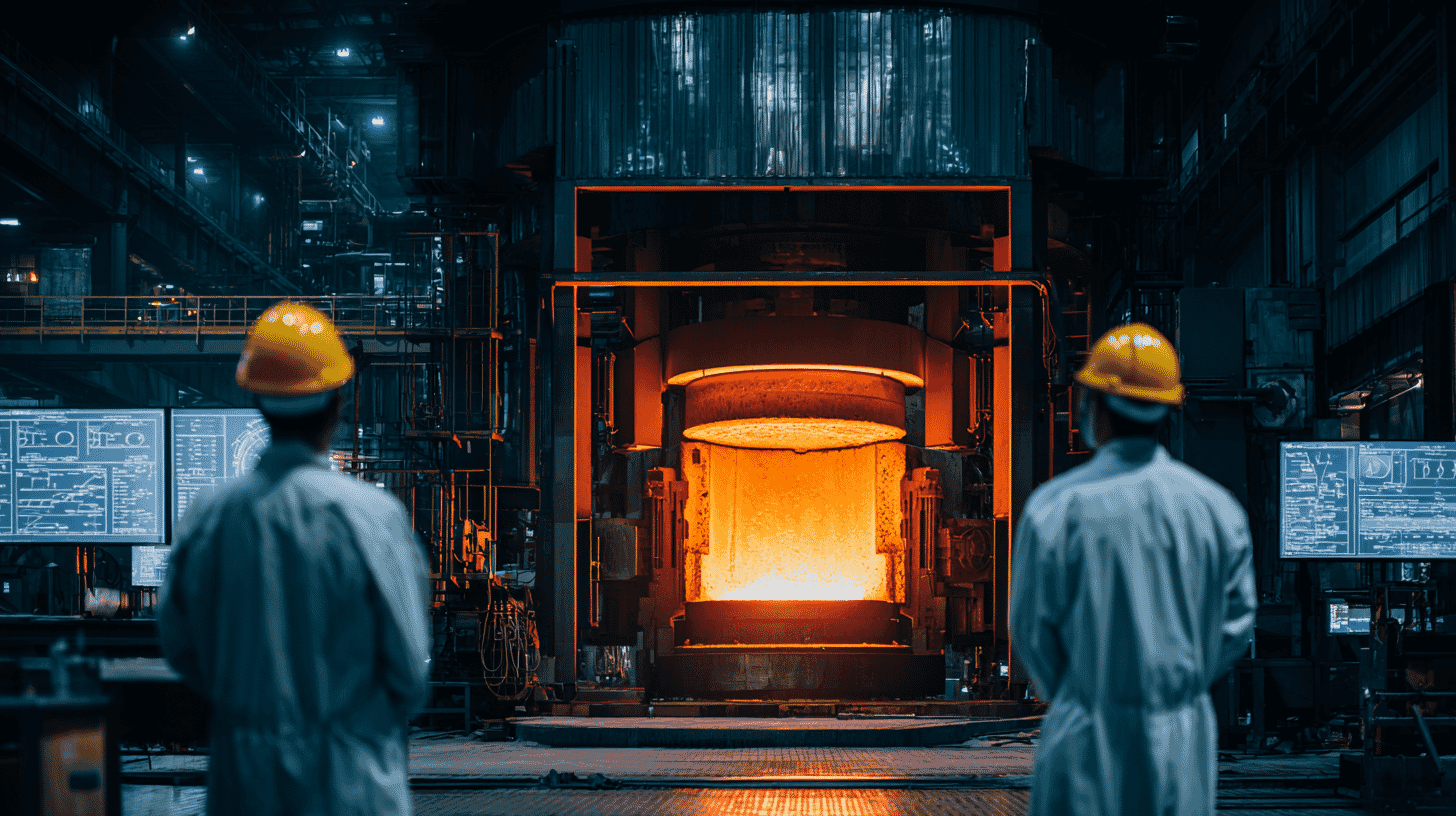
In the geopolitical chess game over rare earth magnets, attention has focused on the materials and the magnets themselves. But upstream of all that sits a tier of companies that build the equipment to make the magnets, and you can count those on one hand worldwide. Japan's vacuum equipment giant ULVAC is now reshoring production of its rare earth magnet vacuum melting furnaces from China to Japan, with orders projected to roughly triple year over year. A picture is emerging in which Japan's equipment makers quietly underwrite the West's de-China supply chain push, selling picks and shovels during the new gold rush.
What Just Happened: The Reshoring Decision
On May 1, 2026, ULVAC, Inc. (TSE Prime: 6728), the vacuum equipment heavyweight headquartered in Chigasaki, Kanagawa Prefecture, announced it would build new domestic production capacity for "continuous vacuum melting furnaces" used in rare earth magnet manufacturing.
Until now, the company has manufactured these furnaces at its Chinese subsidiary and supplied them to magnet makers worldwide. The new decision responds to a projected roughly threefold year-over-year surge in orders from US and European magnet manufacturers, marking a clear shift away from China-only production.
Key details of the announcement:
- Target product: Continuous vacuum melting furnace
- Domestic production capacity: Up to 12 units per year
- Domestic facility launch: September 2026
- Shipments: Rolling start
The Nikkei broke the reshoring plan in February 2026, and ULVAC shares jumped sharply on the report. Investors are betting on the broadening application of ULVAC equipment in neodymium magnet production.
The Picks-and-Shovels Economics
There's a classic story about the 19th-century gold rush: the people who actually got rich weren't the ones digging for gold. They were the ones selling picks and shovels.
What's happening in the rare earth magnet market today follows that exact pattern.
In response to Chinese export controls, the United States, Europe, and Australia are pouring massive subsidies and Department of Defense contracts into building "mine-to-magnet" supply chains at home. MP Materials has its magnet plant running in Fort Worth, Texas. USA Rare Earth is targeting 600 metric tons per year of capacity at its Stillwater, Oklahoma facility by Q4 2026, scaling to 1,200 MTPA in Q1 2027. The UK's Pensana plant is aiming to cover 5% of global neodymium and praseodymium demand.
But all of these "magnet-making" companies need machines to make the magnets. And the number of companies in the world that can build those machines is vanishingly small.
ULVAC is one of the few equipment makers globally that offers a comprehensive lineup for the core vacuum processes in rare earth magnet production, meaning melting, sintering, and aging, and the company claims over 70% global market share in continuous vacuum furnaces for the main process steps. More than 70 years of accumulated technology in domesticating vacuum melting and deposition equipment is now bearing fruit just as the rare earth magnet market enters its expansion phase.
What Is a Continuous Vacuum Melting Furnace?
For readers who might draw a blank at "vacuum melting furnace," here's the lay of the land.
The neodymium magnet (Nd-Fe-B) manufacturing process roughly follows these steps:
- Melt and cast rare earth raw materials (neodymium, iron, boron, etc.) under vacuum to form an alloy (vacuum melting)
- Pulverize the alloy into fine powder
- Press-form the powder under a magnetic field
- Sinter under vacuum to consolidate (vacuum sintering)
- Heat-treat to optimize magnetic properties (aging)
The alloy structure formed in that initial melting step is decisive: it determines the final magnet's performance. Any oxygen or nitrogen contamination degrades the magnet, so an extremely high-grade vacuum environment is essential.
ULVAC has shipped more than 400 vacuum melting furnaces cumulatively. The company has layered on proprietary technologies including high-vacuum degassing refinement using cryogenic panels and unidirectional stirring systems for multi-element alloying.
"Customers Reluctant to Buy Chinese Equipment"
According to Nikkei's reporting, what pushed ULVAC into reshoring was the voice of customers who were reluctant to buy Chinese-made equipment.
This is rational on the customer side. If you're going to the trouble of building a magnet factory in the US or Europe specifically to escape Chinese dependency, having that factory's core equipment be Chinese-made defeats the purpose. From maintenance to spare parts to technical updates, every touchpoint runs back through China, which is unacceptable from an economic security standpoint.
ULVAC will continue manufacturing in its Chinese subsidiary as a stable supply base for Chinese customers, while building a "dual-pole supply structure" by adding Japanese production. Customers can now choose between Chinese-made and Japanese-made furnaces and design their supply chains according to their geopolitical risk tolerance.
This is the "friend-shoring" logic that has already shaped semiconductor equipment and materials, now spreading to rare earth magnet equipment.
Japan's Role in Cracking the Magnet Monopoly
According to the latest report from the International Energy Agency (IEA), China accounted for roughly 60% of global rare earth mining (neodymium, praseodymium, dysprosium, terbium) in 2024. Its share rises to about 91% in separation and refining, and in permanent magnet manufacturing, which stood at around 50% two decades ago, China has now grown past 90%.
In April 2025, the Chinese government imposed export controls on seven heavy rare earth elements and related compounds and magnets. Export volumes plummeted in April and May, forcing US and European automakers to cut utilization rates or temporarily shut down plants. In some importing countries, rare earth prices spiked to as much as six times Chinese domestic prices.
Faced with this crisis, countries are racing to build magnet manufacturing capacity. Consultancy IDTechEx forecasts that US rare earth magnet manufacturing capacity will grow nearly sixfold by 2036.
But what physically enables that expansion is, ultimately, the equipment makers. ULVAC is forecasting roughly triple the orders in 2026 compared to 2025, and if that materializes the company becomes one of the lead actors physically underwriting Western magnet capacity buildup.
The Equipment Maker's Other Faces
ULVAC may be unfamiliar to general readers, but it occupies an extraordinarily important position in industry.
The company's "Magcaster" series of vacuum induction melting furnaces is used not only for rare earth magnets (Nd-Fe-B, Sm-Co) but also for titanium alloys, precious metals, and nickel-based heat-resistant alloys. ULVAC also operates in semiconductor and display manufacturing equipment with sputtering systems and was named a TSMC supplier of the year in 2025.
In other words, ULVAC is something of a general trading house of equipment, holding world-leading shares in semiconductor equipment, display equipment, magnet equipment, and cryostat (ultra-low-temperature equipment) for quantum computers. All four are geopolitically significant fields.
Behind the scenes, this is one of the companies underwriting Japan's high-tech industrial base.
What Should Temper the Optimism
So far this has been mostly an upbeat story. A few caveats are worth noting.
Scale and timing: Twelve units per year of domestic capacity is debatable as a sufficient response to surging global magnet demand. China's magnet production capacity runs at roughly 100,000 tons per year. Western magnet startups are still orders of magnitude smaller, and whether the equipment side can keep pace with that ramp is uncertain.
Cost competitiveness: Japanese domestic production will likely run higher than Chinese production. How much "de-China premium" Western customers will absorb, and whether anything other than defense and aerospace contracts will be economically viable, remains to be seen.
China's countermove: Beijing may push hard to develop a domestic magnet equipment industry. China has historically responded to access restrictions on equipment like Lasertec's EUV mask blank inspection systems by accelerating domestic alternatives. The same dynamic could play out for rare earth magnet equipment.
Workforce signals: on February 10, 2026, ULVAC opened a voluntary early retirement program covering roughly 170 eligible employees at its Tohoku plant, Kyushu plant, and Kumamoto processing center. No target headcount was set, and the separation date is June 30. It forms part of the "Value Up Plan" mid-term strategy adopted in August 2025. The semiconductor capex slowdown has produced a revenue and profit decline, and over-rotating into rare earth magnet equipment based on optimistic forecasts could leave the company short-handed if semiconductor demand snaps back sharply.
The Blind Spot in the Supply Chain Debate
When people talk about the geopolitics of rare earth magnets, three nodes get the attention: mines, refineries, and magnet factories. The fact that the equipment that runs those factories can only be built by a handful of countries worldwide has been surprisingly underdiscussed.
Japan lost ground to China and Korea in consumer electronics during the 1990s and 2000s, but it has held world-class positions in the upstream layers of equipment and materials throughout. ULVAC's reshoring move is, in a sense, fresh proof that this equipment industry holds geopolitical value as a kind of strategic asset.
In your country, is domestic rare earth magnet capacity being built up? Where do those factories source their equipment? Is "domestic equipment manufacturing" becoming a political issue? Let us know in the comments.
References
- https://prtimes.jp/main/html/rd/p/000000012.000151150.html
- https://www.nikkei.com/article/DGXZQOUC2414A0U6A420C2000000/
- https://kabutan.jp/news/marketnews/?b=n202602120468
- https://www.ulvac.co.jp/products/vacuum_furnace/_fmi/index.html
- https://www.iea.org/commentaries/with-new-export-controls-on-critical-minerals-supply-concentration-risks-become-reality
- https://www.iea.org/reports/rare-earth-elements/executive-summary
- https://www.cnbc.com/2025/12/24/critical-minerals-rare-earth-magnet-makers-relish-a-moment-in-the-sun.html
- https://www.idtechex.com/en/research-report/rare-earth-magnets/1112
- https://rare-earth-mining.com/top-10-rare-earth-magnet-manufacturers/









Global Discussion
14 comments