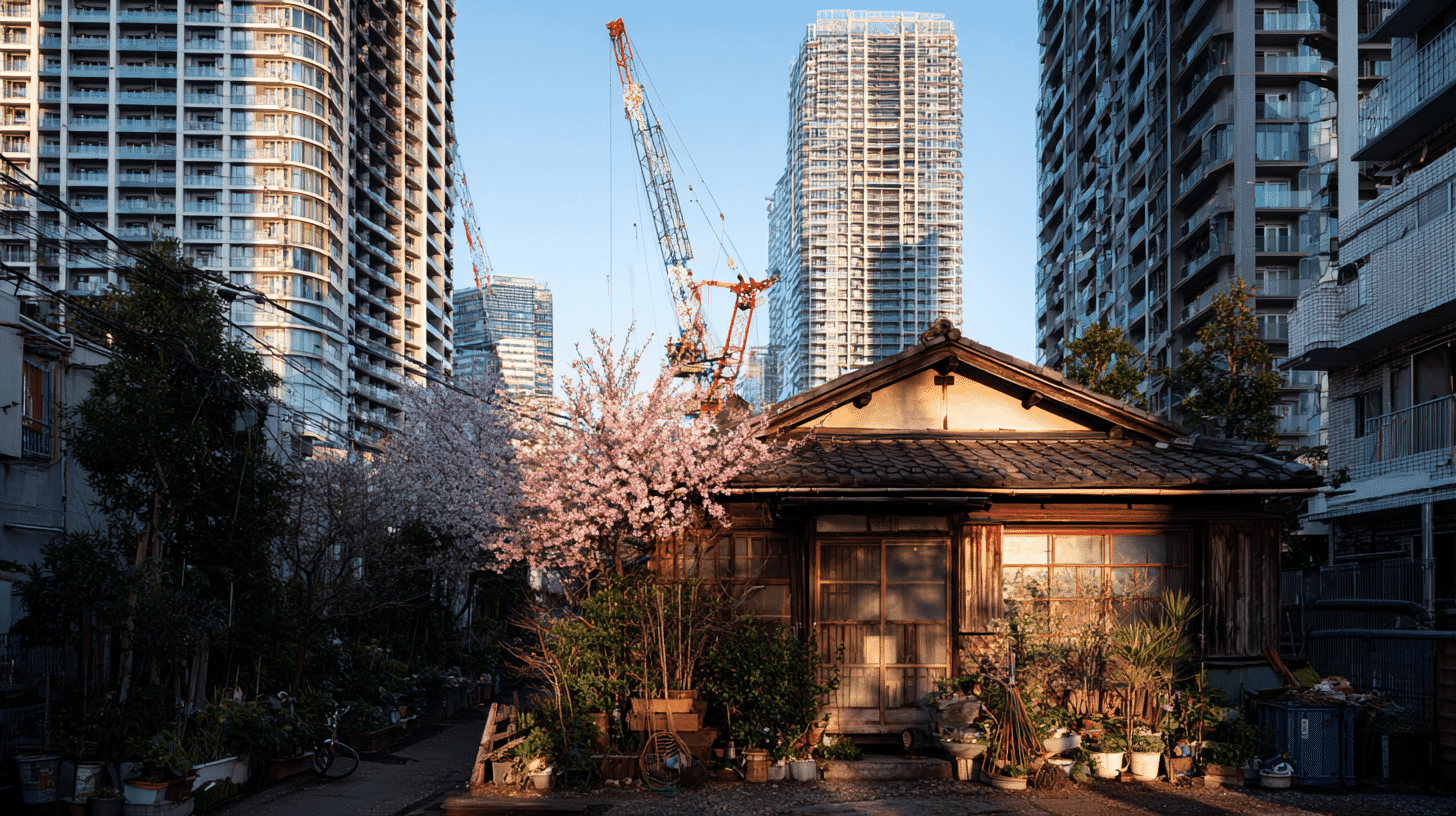
Japan's real estate has become a bargain bin for global investors. In 2025, large-scale property deals hit a record ¥6.5 trillion, up 31% from the previous year, and roughly ¥2.4 trillion of that came from foreign investors. The weak yen makes Japanese property look like a steal. But for ordinary Japanese families, homeownership is becoming an increasingly distant dream. (Dollar figures below use ¥160 to the dollar, the rate as of July 2026.)
Record-Breaking Investment Floods Japan's Property Market
According to data from CBRE, a major real estate services firm, large-scale property investments (over ¥1 billion, about $6.3 million per deal) in Japan reached a record ¥6.5 trillion (about $41 billion) in 2025, far surpassing the previous record of ¥5.4 trillion set during the pre-financial crisis boom of 2007. Foreign investors accounted for roughly ¥2.4 trillion (about $15 billion) of this total, with 60% of all investment concentrated in the Tokyo metropolitan area.
The primary driver is the historically weak yen. The dollar touched ¥162 in late June 2026, a level unseen since December 1986, and has stayed in the ¥160s through July. International investors can acquire Japanese properties at what feels like a steep discount. Global Property Guide data shows Tokyo's average price per square meter stands at roughly $5,377, compared to Hong Kong's $22,291 (four times higher), Singapore's $19,300 (nearly four times higher), and Seoul's $10,740 (double).
In practical terms, $1 million buys approximately 64 square meters of prime Tokyo real estate, double what the same amount gets you in Singapore and triple what it buys in Hong Kong.
Land Prices Hit Post-Bubble Record
Japan's Ministry of Land, Infrastructure, Transport and Tourism released its 2026 official land price survey (as of January 1, 2026) on March 17, revealing that the national average across all land categories rose 2.8% year-on-year, the fifth consecutive annual increase and the largest gain since the bubble era collapse of 1992.
Tokyo led the charge: residential land in the capital's 23 wards rose 9.0% (up from 7.9% the previous year), while commercial land surged 13.8% (up from 11.8%). The most expensive commercial land in Japan, for the 20th consecutive year, was the Yamano Music store in Ginza 4-chome at ¥67.1 million per square meter (about $419,000), up 10.9%.
Two themes dominated the top of the price increase rankings nationwide:
Semiconductor boom towns: The number one spot nationally went to Chitose City in Hokkaido, where land prices surged 44.1%. Rapidus, a next-generation semiconductor manufacturer, started its pilot line there in April 2025 and is investing toward volume production in 2027. Land prices have roughly tripled since 2022. In Kumamoto Prefecture, TSMC's arrival has driven prices up over 30% in towns like Ozu and Kikuyo.
Inbound tourism hotspots: Osaka's Chuo Ward saw commercial land prices jump 15.5%, driven by demand for hotels and retail targeting foreign visitors in the Shinsaibashi and Dotonbori areas. Resort areas like Hakuba in Nagano Prefecture also recorded significant increases from wealthy domestic and international buyers seeking vacation properties.
Tokyo Condos: ¥100 Million Is the New Baseline
Tokyo's condominium market has reached a level that shuts out the vast majority of working families.
In the first half of 2025, the average new condominium price in Tokyo's 23 wards hit ¥130.64 million (about $817,000). Even more striking: the median price, a better indicator of what typical buyers face, crossed the ¥100 million mark for the first time, reaching ¥110.1 million (about $688,000).
Of the 2,964 units launched in the 23 wards during this period, 1,640 units, roughly 55%, were priced above ¥100 million. The "oku-tion" (a Japanese neologism combining oku meaning "hundred million yen" with "mansion," the Japanese word for condominium) is no longer the exception, it's the norm.
A survey by Mitsubishi UFJ Trust Bank found that 20-40% of condominiums supplied in the Greater Tokyo Area in the second half of fiscal 2024 were purchased by foreign buyers. In the ultra-luxury segment, overseas investors paying cash for units worth several million dollars is increasingly common.
The result? Families in their 30s, the prime homebuying demographic, are fleeing Tokyo for the surrounding prefectures of Saitama, Chiba, and Kanagawa in search of affordable housing. The city of Nagareyama in Chiba, which has invested in childcare infrastructure and offers good commuter access, saw residential land prices jump 13.3%.
Why Tokyo Looks Like the World's Biggest Bargain
The yen's weakness is only part of the story. Several structural factors make Tokyo uniquely attractive to foreign capital:
Higher yields: Tokyo's office yield gap (the difference between property yields and borrowing costs) stands at approximately 1.9%, compared to New York's 1.7% and London's 1.5%. In other words, Tokyo offers better returns relative to financing costs.
Virtually no restrictions: Japan is one of the few developed nations where foreigners can buy real estate with essentially no regulatory barriers. No residency requirement, no citizenship needed, and buyers acquire full freehold ownership. Compare this to Singapore (60% additional stamp duty for foreigners); Australia, which barred foreign purchases of established dwellings from April 1, 2025 and has since extended the measure to June 30, 2029; and Canada, whose federal ban on non-Canadians buying residential property in urban areas has been in force since January 2023 and runs to January 1, 2027. Japan's open door is conspicuous in a world moving toward restriction.
Safety and stability: Japan's political stability, low crime rate, and world-class infrastructure make it an attractive haven for wealthy individuals from Hong Kong and Singapore seeking to diversify assets away from geopolitical risk zones.
How Tokyo Compares to Global Cities
To illustrate Tokyo's relative affordability in global terms:
For $1 million, about ¥160 million, a buyer can acquire roughly 64 square meters in central Tokyo, compared to about 33 square meters in Manhattan (New York), 28 square meters in Zone 1 London, 32 square meters in Singapore, and just 22 square meters in Hong Kong.
However, the gap is narrowing rapidly. Luxury condominiums in Tokyo's Minato Ward now command prices exceeding ¥1.44 million per square meter (about $9,000), putting them in the same league as prime London and New York properties.
Meanwhile, Osaka is emerging as an alternative destination. Average property prices in Osaka run at roughly $4,500 per square meter, about half of Tokyo's central wards, while the city prepares for ongoing urban renewal and the lingering economic momentum from the 2025 World Expo.
Warning Signs: Is a Correction Coming?
Multiple risk factors suggest the current price rally won't last forever:
Rising interest rates: The Bank of Japan has begun normalizing monetary policy. As variable-rate mortgage reviews take effect, increased borrowing costs could dampen domestic demand, particularly among the stretched first-time buyers who have been pushing into suburban markets.
Chinese money retreating: China's ongoing domestic real estate crisis has squeezed the finances of many Chinese investors. Reports indicate some are beginning to sell their Japanese holdings to raise cash. Analysts at Oraga Research suggest the Chinese "bakugai" (explosive buying) wave may have already peaked.
Yen reversal risk: The ¥160s are a 40-year low for the currency, and the authorities have been conducting yen-buying intervention since late April 2026. If the yen strengthens significantly, foreign investors who bought at favorable exchange rates may rush to sell and lock in currency gains, potentially flooding the market with inventory.
Supply recovery: Construction delays caused by Japan's "2024 problem" (stricter overtime regulations in the construction industry) extended project timelines by roughly 30%. As these constraints ease, new supply could help rebalance the market.
Real estate analyst Tomohiro Makino of Oraga Research has suggested that "2026 could be the year the perpetual upward trend ends," particularly for investment-heavy areas and high-rise towers. However, he expects that properties in strong locations with genuine residential demand, station-adjacent, well-managed buildings serving families, will remain resilient.
The Regulatory Debate Hasn't Really Started
Foreign investment brings undeniable benefits: market liquidity, construction jobs, and tax revenue. But the government's only concrete step so far is studying whether to record nationality in property registration. Restrictions on purchase itself are not on the table. Canada, by contrast, is redesigning its framework after concluding that a ban aimed at foreign buyers, who accounted for about 1.1% of home sales in British Columbia in 2021, had limited measurable effect. Japan does not even have statistics showing who is buying how much. Before anyone can argue about regulation, the evidence is missing.
How does your country handle foreign real estate investment? Are locals being priced out in your city? We'd love to hear your perspective in the comments.
References
- https://www.nikkei.com/article/DGXZQOUA111YJ0R10C26A3000000/
- https://www.rakumachi.jp/news/column/395307
- https://toyokeizai.net/articles/-/939327
- https://diamond.jp/articles/-/386497
- https://jbpress.ismedia.jp/articles/-/89240
- https://tokyoportfolio.com/articles/tokyo-real-estate-prices-q1-2025-quarterly-market-trends/
- https://www.globalpropertyguide.com/asia/square-meter-prices






Global Discussion
15 comments