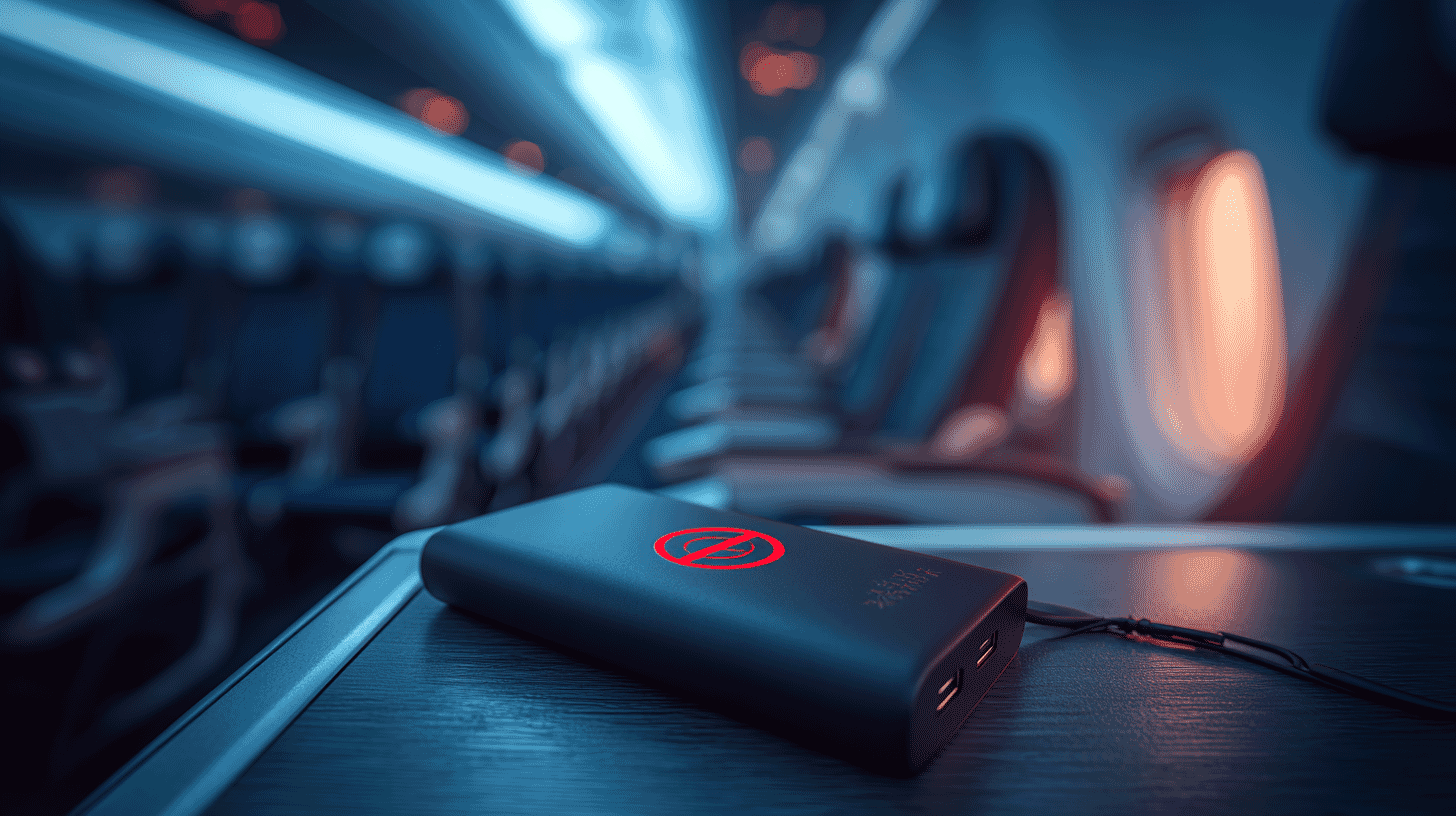
🔋✈️ Since April 24, 2026, you can no longer charge with a power bank on any flight to or from Japan. Charging the power bank itself is out too, and carry-on is capped at two per person. If you are planning a trip to Japan, here is what changed.
Why Japan Is Cracking Down on Power Banks
Mobile batteries, or power banks, have become indispensable travel companions in the smartphone era. But behind their convenience lies a growing safety crisis that has aviation authorities worldwide on alert.
In-flight incidents involving lithium-ion battery fires in power banks have surged in recent years. Japan's National Institute of Technology and Evaluation (NITE) recorded 123 mobile battery-related accidents in 2024 alone. When a fire breaks out inside an aircraft cabin at cruising altitude, there's nowhere for passengers to go, making even minor battery incidents potentially catastrophic.
The turning point came on January 28, 2025, when Air Busan flight 391 (an Airbus A321) bound for Hong Kong caught fire while preparing for departure at Gimhae International Airport in Busan, South Korea. Fire broke out in a rear overhead bin. All 176 people aboard evacuated by slide, and South Korea's transport ministry reported three injuries. The aircraft was destroyed.
In a preliminary report published on February 27, 2025, South Korea's Aviation and Railway Accident Investigation Board concluded that thermal runaway in a single lithium-ion power bank stored in the overhead bin started the fire. One battery wrote off an A321.
Two months later, a Hong Kong Airlines flight from Hangzhou saw a similar overhead bin fire, this time captured on video by passengers dousing the flames with bottled water, footage that went viral across social media worldwide.
These incidents pushed the International Civil Aviation Organization (ICAO), a UN specialized agency with 193 member states, to fast-track an emergency revision of international safety standards. Because ICAO sets the baseline for global aviation rules, these changes will effectively become the worldwide norm. Japan's Ministry of Land, Infrastructure, Transport and Tourism (MLIT) revised its domestic regulations to align with the new ICAO standards.
What the New Rules Actually Say
MLIT published the new rules on April 14, 2026 and applied them from April 24. They cover three key areas.
The penalties are worth understanding precisely. Exceeding the quantity limit, exceeding the capacity limit, charging the power bank itself onboard, putting one in checked baggage, and failing to insulate terminals can each carry penalties under the Civil Aeronautics Act of up to two years' imprisonment or a fine of up to 1 million yen. Charging another device from a power bank is on the prohibited list but is not among the items for which penalties are spelled out; ANA's own notice says charging the power bank is "prohibited" while charging from it is something passengers should "refrain from." Crew are exempt where their duties require it.
Carry-on limit of 2 power banks per person. Regardless of capacity, you can now bring a maximum of 2 mobile batteries onboard. This count includes spare batteries for cameras and other devices, though spare batteries rated at 100Wh or below are exempt from the limit. Previously, there was no quantity restriction for power banks under 100Wh, now, even a small 5,000mAh charger counts toward the 2-unit cap.
No charging with power banks during flights. You cannot charge your phone, tablet, or any device using a power bank while onboard. You also cannot charge the power bank itself using the aircraft's seat-mounted outlets or USB ports. To be precise, this is a ban on charging, not a blanket ban on carrying power banks, but in practice there is little reason to have one out during the flight. Power banks must also be kept within reach rather than in the overhead bin, so that any overheating is noticed immediately, now a globally recommended practice.
Checked baggage ban remains. Power banks still cannot go in checked luggage under any circumstances. They must be carried in your cabin baggage and stored where you can see them: in the seat pocket or at your feet, not in the overhead bin.
What's NOT banned: Charging your devices directly from the aircraft's built-in USB ports or power outlets is perfectly fine. The restriction applies specifically to power banks as an intermediary charging device. Batteries built into your laptop, phone, or tablet are not classified as "mobile batteries" and face no new restrictions; you can keep using your devices normally during the flight. MLIT defines a mobile battery as a device with a built-in lithium-ion cell whose purpose is charging other electronics.
Separately, effective the same April 24 date, MLIT's Civil Aviation Bureau added sodium-ion batteries to the list of prohibited items. Unlike lithium-ion, those are barred from both cabin and checked baggage.
Understanding Watt-Hours (Wh): A Quick Guide
The 160Wh upper limit for carry-on power banks might sound abstract, but here's how to check your device. Most power banks display capacity in mAh (milliamp-hours), so use this formula:
Wh = mAh × Voltage (V) ÷ 1,000
Standard power banks operate at 3.7V, which means a 10,000mAh unit is approximately 37Wh, a 20,000mAh unit is about 74Wh, and a 30,000mAh unit comes to roughly 111Wh. In other words, the everyday power banks most travelers carry, typically in the 10,000 to 20,000mAh range, fall well within the 160Wh limit. Large portable power stations designed for camping or outdoor use, however, may exceed it and should be checked carefully.
All Flights To and From Japan Are Covered
This isn't just a domestic rule. The ban applies to every airline operating flights to and from Japan, including international carriers and low-cost carriers (LCCs). Since ICAO's 193 member states are expected to adopt similar standards, this will effectively become a global regulation rather than something unique to Japan.
Several countries and airlines moved ahead of the ICAO timeline. In South Korea, Air Busan itself banned overhead-bin storage from February 7, 2025, and the transport ministry imposed nationwide restrictions from March 1: no overhead-bin storage, no in-flight use or charging, and each unit bagged individually and kept in the seat pocket. Thai Airways, Singapore Airlines and China Airlines also banned in-flight use during March 2025.
Australia's Qantas, Jetstar, and Virgin Australia followed in December 2025. Germany's Lufthansa Group implemented a full ban in January 2026.
How Japanese Airlines Are Responding
With power banks off the table, the availability of seat-mounted charging becomes crucial. Japan Airlines (JAL) reports that all 75 of its international fleet aircraft have charging facilities, and 70 of 71 domestic aircraft are equipped (one Boeing 767 being the exception). ANA has similarly equipped the majority of its fleet. However, many LCCs still operate aircraft without seat power, which could frustrate budget travelers who relied on power banks for long flights.
Aviation analyst Kotaro Toriumi has noted that the stricter carry-on rules could push some domestic travelers toward Japan's bullet trains (Shinkansen), which have no such restrictions on power bank use, a potentially significant competitive shift.
How to Prepare for Your Trip to Japan
If you're flying to Japan in April 2026 or later, here's your preparation checklist:
Check your power banks. Verify the Wh rating on each unit and make sure none exceed 160Wh. Remember, you're limited to 2 total. Leave extras at home or at your hotel.
Charge everything before boarding. With no power bank access during your flight, fully charge your phone, tablet, e-reader, and any other devices before you get to the gate. Consider closing unnecessary apps, enabling battery-saving mode, and downloading entertainment (movies, podcasts, ebooks) in advance so you're not streaming over Wi-Fi and draining your battery.
Book seats with power outlets. Direct charging from the aircraft's built-in USB ports and outlets is still allowed. When booking, look for aircraft types and seat classes that offer charging. Full-service carriers like JAL and ANA generally provide this, but if you're flying an LCC, check the specific aircraft.
Use airport charging spots. Japan's major airports, among them Haneda, Narita and Kansai, offer charging stations throughout their terminals. Arrive a bit early and top up your devices before boarding.
Stay informed. After a public comment period through March 30, 2026, and the ICAO Council's adoption of the standards in late March, the enforcement date was set at April 24, 2026, overlapping with the spring travel season and Golden Week. Some airlines impose stricter rules than the national baseline, so the final word is your carrier's own guidance.
Japan is following a global trend here rather than setting one, and the uniformity of ICAO-based standards should eventually make the rules predictable no matter where you fly. In Japan, reactions to the new regulation have been mixed. Many accept the safety rationale, while others worry about the impact on LCC passengers without access to seat power, or question whether a blanket ban is the best approach when the real problem may be counterfeit and poorly manufactured batteries.
What are the rules for power banks on flights in your country? Has your airline already banned in-flight use, or can you still charge freely at 35,000 feet? We'd love to hear about your experiences and what you think of these new global regulations.
References
- https://www.mlit.go.jp/report/press/kouku10_hh_000310.html
- https://www.jal.co.jp/jp/ja/info/2026/other/260330/
- https://www.ana.co.jp/ja/jp/special-notice/001379.html
- https://flyteam.jp/news/article/142620
- https://www.travelvoice.jp/20260227-159332
- https://www.itmedia.co.jp/news/articles/2602/18/news122.html








Global Discussion
16 comments