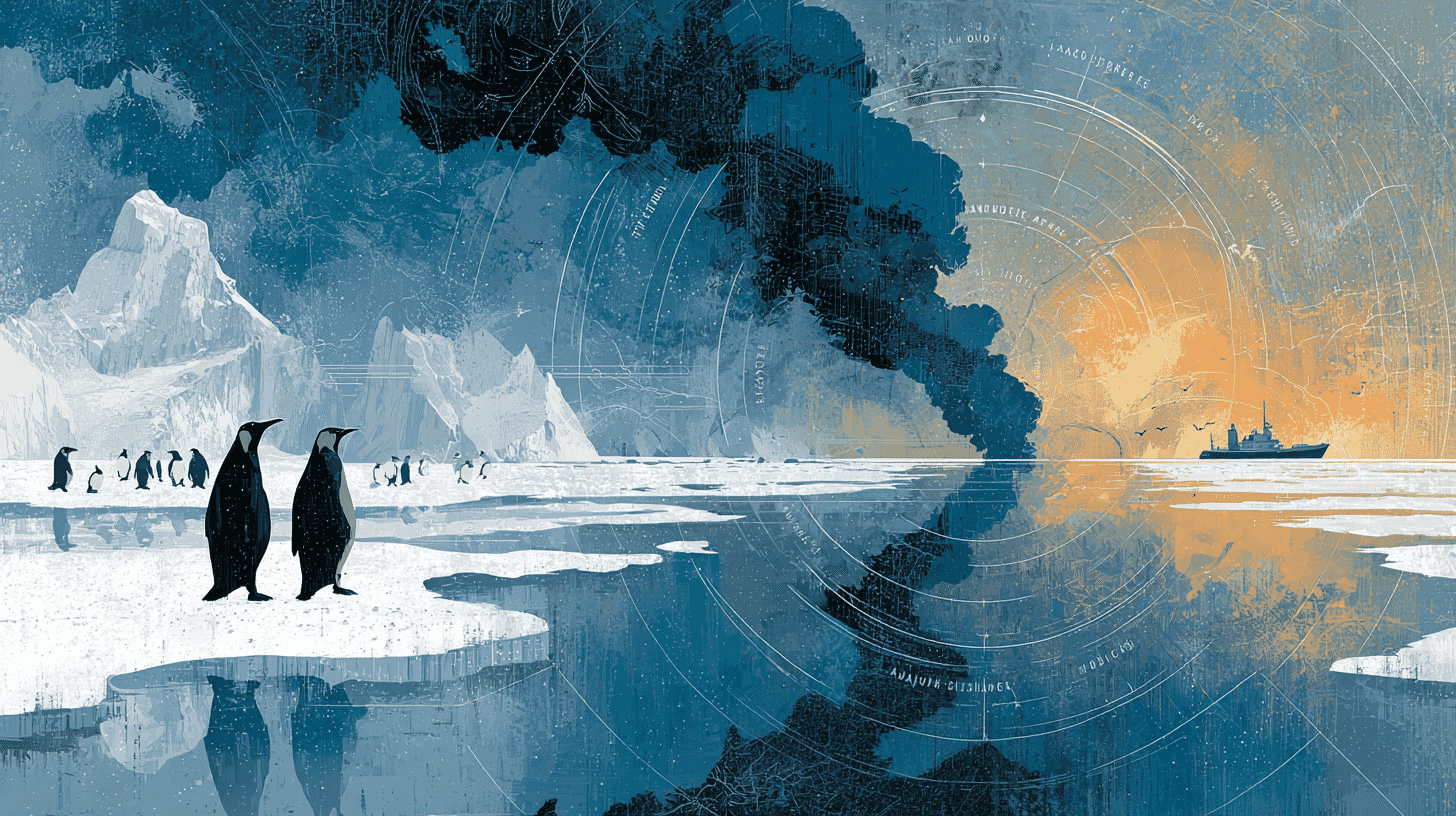
For the first time in 32 years, Japan hosted the Antarctic Treaty Consultative Meeting, and ATCM48 closed in Hiroshima in May 2026. Tourist numbers have exploded from 5,000 a year in the 1990s to over 120,000, sea ice has hit record lows, and emperor penguins were upgraded to "Endangered" weeks before the meeting opened. More than 400 delegates from 44 countries gathered in a city defined by its peace symbolism. Here is what was on the table, and how much of it moved.
A 32-Year Gap, Now Closed in Hiroshima
From May 11 to 21, 2026, the 48th Antarctic Treaty Consultative Meeting (ATCM48) and the 28th Committee for Environmental Protection (CEP28) met in Hiroshima, chaired by Ambassador Hideki Uyama. It was only the third time Japan has hosted: the 6th meeting in Tokyo in 1970, the 18th in Kyoto in 1994, and now Hiroshima, a 32-year gap.
The ATCM is the annual gathering of the 29 Consultative Parties to the Antarctic Treaty, where they hammer out decisions on peaceful use, scientific cooperation, and environmental protection. The treaty itself had 58 parties as of January 2026; the Consultative Parties are those running active science programmes there. Every decision is taken by consensus, and that consensus has become harder to reach in recent years.
The choice of Hiroshima carries symbolic weight. The Antarctic Treaty's core promise is to keep Antarctica as a place dedicated to peace and science. Hosting the meeting in a city defined by its anti-war message was itself a signal to the international community.
What's Actually Going Wrong in Antarctica
To understand what's at stake at ATCM48, you need to know what's happening on the ice right now.
1. Tourist Explosion and the "450,000 by 2033" Forecast
Antarctic tourism has gone vertical. From 5,000–7,000 visitors per year in the 1990s, the figure broke 10,000 around 2000, and reached roughly 120,000 in the 2023–24 season. One research forecast suggests the number could reach 450,000 a year by 2033, roughly four times today's levels.
It's not just the headcount. Tourism is concentrated in the brief Southern Hemisphere summer (January to March), packing intense pressure into a few months on a fragile ecosystem. There's also a growing problem of "rogue tourism", private yachts and unpermitted small expeditions that don't belong to IAATO (the International Association of Antarctica Tour Operators) and operate in a regulatory gap.
2. Tourists Bring Pollution, and Even Speed Up the Snowmelt
A startling 2025 study, led by researchers including Raul Cordero of the University of Groningen in the Netherlands, found that in areas of Antarctica with human activity, concentrations of heavy-metal particles (nickel, copper, zinc, lead) are now ten times higher than 40 years ago.
Cruise ships burn fossil fuel, which produces black carbon, soot particles that absorb sunlight. When black carbon settles on snow, it accelerates melting. According to Cordero, a single tourist may be responsible for accelerating the melt of around 100 tonnes of snow.
And long-staying scientific personnel have a per-person impact estimated at up to 10 times that of a single tourist. "We're here for science" doesn't wipe out the footprint.
3. Sea Ice at Record Lows: A "5-Sigma" Event in 2023
Antarctic sea ice hit historic lows from 2022 through 2024. The hit was particularly severe in the Bellingshausen Sea, west of the Antarctic Peninsula. Sea ice that had averaged about 500,000 square kilometres (roughly the size of Spain) over 50 years collapsed to 100,000 square kilometres in 2023. Coastal "fast ice", sea ice anchored to the shore, was reduced to just 2,000 square kilometres.
In statistical terms, this was a "5-sigma" event, more than five standard deviations from the norm, a probability so low it should occur only once in millions of years. It shook the research community.
4. Emperor Penguins Officially Upgraded to "Endangered"
On April 9, 2026, the IUCN (International Union for Conservation of Nature) moved emperor penguins from "Near Threatened" to "Endangered." The world's largest penguin has officially entered the countdown toward extinction.
The cause is straightforward: ice collapse. Emperor penguins don't breed on land, they breed on the fast ice. When ice breaks up too early, chicks that haven't yet grown waterproof feathers fall into freezing water and drown.
According to satellite-image analysis by the British Antarctic Survey, four of the five emperor penguin colonies around the Bellingshausen Sea suffered total breeding failure in 2022. In Marie Byrd Land, satellite imagery had previously shown more than 100 moulting groups in the same region; by 2025, only 25 small groups were visible.
The IUCN projects that emperor penguin populations will fall by 50% within the next 50 years if current warming trends continue.
5. Antarctic Fur Seals Endangered Too, as the Krill Ecosystem Frays
It isn't just the penguins. Antarctic fur seals were also reclassified in 2026, from "Least Concern" all the way to "Endangered." The species' population has fallen by more than 50% between 1999 and 2025.
The driver is krill. Warming ocean waters are pushing krill toward colder regions, and species that depend on krill are being affected through the food chain. The Southern Ocean's food web is, in effect, collapsing from the bottom up.
CCAMLR (the Commission for the Conservation of Antarctic Marine Living Resources), of which Japan is a member, is responsible for managing krill and Patagonian/Antarctic toothfish ("mero" in Japanese) stocks. But proposals to expand Marine Protected Areas (MPAs) have stalled for years, blocked by Russia and China refusing consensus.
The Five Issues That Dominated Hiroshima
Against this backdrop, five issues dominated the Hiroshima agenda.
① A Stronger Tourism-Management Framework
The biggest item on the table was "how to regulate Antarctic tourism." Ahead of the meeting, Ambassador Uyama told a CSIS interview that tourism management was likely to receive particular attention this year.
Specific points include updating site-specific guidelines, building a comprehensive framework, developing visitor-management policies, addressing the diversification of activities (helicopter tours, camping, polar plunges), and ensuring transparent sharing of visitor statistics and incident data.
② Designating Emperor Penguins as a Specially Protected Species
The other pending issue was the proposal to designate emperor penguins as a Specially Protected Species under the Antarctic Treaty system. The species has become a symbol of climate change's impact on polar wildlife, and international interest is high. Designation, though, requires unanimity.
③ Toward Bringing Annex VI into Force: Japan's Domestic Move
Annex VI of the Madrid Protocol on Environmental Protection, adopted in 2005, deals with liability for environmental emergencies such as oil spills from tourist ships. But it requires ratification by all 28 states that were Consultative Parties when it was adopted, and more than 20 years on, it is still not in force. As of March 2026, 19 had ratified and nine had not, Japan among them.
On April 3, 2026, Japan's Cabinet approved a bill amending its Antarctic Environmental Protection Law and sent it to the Diet, putting in place the domestic measures needed for Japan to ratify Annex VI. The amendment has three pillars.
First, it expands the scope of "Antarctic activities" requiring prior confirmation by the Minister of the Environment. Until now, the focus was activities that involve landing on the continent. Under the bill, tourist ships and research vessels operating only within Antarctic waters, even without crew landing, would also need prior confirmation.
Second, it tightens obligations on activity organisers. Organisers will be required to submit emergency response plans and to put in place measures (such as insurance) to ensure they can pay up to the maximum amount specified in Annex VI in the event of an environmental emergency.
Third, the Environment Minister will be empowered to officially declare an environmental emergency, mandate response measures, and recover costs from organisers if a Treaty Party government takes the action in their place.
④ Strengthening Transparency, Japan's Top Priority
Ambassador Uyama had identified transparency as Japan's top priority for this ATCM. When parties' activities in Antarctica lack transparency, mistrust grows and the spirit of the treaty erodes. The meeting took up inspection regimes, information sharing, and how to govern dual-use technologies, with both civilian and military potential, without choking off legitimate scientific work.
⑤ Pushing for an Expanded Marine Protected Area System
Environmental NGOs including the Antarctic and Southern Ocean Coalition (ASOC) are calling on Japan to use the Hiroshima meeting as a turning point for MPA expansion. Since the Ross Sea MPA (1.55 million square kilometres, the world's largest at the time) was established in 2016, new proposals such as the East Antarctic MPA have been stuck on the table for years.
There is also a question of consistency with the global "30 by 30" goal of protecting 30% of the planet by 2030, agreed under the Convention on Biological Diversity in 2022.
How It Actually Ended
ATCM48 and CEP28 closed on May 21. The headline proposal, listing the emperor penguin as a Specially Protected Species, failed: China and Russia withheld consent. In its place, all parties agreed to recognise the risk that shrinking sea ice poses to the species' survival, to treat its protection as a priority, and to keep working on appropriate mechanisms. Short of the label, but not nothing.
On environmental protection, two new Antarctic Specially Protected Areas were designated. On transparency, parties confirmed the importance of exchanging information about their Antarctic activities and adopted a resolution encouraging them to do so, which is the clearest win for Japan's stated priority.
On tourism, delegates worked through concrete regulatory and monitoring approaches and agreed to keep the discussion running between sessions. No cap on visitor numbers, no binding framework yet. A joint workshop between the CEP and the CCAMLR Scientific Committee also convened on climate change and monitoring.
At the closing press conference, Ambassador Uyama said the meeting had managed to hold on to shared purpose and international cooperation in an era of division and uncertainty. ASOC's assessment was blunter: diplomatic decision-making, it warned, remains dangerously slow relative to the pace of climate and biodiversity change in Antarctica.
Japan's 70 Years on the Ice, and Why Its Voice Matters
Japan has continuously conducted Antarctic research since the International Geophysical Year of 1957–58, close to 70 years. From Showa Station, Mizuho Station, Asuka Station, and Dome Fuji Station, Japanese researchers have analysed ice cores reaching back 720,000 years, built one of the world's largest meteorite collections, and discovered the ozone hole (Shigeru Chubachi, 1982).
Japan is one of the 12 original signatories of the Antarctic Treaty and is a "non-claimant", meaning it neither asserts territorial sovereignty in Antarctica nor recognises the claims of others. The seven claimant states are the UK, Norway, France, Australia, New Zealand, Chile, and Argentina, with some claims overlapping. Japan's non-claimant position has historically allowed it to bridge claimants and non-claimants. Hosting after a 32-year gap reaffirms that role.
What the Continent Is Asking the World
Antarctica is the last great wilderness on Earth. And yet, almost every problem facing modern human society is reflected there in microcosm: climate change, the dark side of the tourism industry, geopolitical tension, the limits of international cooperation, and the slow pace of national-level legislation.
The Hiroshima meeting had to deal with all of these at once. Consensus decision-making, the presence of Russia and China, intensifying warming, easy agreements aren't on offer. Even so, the fact that the Antarctic Treaty system has functioned for 65 years suggests international cooperation isn't impossible.
What's happening in Antarctica will reach the world's coastlines eventually.
How aware is Antarctica's situation in your country? How do you feel about climate change threatening the ecosystem of a distant continent?
References
- https://www.env.go.jp/press/press_04382.html (Ministry of the Environment: ATCM48 announcement)
- https://www.env.go.jp/press/press_03750.html (Ministry of the Environment: Cabinet decision on Antarctic Environmental Protection Law amendment)
- https://www.mofa.go.jp/press/release/pressite_000001_02289.html (Ministry of Foreign Affairs: ATCM48)
- https://www.csis.org/analysis/governing-antarctica-2026
- https://news.mongabay.com/short-article/2026/04/emperor-penguins-are-now-endangered-amid-climate-change-and-melting-ice/
- https://iucn.org/events/external-event/48th-antarctic-treaty-consultative-meeting
- https://www.asoc.org/news/joint-statement-100-days-to-atcm48-in-hiroshima-japan/






Global Discussion
14 comments