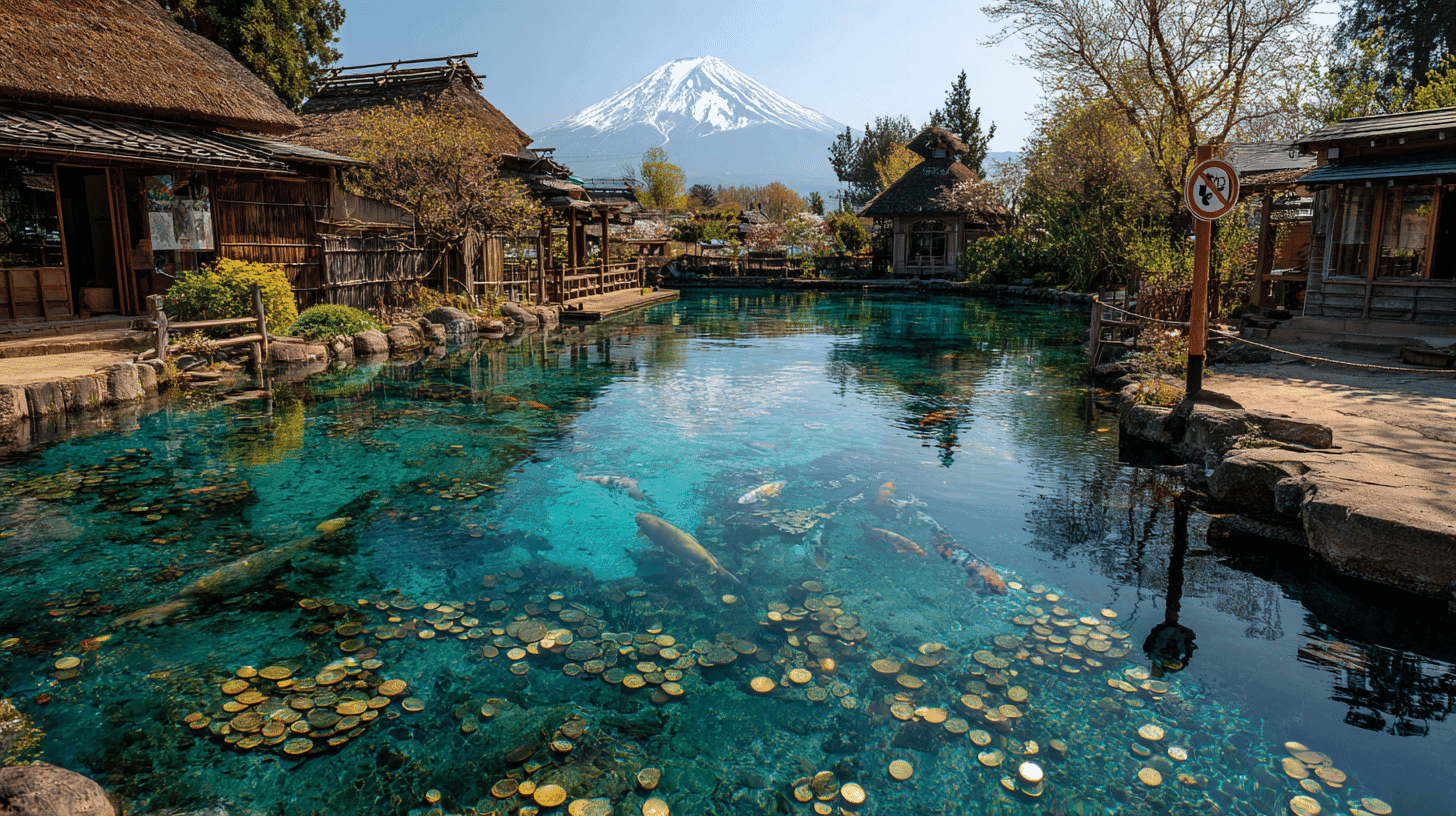
Imagine water so pure it took twenty years to filter through the volcanic rock of Mt. Fuji. Now imagine thousands of coins slowly poisoning the fish that live in it. That's exactly what's happening at Oshino Hakkai, one of Japan's most beautiful UNESCO World Heritage sites, and why your "good luck" coin might be killing koi.
What Is Oshino Hakkai?
Tucked into the foothills north of Mt. Fuji in Yamanashi Prefecture, Oshino Hakkai is a cluster of eight crystal-clear spring-fed ponds. The water originates as snowmelt on Mt. Fuji, seeping through layers of porous lava rock over roughly two decades before bubbling up as some of the purest natural spring water in Japan.
The site was registered as part of the Mt. Fuji UNESCO World Cultural Heritage designation in 2013 and is also a nationally designated Natural Monument. Traditional thatched-roof buildings dot the surrounding village, and on a clear day, Mt. Fuji towers majestically in the background. It's a scene straight out of a postcard, and a must-visit stop on any Fuji Five Lakes itinerary.
The Coin Problem: Good Intentions, Toxic Results
In many Western countries, tossing a coin into a fountain or spring is a beloved tradition. Think of Rome's Trevi Fountain, where millions of coins are thrown each year. Tourists visiting Oshino Hakkai have been applying this same instinct to the pristine ponds, and the results are devastating.
Here's the critical cultural difference: throwing coins into water is not a Japanese tradition. Japan has its own coin-based wishing custom, but it involves tossing money into a saisenbako (offering box) at Shinto shrines, not into natural bodies of water. At sites like Oshino Hakkai, throwing coins into the ponds is essentially littering in a sacred, protected natural environment.
Signs in four languages (Japanese, English, Chinese, and Korean) warn visitors not to throw coins. But the warnings are routinely ignored. When asked why they tossed coins, foreign tourists told reporters: "There were already lots of coins in there," and "For good luck, to make a wish." The existing coins create a vicious cycle, signaling to newcomers that it's an acceptable practice.
From 4,400 to 18,000: A Four-Fold Surge
Volunteer divers periodically descend into the ponds to retrieve coins by hand. In 2024, they collected about 4,400 coins. In 2025, that number skyrocketed to roughly 18,000, a four-fold increase that mirrors the surge in inbound tourism to Japan.
The recovered coins aren't just Japanese yen. They include Chinese yuan, U.S. dollars, euros, Thai baht, and currencies from around the world, a clear indicator of the problem's international scope.
Each Coin Is a Slow-Release Poison Pill
The damage goes far beyond aesthetics. Each coin undergoes chemical reactions in the unique environment of these ponds, steadily releasing toxic metals.
Oshino Hakkai's water isn't ordinary tap water or fountain water. It's ultra-pure spring water with a distinct pH level and a delicate ecosystem of bacteria, plants, and fish that evolved over centuries. In this environment, the copper and zinc in coins break down significantly faster than they would in regular water.
In effect, every coin acts as a slow-release capsule of harmful chemicals. The dissolved metals directly affect the koi and other fish, while also accumulating in the pond-bottom sediment where they're absorbed by shrimp, plants, and other organisms, infiltrating the entire food chain of these small, closed ecosystems.
Japan's Creative Countermeasure: The Saisenbako Solution
Rather than simply fighting human nature, Oshino Village is trying to redirect it. The plan: install collection boxes modeled after the saisenbako (offering boxes) found at Shinto shrines near the ponds. The idea is to give coin-tossing tourists a culturally appropriate outlet for their impulse.
The village is funding the project through a crowdfunding campaign tied to Japan's furusato nozei (hometown tax) system, with installation planned for fiscal year 2026. The boxes won't grant divine blessings, but they may satisfy the urge to throw a coin, and spare the ponds in the process.
How to Actually Make a Wish in Japan
Japan has a rich tradition of coin-based wishes, just not in ponds. Here's how it works:
At virtually every Shinto shrine and Buddhist temple in Japan, you'll find a saisenbako, a wooden box with a slatted top. Visitors toss in a coin (5 yen, or about $0.03, is considered lucky because go-en sounds like the word for "good fortune/connection"), clap their hands, and make a wish. The sound of the coin is believed to awaken the enshrined deity.
For a unique twist, visit Zeniarai Benzaiten Shrine in Kamakura, where you can literally wash your money in sacred water, it's said to multiply your wealth. These are the proper, culturally sanctioned ways to use coins for wishes in Japan.
Visitor's Guide to Oshino Hakkai
Getting there: Take a bus (about 20 minutes) from Fujisan Station on the Fuji Kyuko Line. From Tokyo's Shinjuku Station, express buses reach Kawaguchiko in about 2 hours; transfer from there. By car, it's roughly 20 minutes from the Kawaguchiko IC on the Chuo Expressway.
Best time to visit: Winter through early spring (December–March) offers the clearest skies and a snow-capped Fuji backdrop. Summer greens are gorgeous too. Cherry blossom season (early April) and autumn foliage (November) are popular but crowded.
While you're there: Try the local specialty tofu made with spring water, grab soba noodles and kusa mochi (herb rice cakes) at a tea house, and consider a stop at Oshino Shinobi no Sato for a ninja-themed experience.
Etiquette Tips for Responsible Visitors
These guidelines apply not just to Oshino Hakkai, but to tourist sites across Japan:
- Never throw coins into ponds, rivers, or springs. In Japan, this isn't a wish, it's littering.
- Read the signs. They're typically posted in four languages. If you see 禁止 (kinshi/prohibited), respect it.
- Find a saisenbako. If you want to make a wish, head to the nearest shrine.
- Respect private property. Don't enter residential areas or private gardens for photos.
- Take your trash with you. Public trash cans are rare in Japan, carry your waste out.
A Microcosm of Overtourism
The coin-throwing problem at Oshino Hakkai isn't an isolated incident. Similar issues have been reported at a fountain outside Kanazawa Station and at shrines in Saitama Prefecture. As Japan's inbound tourism booms, well-meaning cultural misunderstandings are causing real environmental harm at sites across the country.
What makes this issue particularly poignant is that the tourists mean no harm. They're applying customs from their own cultures with genuine good intentions. But good intentions don't protect endangered ecosystems. Taking a few minutes to learn about local customs before visiting, that's the first step toward being a truly respectful traveler.
Japan is currently grappling with a profound question through something as small as a tossed coin: how do you welcome the world while protecting what makes a place special? What similar challenges do tourist destinations face in your country? We'd love to hear your perspective.






Global Discussion
14 comments