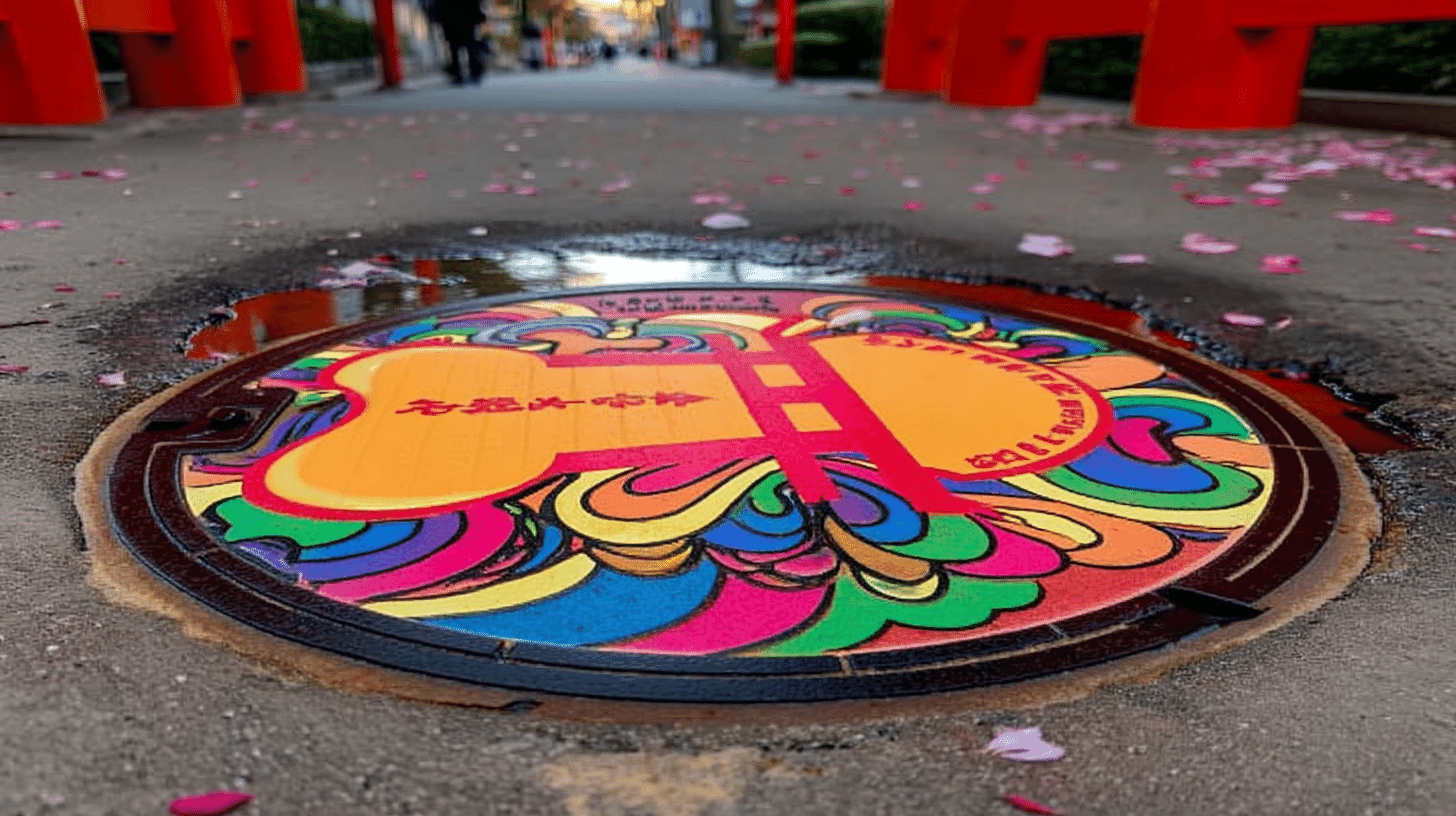
What if the ground beneath your feet doubled as a gallery, and one exhibit happened to be a sacred phallus? A newly installed manhole cover in Ninohe City, Iwate Prefecture, is making waves online with its bold depiction of a Shinto fertility deity. But look beyond the shock value, and you'll discover an entire subculture: Japan has roughly 12,000 unique manhole cover designs, legions of dedicated fans called "manholers," and a nationwide collecting craze that rivals Pokémon cards.
The Fertility God Manhole of Ninohe
On March 24, 2026, a vividly colorful manhole cover was installed on the sidewalk in front of Kobunoki Shrine in Ninohe, a small city in northern Iwate Prefecture. The design features Konsei Daimyojin, the "Great Deity of the Metal Phallus", a Shinto god of fertility, safe childbirth, and marital harmony. The shrine's parishioners' association donated the cover to the city after commissioning a specialist designer who had been working on it since June 2025.
Kobunoki Shrine has a history stretching back to 1931, when it was established during a devastating famine in the Tohoku region. Recently forced to relocate due to an urban redevelopment project, the shrine ran a crowdfunding campaign that blew past its 10-million-yen goal (about $63,000). It now sits just a two-minute walk from Ninohe Station on the Tohoku Shinkansen line, roughly three hours from Tokyo.
Why Phalluses? Japan's Fertility Festival Tradition
Visitors from abroad are often startled to see phallic imagery in public spaces in Japan, but these symbols carry deep spiritual significance. In Shinto tradition, phallus-shaped objects have been venerated for centuries as symbols of fertility, prosperity, and protection against evil.
The most famous expression of this tradition is the Kanamara Matsuri ("Festival of the Steel Phallus"), held every April at Kanayama Shrine in Kawasaki, just south of Tokyo. Giant phallus-shaped floats parade through the streets, vendors sell suggestively shaped candy, and the atmosphere is one of cheerful celebration rather than embarrassment. Originally a prayer for protection against sexually transmitted diseases and for business prosperity, the festival has become a major draw for international tourists. The 2026 edition took place on April 5.
Ninohe has its own version: the annual Konsei Festival, where teams race up a hill near the station while carrying a portable shrine bearing the deity. The event's highlight, a timed race called the "KON-1 Grand Prix", drew a record 8,500 spectators in 2024.
Japan's Manhole Cover Art: A World Like No Other
What makes Japan's manhole covers unique on a global scale is the sheer diversity and artistry. Municipalities across the country compete to create original designs featuring local landmarks, regional specialties, mascot characters, and even anime collaborations. With roughly 12,000 distinct designs nationwide, Japan's sidewalks form what some fans call "the world's largest open-air gallery."
Fueling the fandom is the "Manhole Card" program, a free collectible card series launched in 2016 by the Gesuido Koho Platform (GKP), a sewerage awareness organization, in partnership with local governments. Each card showcases a municipality's signature manhole design and can only be obtained by visiting the designated distribution point in person, typically a tourism office or roadside station. As of April 2026, 28 series have been released, making it a nationwide scavenger hunt.
The Rise of the "Manholers"
Dedicated manhole cover enthusiasts are known in Japanese as "manholers" (マンホーラー). They plan road trips around card distribution schedules, use share-cycle services to cover more ground, and meticulously track their collections with specialized apps.
The most popular app, "Manhole Card Map" (available on Android and iOS), displays every distribution point on a map color-coded by collection status: red for uncollected, semi-transparent for collected, orange for out-of-stock. Another app, "Manhole Collection" (iOS), lets users register not just official cards but any interesting manhole cover they encounter on their travels.
For visiting tourists, these apps offer a fun way to add structure to a trip. Chasing manhole cards naturally leads travelers off the beaten path and into local communities, exactly the kind of dispersed tourism that Japan's rural areas desperately need.
A Tiny Gateway to Local Economies
For municipalities struggling with depopulation and aging demographics, as Ninohe is, an eye-catching manhole cover is a surprisingly effective low-cost tourism tool. Distribution points at tourism offices and roadside stations mean that card collectors inevitably explore the surrounding area, buying local specialties and dining at nearby restaurants.
In a country where infrastructure is typically invisible, Japan has turned the humble manhole cover into a canvas for civic pride, a tourism magnet, and a bridge between tradition and pop culture.
What About Your Country?
In Japan, everything from fertility gods to beloved anime characters adorns the ground beneath your feet. Does your country or city have its own unique manhole covers, street art traditions, or unexpected public art? Let us know in the comments.






Global Discussion
15 comments