✝️ Beneath the Church of the Holy Sepulchre in Jerusalem, archaeologists have spent four years working through an old limestone quarry and the garden soil that filled it, checking whether the ground matches what the Gospel of John describes. About 9,000 kilometers east, a village of 1,919 people in northern Japan skipped that step entirely. It has had the tomb of Jesus since 1935, and every June it holds a Shinto memorial rite there.
Two mounds on a hill in Aomori
Drive Route 454 between the port city of Hachinohe and Lake Towada and you will pass a roadside sign that reads, in plain Japanese, "Tomb of Christ." It points to Shingo, a village in the Sannohe district of Aomori Prefecture, near the northern tip of Japan's main island.
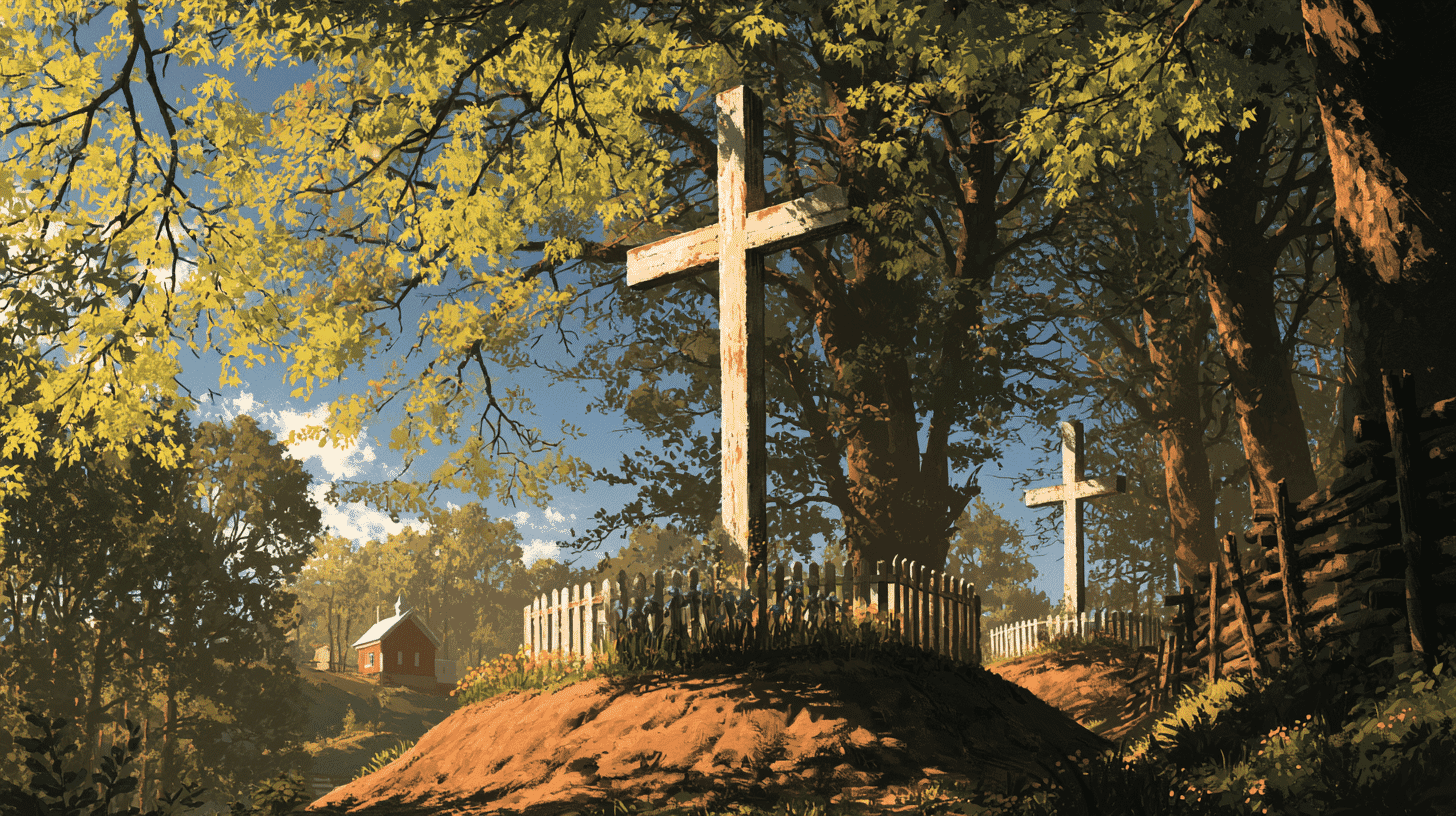
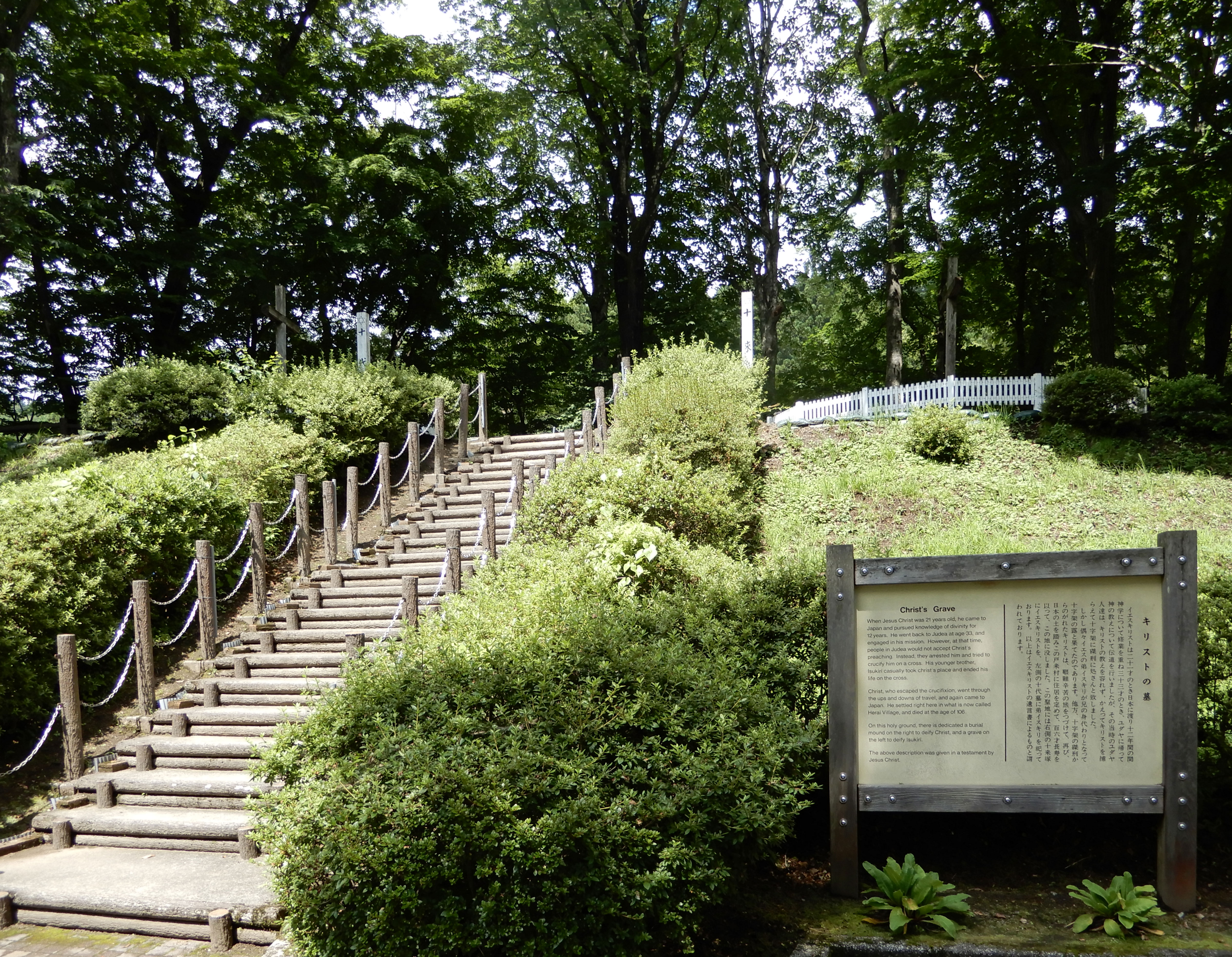
The site is a small park on a wooded rise. At the top sit two low earthen mounds, each with a plain wooden cross planted in it. The one on the right is called Toraizuka and is said to hold Jesus. The one on the left, Judaibo, is said to hold a lock of hair belonging to his younger brother, Isukiri.
Set into the ground between them is a slab of white limestone roughly 25 by 70 centimeters. It is Jerusalem stone, the material used on building exteriors across the old city, and the City of Jerusalem gave it to Shingo in 2004 as a token of friendship. Israel's ambassador to Japan attended the unveiling. The Hebrew inscription says as much.
Source: Wikimedia Commons (CC0)
The story on the site's information board runs like this. Jesus first came to Japan at 21 and spent twelve years studying theology. He returned to Judea at 33, preached, and was arrested. His younger brother Isukiri took his place on the cross. Jesus escaped east across Siberia, came back to Japan, settled in the village then called Herai, changed his name to Torai Taro Daitenku, married a local woman, raised three daughters, and died at 106.
Further up the path is a small museum, the Kirisuto no Sato Densho-kan, open since May 1996 and run by a foundation the village itself funds. It displays the documents the claim came from, along with a Japanese-language "will of Christ" that the museum's own caption attributes to a group of archaeologists in 1936. As of September 2026, admission runs ¥500 for high schoolers and adults and ¥300 for younger children, roughly three dollars and under two at about ¥160 to the dollar. It shuts on Wednesdays and closes entirely for winter, from early November to late April.
The village's own website hedges too. Whether these are really the graves of Jesus and Isukiri, it says, is something it will leave to you.
How a village acquired a tomb in 1935
In the early 1930s, Lake Towada was becoming famous. A campaign was underway to have the area designated a national park, roads and bus routes were going in to serve it, and Herai found itself just off the new tourist circuit. In September 1934 the mayor, Denjiro Sasaki, set up a local-history committee. A month later he invited a well-known painter in the nihonga tradition, Banzan Toya, to come and publicize a scenic plateau in the village called Mayogatai.
Toya arrived with interests of his own. He was immersed in the Takenouchi Documents, a body of writing presented as an ancient chronicle predating Japan's first emperor and kept by the family of a religious leader named Kiyomaro Takeuchi (1875-1965). Historians treat it as a forgery, most likely Takeuchi's own composition. Its appeal was straightforward: Japan was the origin of everything. Buddha, Confucius, Mencius and Moses had all trained there.
Toya toured Herai, concluded it had been an ancient sacred capital, identified a nearby hill as a pyramid, and published the finding in the regional daily Toou Nippo on December 1, 1934. The following August, Takeuchi came to see for himself. On a rise the locals called Hakadokodate, he stopped in front of two old mounds and announced that this was the place.
In 1937 a writer named Kiku Yamane put the story into a book and added flourishes of her own. She also located the tomb of Moses, in Ishikawa Prefecture, which is why Ishikawa has a Moses Park today, opened in 1993 on top of a genuine group of ancient burial mounds. An Associated Press correspondent in Tokyo filed a piece on the Aomori tomb in December 1938. A Japanese documentary film followed in 1939.
Takeuchi's own run went less well: in February 1936 he was arrested on suspicion of lèse-majesté involving Ise Shrine, and the sacred treasures he had been exhibiting were seized as evidence.
The evidence, and what happens when you check it
The claim rests on a handful of coincidences, which the village lists openly. Herai sounds like Hebrew. The local dialect calls a father aya or dada and a mother apa or gaga. Babies used to be marked with an ink cross on the forehead before their first outing. One family carries a star-shaped crest. And the village bon dance is sung to words nobody can translate.
Two of these have clear answers. The first is that Herai is old. It appears as Herai-no-go in a land survey of the Nukanobu district dated 1298, and regional dictionaries treat it as an established place name through the medieval period. The name had been sitting there for more than 600 years before anyone in Japan had a reason to hear "Hebrew" in it.
The dance is called Nanyadoyara, and it is sung across a wide band of former Nanbu territory spanning Aomori, Iwate and Akita, not only in Shingo. A theologian from Iwate, Eiji Kawamorita, read the refrain as Hebrew during the Taisho era and produced a military chant out of it. But the folklorist Kunio Yanagita had already watched the same dance in a fishing hamlet on the Iwate coast and wrote the words down as something far more ordinary: a woman's teasing line on a festival night, roughly "do as you please, do whatever you will." Yanagita's reading fits the occasion the song is actually sung on.
A 1976 Mainichi Shimbun volume on the Tohoku region reported that the site is the slope behind the Sawaguchi family home, holding about 100 Sawaguchi gravestones, and that the memory locals attached to the two mounds was that a great house had once stood there and someone important was buried on the spot, with nothing more definite than that. By Okamoto's account, Herai had no Christians and no hidden-Christian tradition. The Jesus story did not surface from below. It arrived by car in 1935, and when villagers retell the visit today, the black sedan usually gets a mention.
In Christian belief Jesus rose and ascended, so there is no body. Okamoto writes that academically and religiously, no tomb of Jesus exists in the first place. That logic reaches Jerusalem just as far. A rival identification, the Garden Tomb, has been argued there since the late nineteenth century, and the Roza Bal shrine in Kashmir has been claimed as the grave of Jesus since 1899. The Aomori mounds are one more entry on that list.
Why a village that doesn't believe keeps the rite
Ryosuke Okamoto, a scholar of religion who has done fieldwork in Shingo, reports that he could not find a single villager who thinks the mounds hold Jesus. The believers, such as they are, arrive from outside.
Before and during the war, being known as the place with the Christ's tomb, an Anglo-American religion at the worst possible moment, brought hostility from neighboring villages. Decades later, when Shingo went around asking residents to contribute artifacts for a tourism push, some people who had lived through those years wanted nothing to do with it.
Herai merged with the Saikoshi district of the old village of Nozawa in July 1955 to form Shingo. The first Christ Festival was held in 1964, the year of the Tokyo Olympics; a mayor of the period described it as less a festival than a gathering. It has run on the first Sunday of June ever since. The pandemic cancelled it in 2020, and the 2021 rite went ahead with about ten people present. That missing year is why the edition held on June 7, 2026 was the 62nd rather than the 63rd.
The form is entirely Shinto. A priest from Mitake Shrine, the oldest in the village, reads a norito, a formal invocation addressed to the kami. Guests present tamagushi, sakaki branches offered at the altar. The Tanaka lion dance is performed, and then Nanyadoyara is danced in a ring around the two crosses. In recent years the village has added a public dance-along and a ramen contest among local shops. One place near the village office serves Christ Ramen, garnished with a slice of fish cake cut as a six-pointed star.
By Okamoto's account, the officiating priest gives an unfussy answer: whoever is buried here, the memorial matters, and if the occupant did turn out to be Christ, a tradition that honors a countless number of kami has room for one more. The same piece reports village staff putting it differently. The person in the ground is one of our ancestors, and you don't let a grave observance lapse.
That is where Okamoto puts the weight of his argument. Religion in Japan tends to be something you do as a member of a community rather than something you sign up to believe. Many people visit shrines at New Year, marry in chapels and are buried by Buddhist priests without feeling a contradiction, because the unit of religion is the practice and the group rather than the creed. Shingo makes this unusually easy to see, precisely because nobody believes the story: take the belief away and the practice is still there, still working.
As of July 31, 2026, Shingo had 1,919 residents across 864 households. Several hundred people turn up for the festival.
Jerusalem and Herai
The Jerusalem excavation began in 2022, when restoration work on the basilica floor opened the ground. It is led by Francesca Romana Stasolla of Sapienza University of Rome and coordinated among the three communities that share the church: the Franciscans, the Greek Orthodox and the Armenians.
Under the floor they found a limestone quarry, active in the Iron Age, later filled in and farmed. Archaeobotanical work turned up olive pits, grape seeds and pollen. Tombs had been cut into the remaining rock faces. John's Gospel places a garden at the site of the crucifixion, containing a new tomb in which no one had yet been laid, and the layers match that setting closely.
A preliminary report appeared in the journal Liber Annuus in 2025. The story circled back through the news at the end of August 2026, after the first volume of the excavation record was published.
The site fits the landscape the Gospel describes, which helps explain why fourth-century Christians settled on this spot rather than another. It does not establish that any particular tomb held the body of Jesus, and Stasolla's team has not claimed that it does.
Both places therefore end up in the same logical position: neither can prove what it claims. What separates them is time and consent. Jerusalem's identification goes back to the fourth century and has been accepted by 1,700 years' worth of pilgrims. Shingo's is 91 years old and is believed by almost nobody in the village, including the people who maintain it. The rite carries on anyway, which suggests the identification was never the load-bearing part.
Is there a place near you that works the same way, sacred because it has always been treated that way rather than because anyone ever proved anything?
References
- https://www.vill.shingo.aomori.jp/sight/sight_main/kankou/sight-christ/
- https://www.nippon.com/ja/japan-topics/g00658/
- https://shingo-go.com/mystery/
- https://shingo-go.com/830/
- https://www.nikkei.com/article/DGXNASFB21030_V20C14A4000000/
- https://www.navitabi.jp/article/4556
- https://ja.wikipedia.org/wiki/%E3%82%AD%E3%83%AA%E3%82%B9%E3%83%88%E3%81%AE%E5%A2%93_(%E6%97%A5%E6%9C%AC)
- https://ja.wikipedia.org/wiki/%E6%88%B8%E6%9D%A5%E6%9D%91
- https://ja.wikipedia.org/wiki/%E3%83%8A%E3%83%8B%E3%83%A3%E3%83%89%E3%83%A4%E3%83%A9
- https://ja.wikipedia.org/wiki/%E4%BC%9D%E8%AA%AC%E3%81%AE%E6%A3%AE%E5%85%AC%E5%9C%92_%E3%83%A2%E3%83%BC%E3%82%BC%E3%83%91%E3%83%BC%E3%82%AF
- https://www.newsweek.com/possible-jesus-tomb-matching-bible-account-discovered-12381399
- https://www.lpj.org/en/news/the-stones-speak-excavations-reshaping-the-history-of-the-holy
- https://www.deccanherald.com/india/jammu-and-kashmir/jesus-tomb-in-india-all-you-need-to-know-about-kashmirs-roza-bal-shrine-3331595



Global Discussion
4 comments