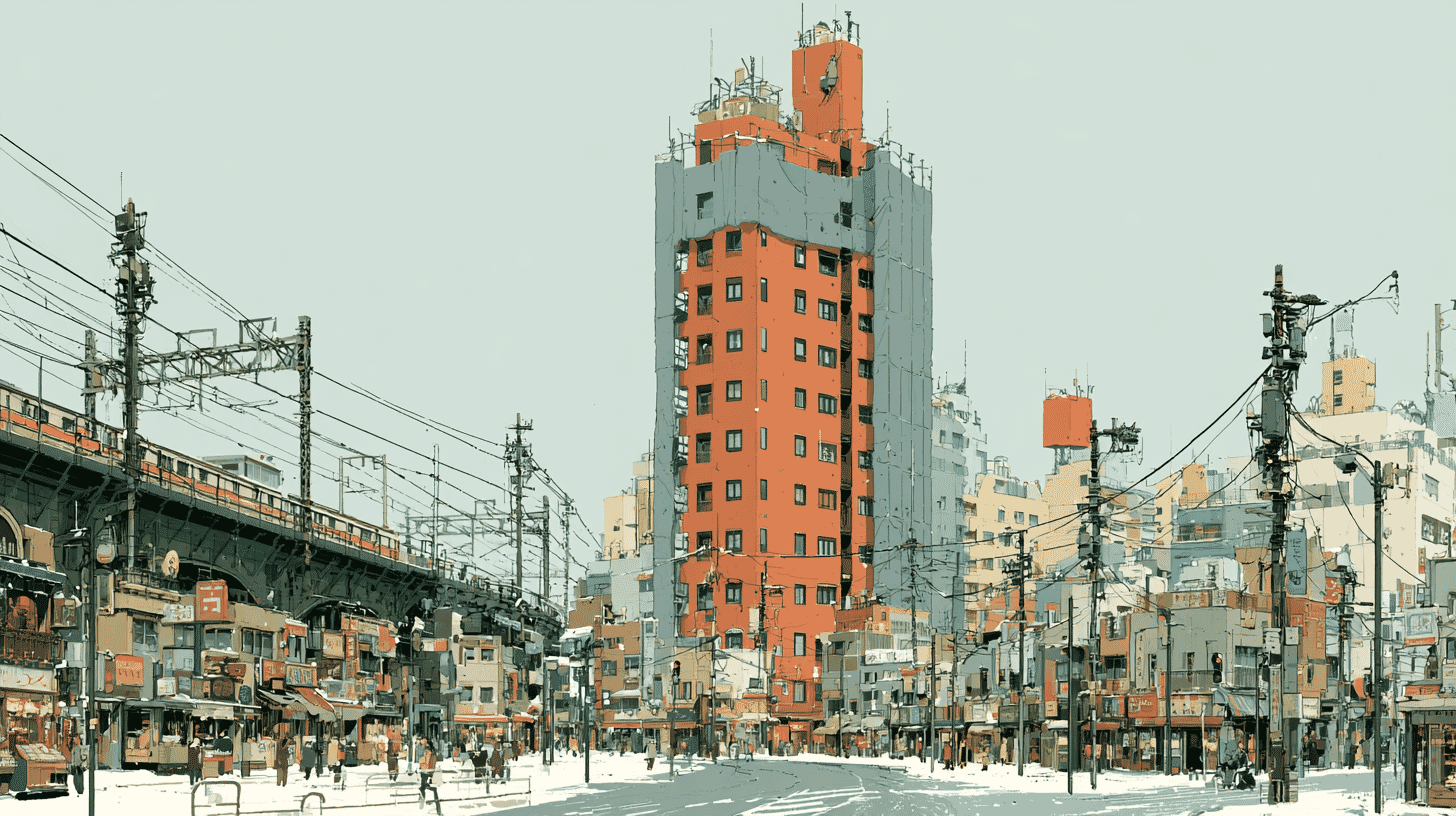
🕌 A nine-story building wrapped in gray construction sheeting sits a short walk from Okachimachi Station in central Tokyo. In October 2025, a single post on X turned it into a national argument. Critics called it an unwelcome symbol of a changing Japan. Defenders called the panic absurd. The thing almost no one mentioned at first: the building isn't new to the neighborhood at all. It replaces a mosque that has served this corner of Tokyo since 2008, in a district that has been international for far longer than that.
What's actually going up under those sheets
The project, provisionally called the Okachimachi Mosque, is being built by the Assalaam Foundation, a non-profit, non-political religious and educational body. The construction notice lists the basics: nine floors above ground, 38.8 meters tall, reinforced concrete. When people hear "nine-story mosque," they tend to picture something sprawling. In fact the lot is tiny, about 191 square meters, with a total floor area of roughly 1,110 square meters. It's a narrow tower, not a megastructure. Inside, the plan combines a prayer hall with educational space and a multipurpose hall, with completion targeted for 2026. If finished as planned, it would rank among the largest mosques in Tokyo, second to the Tokyo Camii in Shibuya.
Crucially, this is a rebuild. The Assalaam Foundation has operated a mosque in this area since 2008. Its current home, the As-Salaam building across the rail tracks, was completed in 2011 and registered as a religious corporation in 2014, with the prayer space upstairs and a community hall open to neighbors on the ground floor. It simply outgrew that space. The foundation's own site even quotes a line from the Quran: there is no compulsion in religion. None of this arrived overnight.
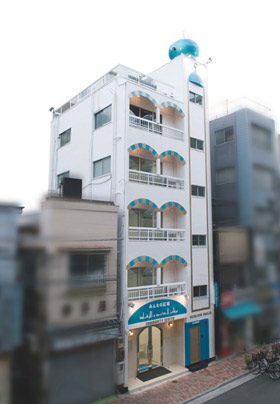
Source: Assalaam Foundation official site
What lit the fuse
The spark was a post on October 6, 2025, by Kosaka Eiji, a politician with the small right-leaning Japan Conservative Party who served six terms on the assembly of Tokyo's Arakawa ward before running unsuccessfully for the lower house in 2024. His message warned, in effect, that recognizing religious freedom without limits could erode Japan, framing the mosque within a broader critique of immigration policy. It spread fast, and a wave of alarmed and angry reactions followed.
It's worth separating two very different things that got tangled together. On one side are practical questions a community might reasonably ask. Would there be an early-morning call to prayer over loudspeakers? In Japan, mosques rarely broadcast the adhan to the street, so the fear here was amplified by misinformation. Why did residents learn about a major religious complex from social media rather than a local briefing? How transparent are religious corporations, and who funds them? Does a nine-story building fit the streetscape? Those are answerable concerns, and answering them is how trust gets built.
On the other side was a flood of openly xenophobic and anti-Islam content, along with baseless conspiracy theories. That material doesn't deserve to be repeated, and lumping it together with the practical questions does a disservice to both. Asking for a public information session is not the same as telling people to leave.
The street tells a different story
Few people know Okachimachi better than the residents who've lived there for decades, and several have pushed back on the alarm. One of them, Kiso Takashi, who has lived in the Ueno–Okachimachi–Akihabara area for more than twenty years, laid out the history. The district takes its name from the okachi, low-ranking Edo-era samurai who supplemented their stipends with metalwork: sword fittings, ornamental temple hardware. That craft tradition became the foundation of what is now one of Japan's largest jewelry trading districts, home to the headquarters of Tokyo's precious-metals and jewelry wholesale cooperative.
The international part grew out of the jewelry trade itself. Indian Jain merchants settled first; Jainism's strict prohibition on lying made them trusted figures in the gem business. South Asian Muslims followed, drawn by the trade, by an existing Indian community that made settling easier, and by cultural overlaps, including dietary rules that aligned with the Jains' strict vegetarianism. A mosque, in other words, has long been part of the town's working machinery. In more than two decades, Kiso says, he has never heard of serious friction between the foreign community and longtime locals.
That pattern isn't unique to Okachimachi. The Kobe Muslim Mosque, built in 1935 and the oldest in Japan, survived the wartime firebombing and later sheltered neighbors; during the 1995 earthquake it took in more than forty people, who rode out the aftermath alongside neighbors. The Tokyo Camii regularly opens its doors for public tours. Across Japan, mosques tend to function less as fortresses than as community anchors.
Japan and Islam, up close
Step back and the numbers explain the unease. Japan's Muslim population, estimated at around 5,000 in 1984, reached roughly 100,000 by 2010 and, by the end of 2023, about 294,000 foreign residents alone, or some 350,000 once an estimated 54,000 Japanese Muslims are counted. Prayer spaces nationwide stood at about 150 as of June 2024, roughly ten times the figure of 25 years earlier. Foreign residents hit a record 3.96 million by mid-2025, and foreign workers topped 2.3 million in late 2024, also a record. With the working-age population projected to fall from 73 million in 2025 to below 50 million by 2062, the country leans ever harder on the very people whose places of worship are now under debate.
That tension became a national political fault line in 2025, when foreign-resident policy turned into a major axis of the upper-house election, "coexistence" versus "restriction" depending on the party. The Okachimachi mosque sits squarely inside that larger argument, and it is far from the only flashpoint. Elsewhere, a mosque built without a permit turned into a fight over zoning rather than faith, and plans for Muslim burial grounds have repeatedly stalled against local opposition. But strip away the politics and much of the local fear comes down to something simpler: unfamiliarity. Most Japanese rarely encounter Islamic practice up close, and where information is thin, speculation fills the gap.
Japan is working out, in real time, what it means to live alongside neighbors whose faith it barely knows. In your country, how is the building of a mosque, or any new place of worship, received?
One last, personal note from the writer. The people who say extreme things are loud, and because they are loud, they can look like the majority. They are not. I, or rather we Japanese, respect your culture and your religion, and we hold them in regard. Where something cannot be reconciled, let us sit down and find a middle ground. I am convinced that this is how Japan, and the great majority of Japanese, truly think. So please, rest assured.









Global Discussion
4 comments