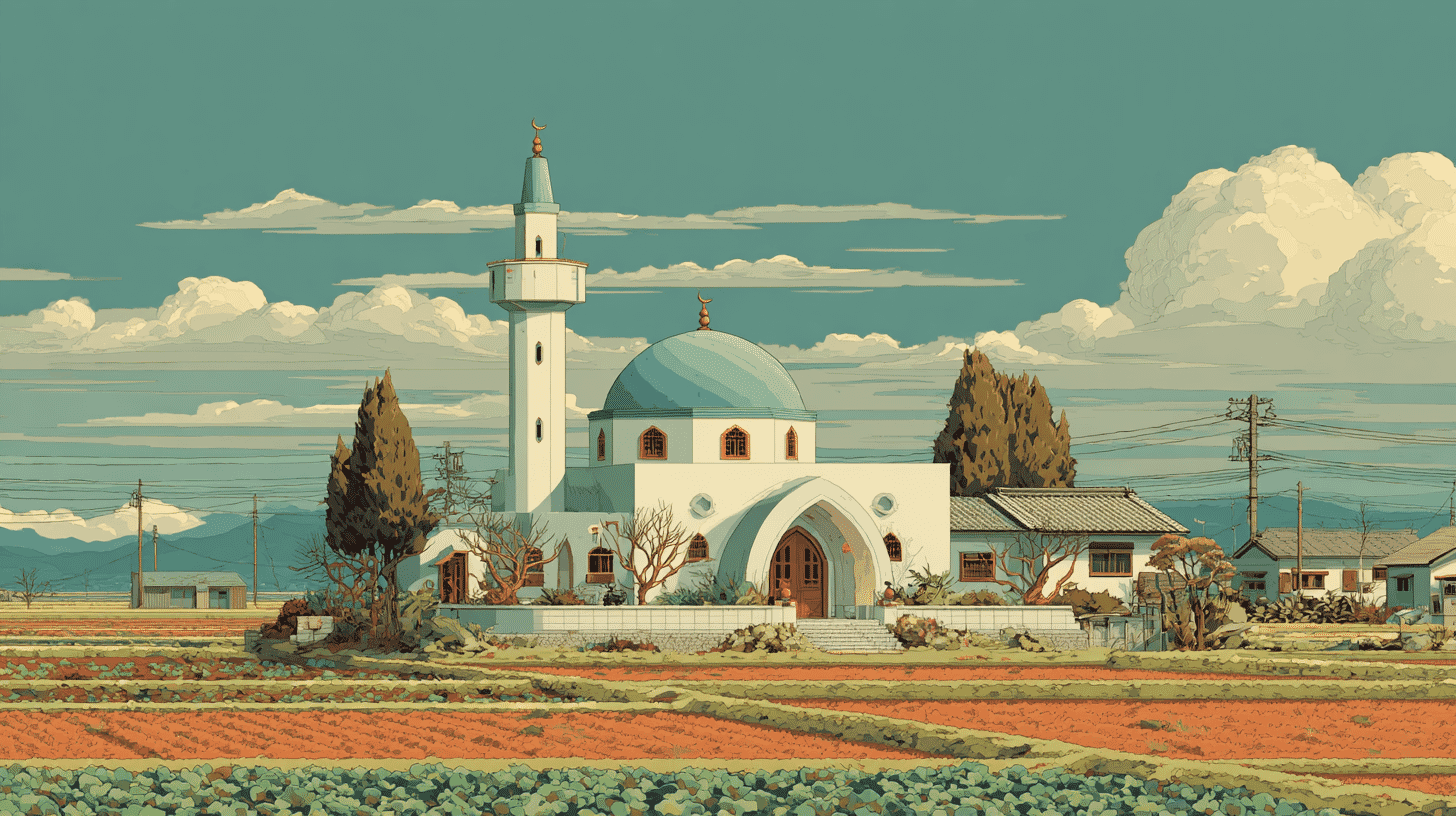
🕌 A large mosque, minaret and all, went up on a patch of farmland on the southern edge of Kawagoe, a Tokyo-area city famous for its Edo-period streets. There was just one catch: in that exact spot, almost nothing is legally allowed to be built, and nobody had asked permission. Now the city wants it gone, and it keeps repeating one thing: this is not about Islam.
What Kawagoe actually found
The building is called Japan Jame Masjid Ramzan, in the Shimoakasaka district about five kilometers south of central Kawagoe, in a stretch of vegetable fields and scattered houses. The site covers about 4,500 square meters and holds four structures, including the domed prayer hall; the land is registered as forest. According to the city's development guidance section, it was put up with no application and no permit at all.
The city says it first learned the building existed in October 2024, after a resident tipped them off. By then the exterior was nearly finished. Officials repeatedly asked for work to stop. At first, they say, site workers responded that they didn't understand Japanese, so staff went out again and again to spell it out in person: you cannot build here.
The structure was unregistered and its owner unclear. In March 2025, the land changed hands, passing from a real estate firm in nearby Fujimi to a company headed by a Pakistani man and registered at the same address. In March 2026, that company finally submitted a written corrective plan, pledging to remove the building within five years. The owners told the city the structure "had already been there," a claim that sits awkwardly against the city's account of watching it go up.
Then, on April 3, 2026, roughly a month after pledging to take it down, the mosque held an opening ceremony, attended by the Pakistani ambassador to Japan and officials from the Overseas Pakistani Foundation.
The city's line has stayed flat throughout: "We are not treating this as a problem because it's a mosque. We issue corrective guidance to illegal buildings every time. This was built without the city's permission, and we are continuing guidance with removal as the final goal."
How a building can be illegal on your own land
To a reader outside Japan, the obvious question is: it's their land, so what's the crime?
The answer is a piece of Japanese planning law that has no clean equivalent in many countries. City-planning areas in Japan are split into two zones. One is meant to be urbanized. The other, the shigaika chōsei kuiki or "urbanization control area," is meant not to be. These zones exist to protect farmland and stop cities from sprawling endlessly into the countryside. Inside them, new construction is broadly prohibited, with narrow exceptions mostly tied to agriculture and forestry. Building anything else, even on land you own outright, requires a permit under the City Planning Act.
So in that zone, an unpermitted structure is illegal on its face, whether it's a house, a warehouse, or a place of worship. That is the whole legal core of the Kawagoe case, and it would apply identically to a Buddhist temple, a Christian church, or a Japanese family's second home.
Why a small case became a national argument
If this were only about one building, it wouldn't have trended. It did, because it landed in the middle of one of Japan's most charged conversations.
Japan's Muslim population has grown fast for a country long thought of as homogeneous. A widely cited study led by Waseda University's Hirofumi Tanada estimated about 420,000 Muslims in Japan at the end of 2024, roughly 0.3% of the population but about 3.9 times the figure of two decades earlier. Indonesians are the largest group (around 200,000), followed by communities from Bangladesh, Pakistan, Malaysia, and Turkey. The number of mosques and prayer halls has climbed to around 160 by mid-2025, with several new ones opening each year. The driver is no mystery: an aging, shrinking workforce and government programs that bring in foreign labor.
That growth has collided with local anxiety. In the coastal city of Fujisawa, the planned Fujisawa Masjid won development approval in July 2025, after which worries spread about burial on the site and noise during prayers. A residents' briefing was held in February 2026, and by April rival crowds were clashing outside Fujisawa Station. Online, the Kawagoe footage spread quickly, and the ambassador's appearance at the opening became a lightning rod. Some of the reaction was straightforward rule-of-law frustration: how does a building this big go up illegally and stay up for over a year? Some of it slid into open hostility toward Muslims and foreigners in general.
The line Japan is trying to walk
Here's the uncomfortable part, and it cuts in more than one direction.
The violation is real. A permit was required, none was sought, and the city's enforcement looks consistent with how it would treat any illegal structure. Waving that away in the name of religious freedom would be its own kind of unfairness, because the rule has to mean the same thing for everyone.
But "just go through the proper channels" quietly assumes the channels lead somewhere. Often they don't. When Muslim communities have tried the lawful route for something as basic as a place to bury their dead, the same thing happened. Islam calls for burial, not cremation, in a country that cremates 99.97% of the time. Proposed sites have been blocked again and again by resident opposition, leaving almost nowhere legal to go. A path that no application can actually clear isn't much of a path.
There's a known trap in the other direction, too: collapsing "illegal building" into "Muslim" or "foreigner." In a 2024 case in Ebetsu, Hokkaido, the city flagged dozens of illegal structures in its own control zone, and most had been built by Japanese, not foreigners. That nuance vanished online, where the story was reframed as a foreigner problem, and the misinformation preceded real-world harassment of the local Pakistani community.
And over all of it sits the population math. Japan's 2025 census recorded its steepest population drop ever, down 3.1 million in five years, with foreign residents now effectively the country's only source of growth. Whatever one thinks of any single mosque, the people behind them, and their need for places to live and pray, aren't going away. If anything, Japan will be competing to attract them.
That is the real case for legal backup: not softer enforcement, but a workable route mapped out in advance, with clear paths to permits, cemeteries and prayer halls, so the choice isn't only "build illegally" or "go without." Residents' worries about traffic, noise, and being consulted are legitimate too, and belong inside that framework. Right now Japan polices the violations after the fact, while the path that would prevent them goes unbuilt.
For now, Kawagoe's case is unresolved. A removal plan is on file; the mosque is open; the outcome isn't settled.
In Japan, the rule holds even on your own land, but a rule works best when there's a lawful way to say yes, not only a way to say no. How does your country balance zoning, religious buildings, and communities that arrive whether the paperwork is ready or not?
Update, July 2026: Kawagoe published a full account of the case on its website on June 10. Mayor Hatsue Morita told the city assembly the same day that it was "a highly malicious case that damages residents' trust." By June 4 the city had confirmed that the presumed owner had stopped prayers at the site and barred entry to the grounds. A voluntary inspection was carried out on July 2, and at a press conference on July 10 the mayor said the city would "deal with it strictly, aiming for an early resolution." Talks with the Pakistani embassy continue, but there is still no clear route to removal.
References
- https://news.yahoo.co.jp/articles/f8439faa6389c55e915b9adc18a54690a66f5b5e
- https://www.city.kawagoe.saitama.jp/shisei/toshikei/1010554/1010806/1017953/1021626.html
- https://www.muslimnetwork.tv/experts-warn-of-misunderstandings-as-japans-muslim-population-rises/
- https://www.japaneselawtranslation.go.jp/en/laws/view/3841/en




Global Discussion
4 comments