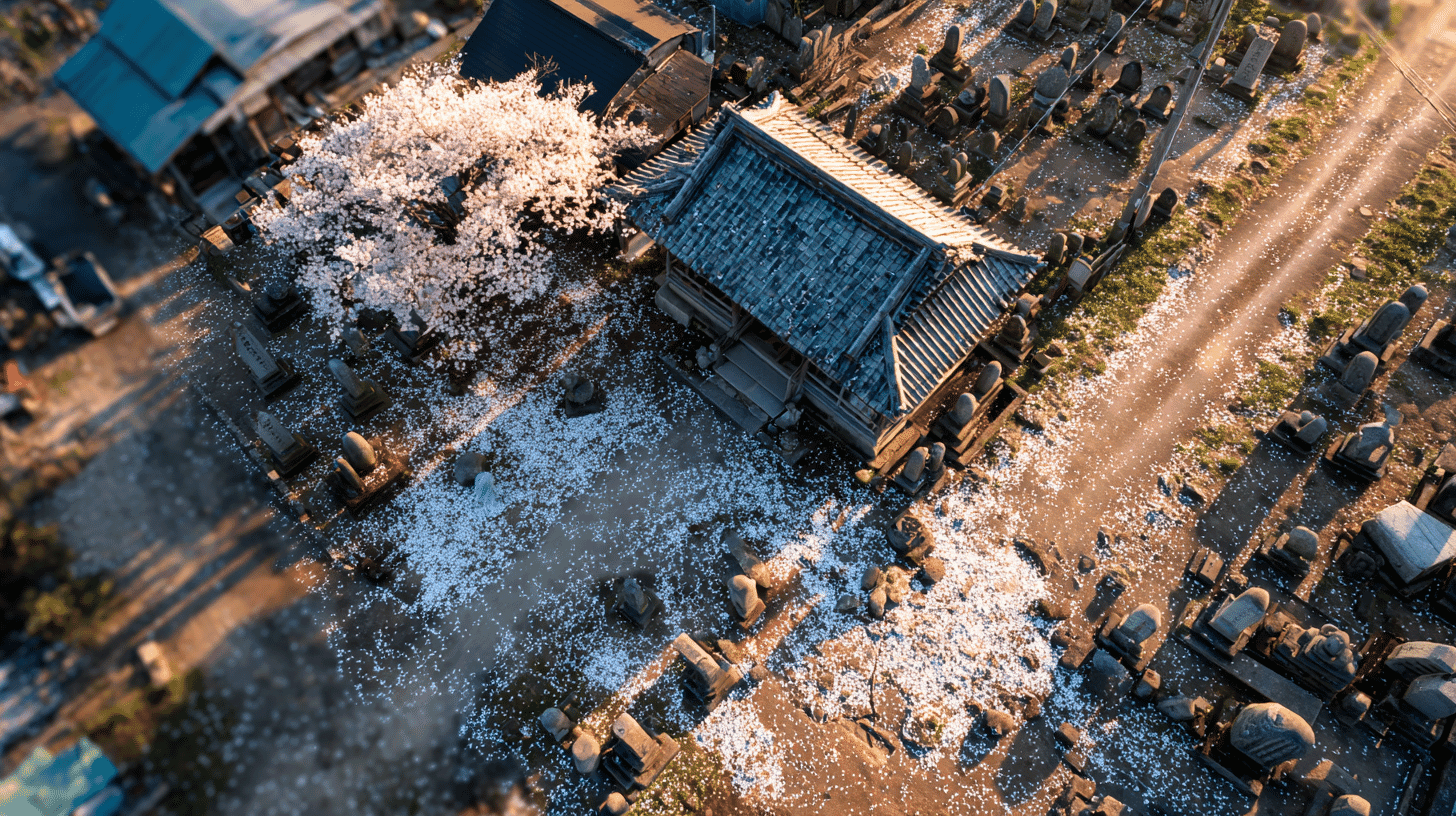
🕌 What happens when you die in Japan and your faith forbids cremation? For the roughly 420,000 Muslims living here, that is not a hypothetical. Islamic practice requires burial, yet Japan cremates 99.97% of its dead and only about 10 cemeteries nationwide accept bodies. New cemetery plans keep getting blocked by local opposition. As the country opens its doors to more foreign workers, it faces an uncomfortable question: can a nation welcome people in life and turn them away in death?
420,000 Muslims, Almost Nowhere to Be Buried
According to the "Muslim Population in Japan 2025" report by Professor Emeritus Hirofumi Tanada of Waseda University, approximately 420,000 Muslims were living in Japan as of late 2024. That figure covers about 363,000 foreign nationals, largely from Indonesia, Pakistan and Bangladesh, plus roughly 55,000 Japanese converts. It amounts to about 0.3% of Japan's population and grows each year as the country leans harder on foreign labor.
For these residents, one of the most distressing challenges is what happens after death. In Islam, the deceased must be washed, wrapped in white cloth, and buried directly in the earth as quickly as possible. The Quran teaches that humans were created from soil and must return to it. Cremation evokes the fires of hell, which makes the question essentially non-negotiable for observant Muslims.
Modern Japan is the world's most committed cremation nation. Ministry of Health, Labour and Welfare figures for fiscal 2022 put the cremation rate at 99.97%, with only 490 burials recorded. Japanese law does not prohibit burial, but the practice has become rare enough that burial-capable cemeteries number about 10 nationwide, nearly all of them in the Kanto region around Tokyo. The Chugoku, Shikoku, Kyushu and Tohoku regions have no Muslim burial sites at all.
The Hiji Town Saga: Six Years of Failed Negotiations
The most prominent case of a stalled Muslim cemetery is in Hiji Town, Oita Prefecture, on the island of Kyushu.
The story begins with the opening of Ritsumeikan Asia Pacific University (APU) in neighboring Beppu City in 2000, which brought a wave of international students to the region. As graduates settled in Kyushu and the local Muslim community grew, the Beppu Muslim Association (BMA), a registered religious corporation, began planning a dedicated burial cemetery. In 2018, the BMA secured roughly 8,000 square meters of mountainous land in Hiji, aiming to create Kyushu's first Muslim burial ground.
As the plan became public, local residents pushed back. Their stated concern was water contamination. Hiji is known for its natural springs, and residents feared buried remains could pollute groundwater used for drinking and farming. In December 2020, a petition signed by 100 residents was formally adopted by the town assembly.
The town proposed alternative municipal land elsewhere. Residents of the Yamaga district in neighboring Kitsuki City then objected that the new site sat too close to their own water source. Takashi Someya, professor emeritus of soil science at Saga University, has explained that buried remains decompose within months through natural microbial processes and pose no contamination risk. The reassurance did not settle public anxiety.
The decisive moment came on August 25, 2024, when Hiji held its mayoral election. Tetsuya Abe, an independent newcomer and former town councillor running explicitly against the cemetery, took 8,037 votes and unseated the incumbent on 54.66% turnout. On October 17 that year the town told the BMA it would not sell the municipal land the plan depended on, effectively killing the project. In 2025, a petition reached the town assembly asking for an ordinance restricting all interments to cremated remains.
Similar Failures Across Japan
Hiji Town is far from an isolated case.
Sakuragawa City, Ibaraki Prefecture: A Buddhist temple cooperating with local Muslims successfully negotiated with city authorities and received official approval for cemetery construction in September 2023. The city's ordinances did not require public consultation meetings, so the process was entirely legal. When residents learned of the plan, opposition erupted anyway. The developer withdrew the application voluntarily and the plan was scrapped in March 2024, legal permission in hand.
Miyagi Prefecture: In October 2024, Governor Yoshihiro Murai told the prefectural assembly that Miyagi would explore building a burial-capable cemetery. This was particularly notable because Miyagi had signed a memorandum with the Indonesian government to expand technical trainee and skilled worker programs. "We talk about multicultural coexistence, yet we haven't addressed this basic need. We must do this even if there's criticism," the governor declared.
The backlash was swift. Complaint emails and phone calls flooded in from across the country, reported at around 2,400. On September 18, 2025, Murai told the assembly he had personally phoned all 35 municipal leaders in Miyagi and every one of them had refused. Calling the project extremely difficult to realize, he withdrew it entirely.
The issue was then weaponized in the gubernatorial campaign that followed, fueling misinformation on social media. Murai won a sixth term on October 26, 2025, but newcomer Masamune Wada, who campaigned on scrapping burial-cemetery plans, finished only about 16,000 votes behind.
The NIMBY Effect and Japan's Psychological Barriers
These opposition movements follow the familiar NIMBY pattern, Not In My Backyard. Residents acknowledge the need for burial sites in principle and refuse to have them nearby. The same reflex greets waste treatment plants and power stations everywhere.
Many residents have been candid about their mixed feelings. One local captured the dilemma: "I know that discrimination against Muslims is wrong, and I understand the public need for burial cemeteries. But I still don't want one built near my home."
The stated opposition centers on water safety, but experts point to deeper cultural factors. Japan's Shinto-influenced concept of kegare, the ritual impurity associated with death, creates an instinctive aversion to unembalmed remains placed directly in the earth. As recently as the 1910s roughly half of Japanese funerals were burials. After decades of near-universal cremation, the practice now feels alien to many.
Success Stories: Temples That Welcome All
Not every story ends in failure.
At Monju-in, a Soto Zen temple in Koshu City, Yamanashi Prefecture, Muslim and Buddhist graves sit side by side. The temple has accepted Muslim burials for years, and the adjacent Islam Reien cemetery is managed by the Japan Muslim Association. One Japanese woman who converted to Islam through marriage found the temple while searching for a burial site for her terminally ill husband. Moved by the head priest, she bought two plots. Her husband was buried there in 2002.
In Wakayama Prefecture, Komadera Temple has prepared 500 burial plots and has capacity for up to 3,500. The temple accepts burial requests from Muslims, Christians, Confucians, and anyone else who prefers burial over cremation, organizing separate areas by religious tradition.
Even in Oita, before the Hiji plan could materialize, the Catholic Church of Beppu and the Oita Trappist Monastery offered temporary burial space for Muslims who died. Interfaith solidarity has carried the community through a period with few other options.
A National Problem with No National Solution
Under Japan's current Cemetery and Burial Act, the authority to approve new cemeteries rests with municipal leaders. The national government has effectively washed its hands of the issue. When asked about the burial difficulties facing Muslims, the Ministry of Health, Labour and Welfare's response was simply: "Cemetery management is a matter for local governments to address based on regional circumstances."
Local officials, however, push the responsibility back upward. A Hiji Town council member stated: "We understand the need for Muslim burial sites. But why here? The national government is the one pushing to bring in foreign workers, they should take responsibility for finding suitable land."
The result is a structural impasse. The national government recruits foreign workers and delegates end-of-life infrastructure to local authorities who answer to opposed voters. No level of government wants the political cost.
Can Japan Welcome the Living If It Rejects the Dead?
Japan's foreign resident population reached roughly 4.13 million at the end of 2025, passing four million for the first time, and its Muslim population keeps growing. Repatriating remains is expensive and leaves families unable to visit graves. Domestic burial demand will only increase.
In 2027, the Technical Intern Training Program will be replaced by the new Ikusei Shuro (Development Employment) system, which for the first time lets workers change employers under set conditions. Local governments hoping to attract and keep foreign workers will need to offer more than jobs, and religious accommodation is part of that.
If the message to foreign workers is come work here but we will not accommodate you in death, Japan undercuts its own answer to its labor shortage. How a society handles the end of a life says a good deal about the values it claims.
In Japan, Muslim burial cemeteries face fierce local opposition despite growing need. How does your country handle different religious burial practices? Do minority communities face similar challenges? Share your thoughts in the comments.
References
- https://www.nippon.com/ja/in-depth/d01085/
- https://www.spf.org/asia-islam/news/20250418.html
- https://www.imemgs.com/masjid/833/
- https://news.yahoo.co.jp/expert/articles/0e8ac5ad2c98870863a1891309011dce74290f31
- https://www.khb-tv.co.jp/news/16036333
- https://kahoku.news/articles/20251018khn000041.html





Global Discussion
15 comments