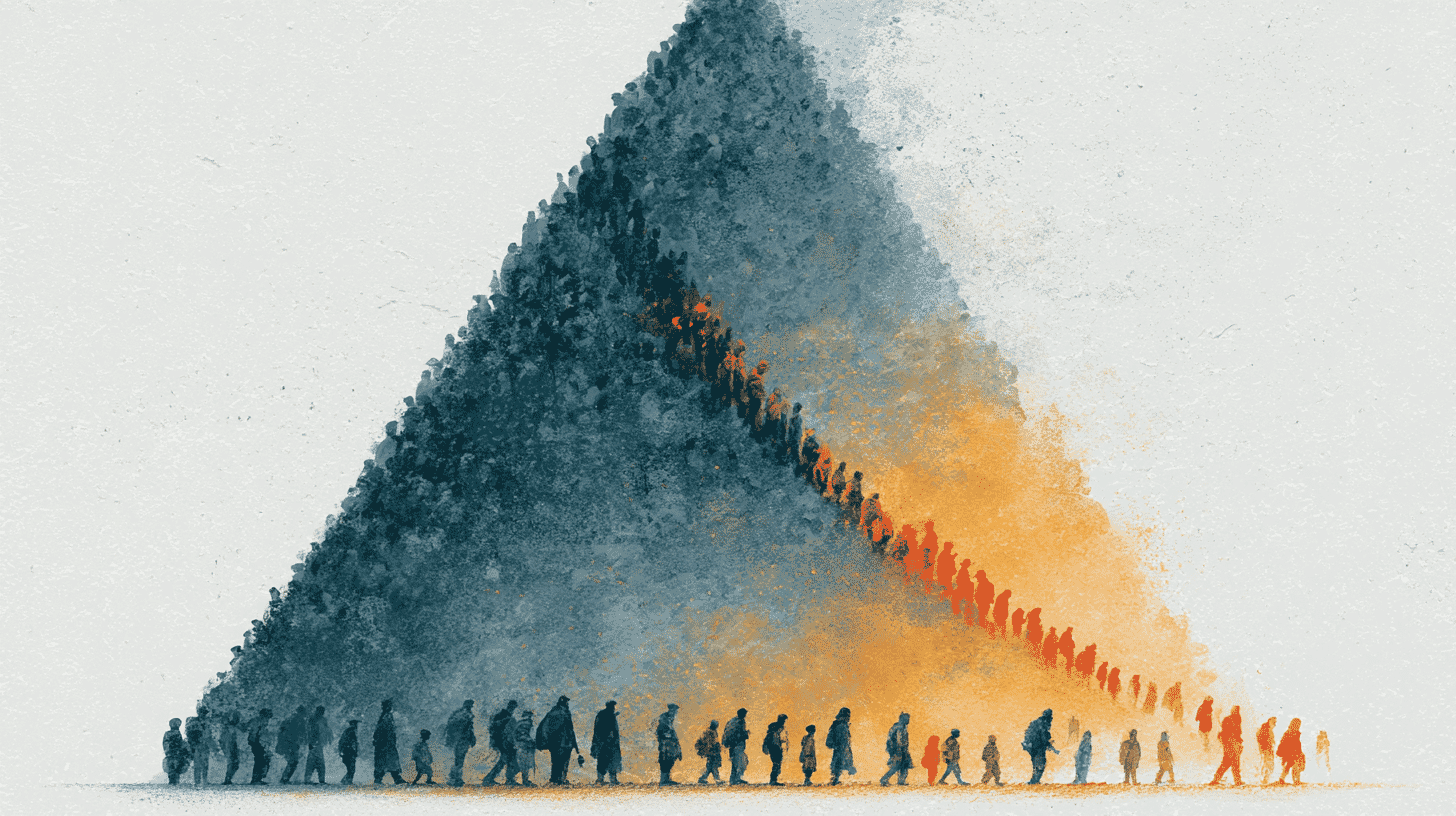
🗾 Japan's population shrank again last year, but the new official numbers reveal something Tokyo rarely says out loud. The country lost roughly 900,000 of its own citizens in twelve months. The only reason the total drop was far smaller is that 328,000 more foreign residents now live in Japan. Quietly, by the numbers, the country is turning into an immigration society.
What the new figures actually show
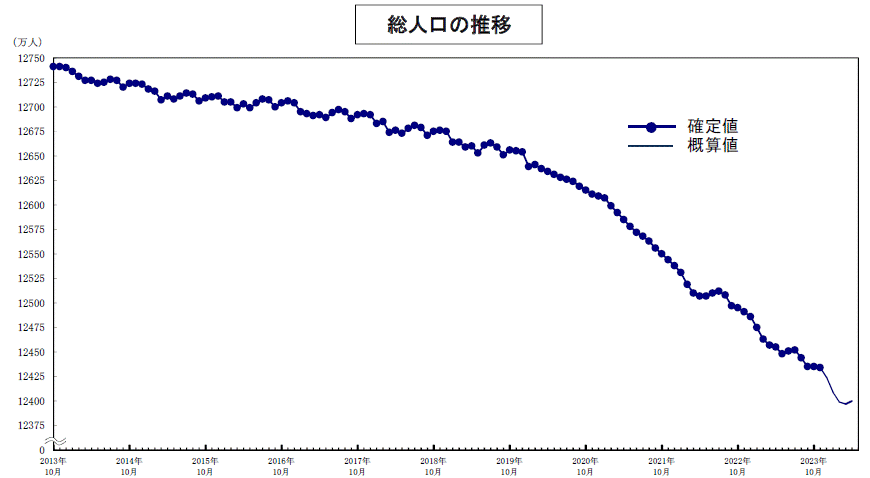
On June 19, 2026, Japan's Ministry of Internal Affairs and Communications released its population estimates. In the final figures for January 1, 2026, the total population stood at 122.98 million, down 572,000 from a year earlier, a 0.46% decline.
That headline hides a split. The number of Japanese nationals fell by 899,000 to 119.25 million, a 0.75% drop and one of the steepest on record. Foreign residents, by contrast, climbed to 3.73 million, up 328,000, or 9.64%, in a single year.
Do the arithmetic and the picture sharpens. Foreign residents now make up just over 3% of everyone living in Japan, yet their growth cancelled out more than a third of the loss in Japanese nationals. Without those new arrivals, the total would have fallen by roughly 900,000 instead of 572,000. The foreign population is, increasingly, the only thing slowing the slide.
Older at the top, thinner at the bottom
The age breakdown is where the long-term strain shows.
Children under 15 dropped 2.62% to 13.38 million. The group aged 65 and over barely moved, at 36.19 million, but the oldest band kept growing: people 75 and older rose 2.17% to 21.37 million.
Set those two figures next to each other and the imbalance is hard to ignore. There are now about 8 million more people aged 75 and up than there are children under 15. The working-age group, 15 to 64, slipped only 0.28% to 73.41 million, but that relative stability is doing a lot of quiet work, and it is exactly the band employers cannot fill.
Source: Statistics Bureau, Ministry of Internal Affairs and Communications
The side door Japan won't call the front
Here is the part Tokyo prefers not to spell out. For decades, successive governments have held the same official line: Japan does not have an "immigration policy," if that phrase means accepting large numbers of foreigners and their families to settle permanently. In practice, the country has expanded foreign labor through a string of work and study channels, what scholars have called Japan's "side door."
The main routes today are the Specified Skilled Worker visa (特定技能, created in 2019) and the Technical Intern Training Program (技能実習), long criticized for poor conditions and for trainees who disappear. The training program is being scrapped. From 2027 it gives way to a new "Employment for Skill Development" system (育成就労), and the stated purpose has shifted from "international contribution" to plainly securing the workers Japan can no longer find at home. People are meant to move from that program onto the Specified Skilled Worker track, which can lead to long-term and even permanent residence.
The scale is no longer small. A separate count by the Immigration Services Agency put mid- and long-term foreign residents at a record 3.96 million at the end of June 2025. Planned caps would allow up to roughly 1.23 million workers across the two main programs over the coming years. The politics have caught up too. Immigration was a live issue in the 2025 upper-house election, and the Takaichi government that followed speaks of an "orderly society of coexistence" while still avoiding the word immigration.
Where Japan sits next to Germany and Canada
Three percent foreign residents sounds modest, and for now it is. The average across OECD countries runs above 10%. Measured against the nations that openly build policy around immigration, Japan is decades behind.
In Germany, roughly one in five residents was born abroad, and about 31% have a migration background once you count naturalized citizens and their children. Germany has recorded more deaths than births every year since 1972. Without immigration, its population would have been shrinking for half a century. Under Chancellor Friedrich Merz, the country has leaned further in, widening a points-based "Opportunity Card" to recruit skilled workers from outside the EU.
Canada goes further still. Immigrants make up about 23% of the population and nearly 29% of the labor force, and in recent years international migration has accounted for essentially all of the country's population growth. One caveat is worth flagging: those German and Canadian figures count the foreign-born, including people who later became citizens, while Japan's 3% counts foreign nationals. On a like-for-like basis the gap is even wider.
The comparison cuts both ways, though. Canada lowered its immigration targets in 2024 after most Canadians told pollsters there were too many newcomers straining housing and services. Germany's politics have hardened around migration. Japan is now reaching the same crossroads those countries hit years ago, with the labor math pulling one way and public unease pulling the other.
A choice Japan is making by not choosing
The numbers point one way. Japan faces a projected shortfall of hundreds of thousands of workers, and the new programs exist to fill it.
What the country has not done is hold the honest national conversation that the label "immigration country" would force: about language support, schooling, housing, and a path to belonging rather than only a path to a job. For now, Japan is becoming an immigration society the way it does many big things, gradually, cautiously, and without quite admitting it.
In your country, is immigration something openly debated and planned for, or something that happens first and gets named later?
References
- Statistics Bureau, Ministry of Internal Affairs and Communications, Population Estimates (released June 19, 2026): https://www.stat.go.jp/data/jinsui/new.html









Global Discussion
4 comments