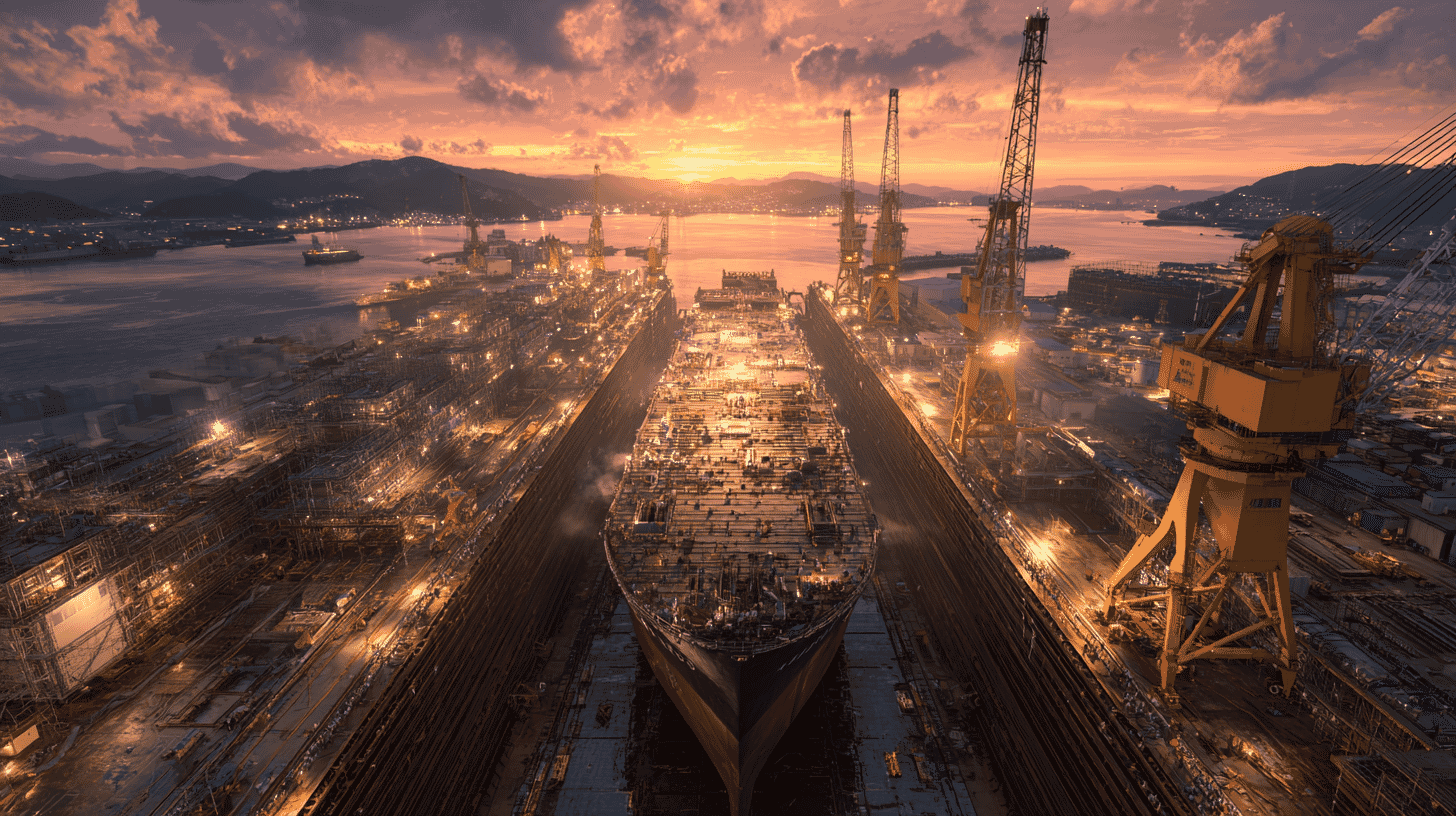
Japan once built 40% of the world's ships. Then, pushed aside by China and South Korea, that shipbuilding powerhouse saw its global share fall to just 8%. Now the government has drawn up a "Shipbuilding Revival Roadmap," channeling about 1 trillion yen ($6.5 billion) in public and private investment. Industry consolidation, warship exports, and cooperation with the U.S. have all begun to provide tailwinds.
From Global Dominance to an 8% Market Share
Japan's shipbuilding industry has a history of world dominance. In the 1990s, Japan accounted for about 40% of global ship construction, a true shipbuilding powerhouse. Along the Seto Inland Sea, shipyards launched giant tankers and container ships one after another, a symbol of Japanese manufacturing.
But in the 2000s, everything changed. China nurtured shipbuilding as national policy, growing fast on the back of massive subsidies and low-cost labor. South Korea's conglomerates, such as Samsung Heavy Industries and Hyundai Heavy Industries (now HD Hyundai), dominated the market with large LNG carriers and ultra-large container ships.
As a result, by national share of the world's 2024 shipbuilding orders, China took over 70%, South Korea about 14%, and Japan just 8%. Japan's annual output also fell from about 16 million gross tons in 2019 to 9.07 million in 2024. Unable to build all the ships its own owners need at home, Japan has relied on Chinese yards for 30–40% of orders since 2022.
A One-Trillion-Yen Roadmap
To break out of this crisis, the Ministry of Land, Infrastructure, Transport and Tourism and the Cabinet Office drew up and released the "Shipbuilding Revival Roadmap" on December 26, 2025. The goal is clear: by 2035, roughly double Japan's annual capacity for ocean-going cargo ships to 18 million gross tons.
How that 18 million figure was set says a lot about the policy. Japan's merchant fleet accounts for about 10% of the world total; assuming Japan holds that share in 2035, 18 million gross tons is the capacity needed to build all of the required tonnage at home. This is not a plan to take world market share back from China and South Korea. It is a plan to be able to meet Japan's own demand domestically again.
The roadmap rests on five pillars: strengthening shipbuilding capacity, securing and training shipyard workers, using decarbonization as a game changer, locking in stable demand, and cooperating with like-minded countries and the Global South. Underlying all of it is a single fact: sea transport carries 99.6% of Japan's trade volume.
To get there, the plan calls for about 1 trillion yen ($6.5 billion) in combined public and private investment. The government will provide roughly 380 billion yen, centered on a "Shipbuilding Revival Fund" aiming for a total of 350 billion yen over ten years; the fiscal 2025 supplementary budget allocated an initial 120 billion yen. Another 12 billion yen goes to an economic-security key-technology program, and 15 billion yen to R&D on AI-driven next-generation shipbuilding robots. The private industry is expected to invest about 350 billion yen in facilities, and the remaining roughly 280 billion yen will fund zero-emission ship production facilities through public-private cooperation using GX (green transformation) economy-transition bonds.
The 120 billion yen from the supplementary budget goes toward automation and labor-saving equipment, such as welding robots, between 2026 and 2028. The fund is designed to add support in three stages as milestones are met.
The roadmap also calls for consolidating the industry into one to three groups by around 2028, cutting costs by about 10% while lifting productivity through digitalization, robotics, and AI. The form consolidation takes is left open, and includes vertical and horizontal tie-ups.
Update: A Shipbuilding Working Group was set up to work out the investment details. At its April 10, 2026 session, members discussed a draft "public-private investment roadmap." Some of the material, including the direction of investment-promotion measures, remains unpublished.
Mega-Merger: Japan's New Shipbuilding Giant
Alongside the roadmap, another development shook the industry: top builder Imabari Shipbuilding making second-ranked Japan Marine United (JMU) a subsidiary.
Announced in June 2025, the deal closed on January 5, 2026, once competition-law reviews at home and abroad were complete. Imabari, which already held 30%, bought 15% each from JFE Holdings and IHI to reach 60%. Combined, the two form a shipbuilding group ranking around fourth in the world, accounting for over half of Japan's domestic output.
The significance goes beyond scale. Imabari is strong in mass-produced merchant ships like tankers and bulk carriers, while JMU has technical strength in high-value ships such as escort vessels. It fuses the "power to build in volume" with the "power to win on technology." Moves to share design and procurement are advancing too. In December 2025, NYK Line, Mitsui O.S.K. Lines, and Kawasaki Kisen formally announced capital participation in MILES, the next-generation ship-design company jointly funded by Mitsubishi Heavy Industries and Imabari.
Historic Warship Export: Japan's Frigate Goes to Australia
Another development not to be missed is the selection of the enhanced Mogami-class frigate, the fiscal 2024 escort vessel (4,800-ton type) also called the "New FFM," as the Australian Navy's next-generation general-purpose frigate. Announced by the Australian government on August 5, 2025, it marks Japan's first postwar co-development, production, and transfer of a major defense platform. Mitsubishi Heavy Industries is the prime contractor.
Australia plans to acquire 11 frigates, with the first three built in Japan and the remaining eight in Australia. The program was initially put at around 10 billion Australian dollars over ten years.
Australia chose Japan for the New FFM's stealth, long-range capability, and ability to operate with fewer crew than conventional frigates, and above all for Japanese shipyards' record of delivering on schedule. Australia's previous frigate program, the British-designed Hunter class, had been plagued by design-change delays and ballooning costs, which strengthened the Japanese bid. The final rival in the selection was Germany's MEKO A-200.
Update: The formal contract was signed in Melbourne on April 18, 2026, covering the first three ships to be built in Japan. Mitsubishi Heavy Industries handles co-development and production of the vessels, Mitsubishi Electric supplies the onboard systems, and NEC provides underwater equipment along with communications and navigation gear. The first ship will be built at MHI's Nagasaki yard for delivery in December 2029. Alongside the contract, Deputy Prime Minister and Defence Minister Richard Marles and Japanese Defense Minister Shinjiro Koizumi signed a "Mogami Memorandum."
The money has been revised upward as well. Australia's 2026 Integrated Investment Program, released that April, commits up to 20 billion Australian dollars to general-purpose frigates over the coming decade. The improved Mogami design is described as having a range of up to about 10,000 nautical miles, a 32-cell vertical launching system, and a crew of roughly 92.
A New Pillar: Working With Washington
Another reason Japan's shipbuilding is drawing attention is progress in U.S.-Japan cooperation.
The United States maintains the world's most powerful navy, yet its domestic shipbuilding capacity has declined sharply. Repair and maintenance of warships face chronic delays, and in merchant shipbuilding it lags far behind China's capacity.
Against this backdrop, on October 28, 2025, in Tokyo, Japanese transport minister Yasushi Kaneko and U.S. Commerce Secretary Howard Lutnick signed a "Memorandum on Cooperation Concerning Shipbuilding." It establishes a Japan-U.S. shipbuilding working group and names five areas of cooperation: expanding building capacity in both countries, promoting investment in the U.S. maritime industrial base, clarifying demand for government and commercial vessels important to economic security, education and training for shipyard workforces, and joint development of advanced construction technology including AI and robotics.
The July 2025 tariff negotiations are part of the backdrop. Shipbuilding was included among the sectors covered by the 550-billion-dollar investment framework that accompanied the agreement. If repairs of U.S. warships in Japan and technology sharing take concrete form, they could secure steady demand for Japanese yards.
Workers, Scale, Cost
For all the tailwinds, the challenges pile up.
First, a serious labor shortage. Shipbuilding is labor-intensive and depends on skilled welders and pipe-fitters, but an aging, shrinking population makes it hard for rural yards to recruit young workers. The roadmap calls for stronger industry-academia-government and regional ties, plus expanded acceptance of foreign workers through the Specified Skilled Worker system and the Employment for Skill Development system launching in April 2027.
Second, the scale barrier. Japan's yards are smaller than their Chinese and Korean rivals and struggle to build multiple large ships at once, a cost disadvantage. Achieving the targeted 10% cost cut will require productivity gains through digitalization, robots, and AI.
Third, the question of large LNG carriers, which Japan has not built domestically in recent years. LNG ships demand advanced technology and are dominated by South Korea. The roadmap says it will study future supply-chain commitments, but conclusions are yet to come. According to press reports, Imabari president Yukito Higaki said at a July 23, 2026 briefing that a restriction excluding LNG carriers had lapsed when Imabari raised its JMU stake from 30% to 60%, and that resuming LNG carrier construction is under consideration.
The Order Book Now Runs More Than Three Years Deep
From 2026 on, global demand for new ships is expected to peak. As international shipping's decarbonization rules tighten, demand should surge for replacing conventional vessels with eco-friendly, next-generation ships.
As of the end of 2025, Japan's yards held an order backlog of 622 ships and about 30.01 million gross tons, more than three years' worth. New-ship talks are already moving to delivery dates in 2029 and beyond.
Keiji Tanaka, chairman of the Cooperative Association of Japan Shipbuilders, said at a January 2026 New Year gathering that "this year is a 'fair wind,' and we want to raise our sails to catch it." Shipbuilding has long construction times and a broad base, from parts and materials makers to port infrastructure, with major ripple effects on regional economies and jobs where yards are located. Will the government's 1-trillion-yen investment end as a slogan, or turn into actual building capacity? Aligning the sequence of orders, facilities, and people, the patient and unglamorous coordination, will be the test of the next decade.
In Japan, hope for a shipbuilding revival mixes with anxiety over whether the gap with China and South Korea can be closed. What is the state of shipbuilding or the maritime industry in your country? What do you think about government support for industry?
References
- https://www.mlit.go.jp/report/press/kaiji05_hh_000317.html
- https://www.jiji.com/jc/article?k=2025122600597&g=eco
- https://www.jetro.go.jp/biznews/2025/08/6aedb56d15329a68.html
- https://www.spf.org/iina/articles/kawakami_12.html
- https://www.cao.go.jp/keizai_anzen_hosho/doc/zousen_roadmap.pdf
- https://www.mlit.go.jp/report/press/kaiji05_hh_000311.html
- https://www.jetro.go.jp/biznews/2026/05/0855e2aed6313832.html
- https://www.mlit.go.jp/maritime/maritime_tk5_000090.html







Global Discussion
15 comments