Westerners once dismissed nori as "black paper" or said it tasted "like carbon paper." Today, that "black paper" is conquering the world. A three-Michelin-star Italian chef serves cuttlefish with nori pesto. Onigiri shops draw lines in Paris and Los Angeles. The global nori market is set to grow from $3.8 billion in 2025 to $6.4 billion by 2034.
How did the seaweed wrapper of a sushi roll force its way into Michelin-starred kitchens in just three decades? This article traces nori's global ascent, from Japan's struggling production grounds to the experimental kitchens of European chefs, and even into the famous 2010 Nature paper that complicated the claim that "only Japanese can digest seaweed."
From "Black Paper" to "Superfood": How Nori's Reputation Flipped
When Japanese food first arrived in the West in the 1980s, nori was the biggest barrier. The sight of "black paper wrapped around rice" prompted many Americans and Europeans to refuse outright. The famous "California roll", sushi with the rice on the outside and nori hidden inside, was invented partly to make sushi palatable to consumers who couldn't get past the seaweed wrapper.
Two forces flipped the script.
The first was the health and wellness wave. Nori is extraordinarily low in calories yet rich in protein, vitamin B12, iron, fiber, and iodine. For Western vegans and vegetarians, B12 is one of the hardest nutrients to obtain from plant sources, and nori became one of the few credible options. Riding the plant-based food boom, North American and European consumers began choosing seaweed snacks over conventional chips.
The second was the global onigiri boom. Searching #onigiri on Instagram returns roughly 849,000 posts as of mid-2024. After the pandemic accelerated takeout demand, onigiri emerged as a cheaper, more vegan-friendly alternative to sushi. From Omusubi Gonbei in Paris to Hana Group's Hua Yu Wee in Hong Kong (which expanded to about 120 stores in roughly a decade) to TOKYO ONIGIRI in London, dedicated onigiri chains carried nori with them everywhere they opened.
The 2010 Nature Paper Behind the "Only the Japanese Can Digest Nori" Claim
You can't talk about nori going global without mentioning the science.
In April 2010, the journal Nature published a paper by French and Canadian researchers that triggered global headlines. The team discovered that an enzyme capable of digesting porphyran, a polysaccharide found in nori but not in land plants, was carried by both the marine bacterium Zobellia galactanivorans and the human gut bacterium Bacteroides plebeius. Crucially, the gut bacteria carrying this enzyme were found in Japanese subjects but not in the North American samples examined at the time.
Headlines went big: "Japanese guts are evolved for sushi," "Americans can't digest seaweed." But the study's actual implications are subtler than the clickbait suggested.
For one, the researchers themselves noted that modern nori is roasted, which sterilizes most of the marine bacteria that would otherwise transfer their genes to gut microbes. The pathway that supposedly gave ancient Japanese the digestive edge has effectively closed for present-day eaters.
For another, follow-up research has complicated the picture. A 2022 study found porphyran-digesting genes in 512 of 1,361 samples from Japanese and Chinese participants, and in a small but non-zero number of Western subjects. The story is less "Japanese only" and more "populations with long histories of eating raw seaweed adapted accordingly."
Most importantly, the major nutrients in nori, protein, vitamins, minerals, fiber, are absorbed by everyone regardless of porphyran-digesting bacteria. You don't need a specialized gut microbe to benefit from a sheet of nori.
What the 2010 paper did do was inject seaweed into pop-science conversation worldwide. The vague worry that "maybe nori is just for Japanese people" got replaced by a fascinating story about ancient gene transfer between sea bacteria and human guts. That conversation, ironically, helped pull nori toward the international mainstream.
Three-Star Chefs and Their Secret Ingredient: Nori Goes French and Italian
Fine dining has played an outsize role in nori's global elevation.
At the three-Michelin-star Uliassi restaurant on Italy's Adriatic coast, chef Mauro Uliassi serves an antipasto in which thinly sliced cuttlefish is dressed with nori pesto, nori sheets blitzed with sesame oil into a green paste. The marine aroma of the seaweed pairs uncannily with the delicate sweetness of the cuttlefish.
Italian chefs working seaweed into pasta is no longer a novelty. Nori-infused tagliatelle, pasta dough with ground nori kneaded in, producing a faintly green sheet that takes on subtle ocean notes, has appeared on modern Italian menus in Milan and New York. It pairs especially well with sea urchin and shellfish.
In France, experimental nori cultivation has begun on Brittany's coast, and local chefs are exploring nori-butter sauces and nori-cream pairings. In North America, chef David Chang of Momofuku has commercialized nori-based seasonings, and high-end kitchens increasingly treat nori as an "umami booster" in everything from compound butters to sauces.
Even mainstream Italian pasta giant Barilla now publishes a "miso, mushroom, and nori spaghetti" recipe on its English-language website. Nori has graduated from specialist Japanese restaurants to home kitchens worldwide.
How Korea Overtook Japan: From 10 Billion vs 4 Billion to 5.9 Billion vs 20.5 Billion
While global demand surges, Japan's production base is in serious trouble.
For most of the 20th century, Japan led the world in nori production and exports. But a recent Worldfolio interview with Nagai Nori laid out the brutal arithmetic: 20 years ago, Japan produced about 10 billion sheets of nori a year while Korea produced about 4 billion. Today, Japan produces 5.9 billion sheets while Korea produces 20.5 billion. The positions have completely reversed.
Korean nori now accounts for about 50% of global nori production and roughly 70% of the worldwide nori sales market, with exports reaching 114 countries. The "nori snacks" stocked on American supermarket shelves are mostly Korean, not Japanese, products.
Why the reversal? Nagai Nori's executives point to corporate structure. Japanese nori producers are mostly individual fishery operators facing aging owners and a lack of successors, the number of nori-producing fisheries has dropped about 40% over the past decade. Korean producers, by contrast, are organized as corporations with succession planning built in.
Compounding the structural problem, Japan's main producing regions, the Ariake Sea (Saga, Fukuoka, Kumamoto, Nagasaki) and the Seto Inland Sea, are dealing with rising seawater temperatures, nutrient deficits, and red tides (toxic plankton blooms). Annual production has fallen below 5 billion sheets for three consecutive years starting in fiscal 2022, a level the industry calls "an unprecedented bad harvest."
Japanese companies are adapting. Sanei Nori (Soma City, Fukushima) has expanded its sales network to about 30 countries and operates a processing facility in Korea to serve global demand. Sticking strictly to Japanese-grown product would mean leaving global demand on the table.
Sushi Nori vs Onigiri Nori: Why They Aren't the Same
A bit of technical context helps explain Japan's regional production.
Japan's nori comes mainly from four areas: the Ariake Sea, the Seto Inland Sea, Ise Bay/Mikawa Bay, and Tokyo Bay (now only the Chiba and Kanagawa sides). The Ariake Sea alone produces about half of Japan's national output.
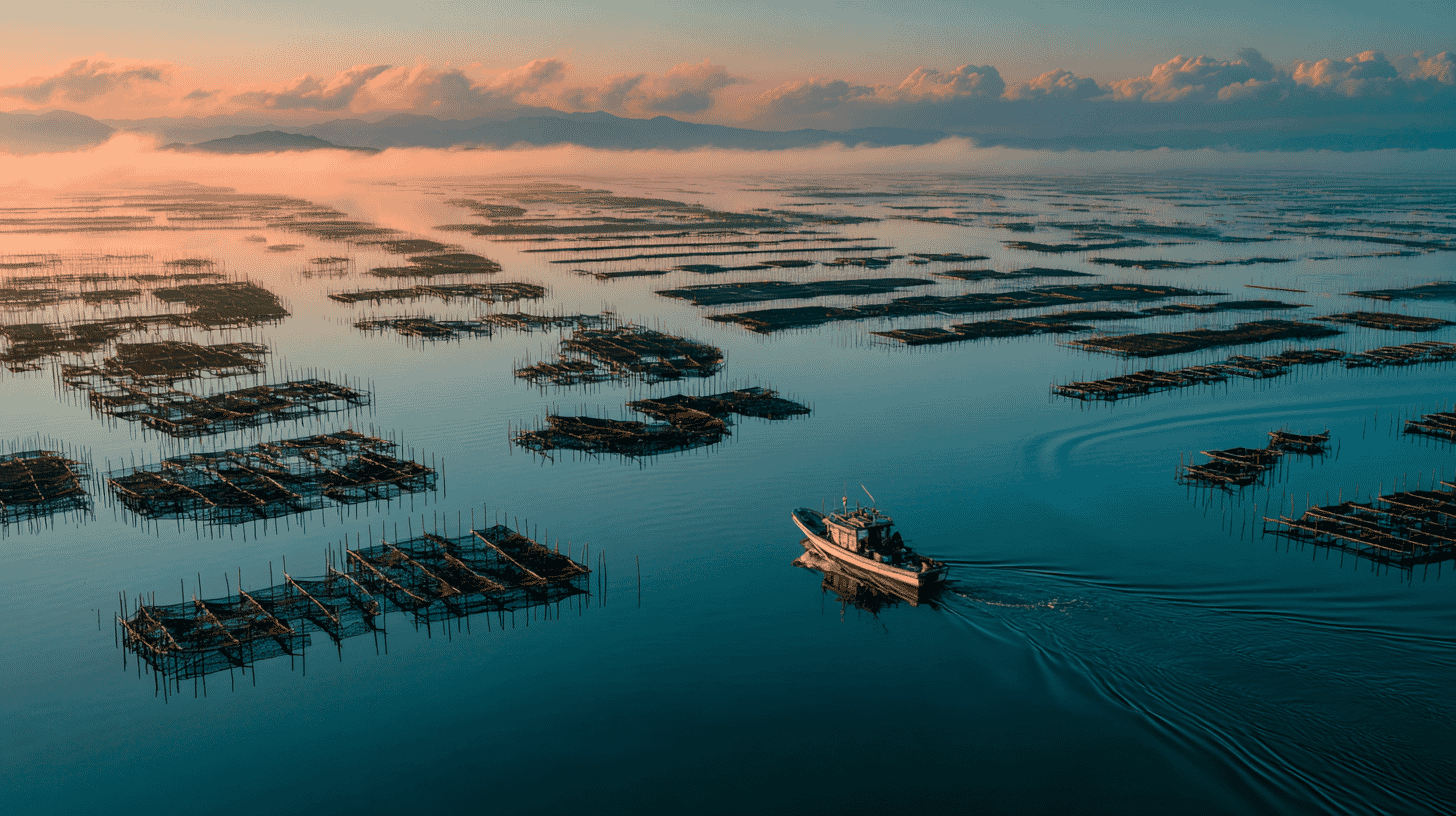
Ariake and Seto use different cultivation methods. Ariake is a shallow tidal sea with massive tidal swings, where the "pole-fixed" method dominates: nets are anchored to bamboo poles so the nori is exposed to air during low tide. This produces soft, melt-in-the-mouth nori. The Seto Inland Sea, with deeper water and faster currents, uses "floating" cultivation where nets stay submerged. The resulting nori is thicker and chewier.
That difference maps directly onto Japanese culinary use. Sushi, especially gunkanmaki and futomaki, where the nori must hold up to vinegared rice without going limp, is best served by the firmer Seto Inland Sea nori. Onigiri, especially convenience-store onigiri eaten hours after preparation, calls for soft, bite-friendly Ariake nori. The clever Seven-Eleven "crisp film" onigiri packaging, which keeps nori dry until the moment of opening, works precisely because Ariake nori is thin and delicate.
The premium tier, "first-pick" (ichiban-zumi) nori, harvested from the very first young shoots of the season, is mostly Ariake. Top-grade first-pick Ariake nori has fetched winning bids exceeding ¥40,000 per kilogram (about $252) at recent fisheries-cooperative auctions.
The Numbers Behind the Global Push
The global nori market sits at roughly $3.8 billion in 2025 and is projected to grow to $6.4 billion by 2034, an annual rate of 5.9%, according to market research firm MarketIntelo. The Asia-Pacific region accounts for about 58.7% of that market, anchored in the deep food-cultural traditions of Japan, Korea, and China.
The fastest-growing format is sheet-form nori, which represented about 42.3% of the total market in 2025, roughly $1.61 billion. Global sushi-kit retail sales surged about 34% during the post-pandemic period, embedding home sushi and onigiri-making in North American and European households.
Snack-format nori chips are growing fast in North America and Southeast Asia. Korean seasoned-nori snacks (gim, flavored with salt and sesame oil) lead the segment, but Japanese makers are pushing back with the "plain crisp" approach. Sanei Nori's expansion to roughly 30 countries with Korean processing capacity is one example of how Japanese players are catching up to the global moment.
What's it like in your country?
From the "black paper" of 1980s sushi rolls to a three-Michelin pasta sauce. The landscape around nori has flipped in just thirty years.
What about where you live, does your supermarket carry nori (or any local edible seaweed)? Is it shelved as health food, Asian groceries, or snacks? How do people cook with it where you are, and are there any traditional dishes in your culture that use sea vegetables? We'd love to hear.
References
- https://nori-hack.com/
- https://www.nikkei.com/article/DGXZQOCC121PY0S4A210C2000000/
- https://www.theworldfolio.com/interviews/nagai-nori-preserving-japans-seaweed-tradition/7132/
- https://www.fedex.com/en-my/business-insights/sme/how-a-small-family-owned-nori-brand-is-winning-global-fans.html
- https://www.nationalgeographic.com/science/article/gut-bacteria-in-japanese-people-borrowed-sushi-digesting-genes-from-ocean-bacteria
- https://www.science.org/content/article/japanese-guts-are-made-sushi
- https://www.greatitalianchefs.com/recipes/cuttlefish-tagliatelle-nori-pesto-fried-quinoa-recipe
- https://marketintelo.com/report/nori-market
- https://tuhonori.co.jp/nori-knowledge/
- https://senken.co.jp/posts/seaweed-241105









Global Discussion
14 comments