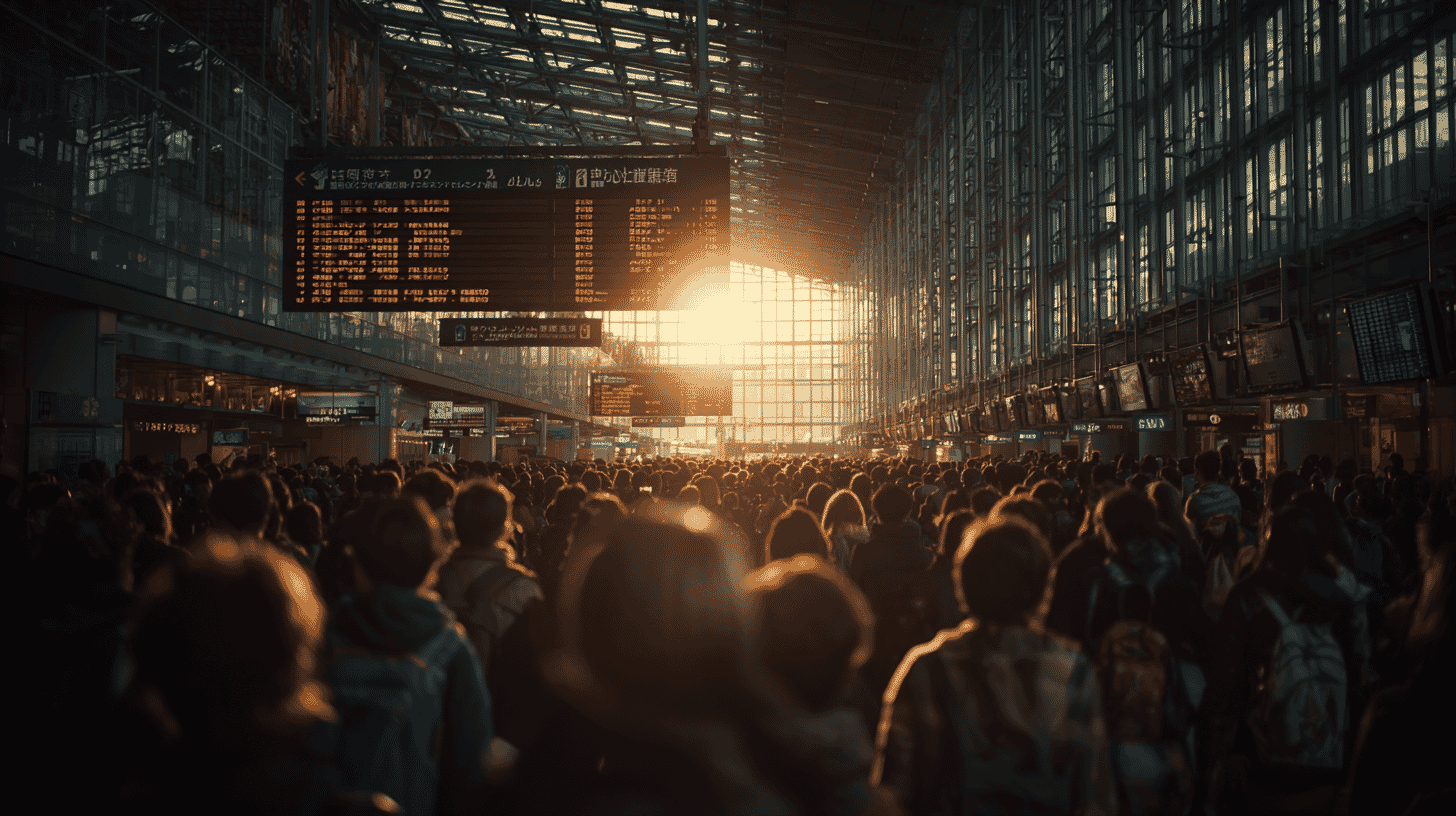
🛫 If you've flown out of Japan, you've paid a departure tax. You probably didn't notice.
As of July 1, 2026, that tax tripled: ¥1,000 to ¥3,000, roughly $19. The reason is 42.68 million foreign visitors, a record, and what they've done to a handful of places. In Kyoto, residents can't board their own city buses. At Fuji's most photographed convenience store, the town hung a black screen to hide the mountain. The bill for fixing that is now being collected from your airfare.
The Tax You Didn't Know You Were Paying
Officially it's the International Tourist Tax, introduced in January 2019, Japan's first new national tax in 27 years. It applies to everyone leaving Japan by plane or ship, regardless of nationality. Foreign tourists pay it. So do Japanese people flying out for a holiday.
Because airlines fold it into the ticket price, most travelers never see it. It still brought in about ¥52.5 billion in fiscal 2024, and it funds a large share of Japan's tourism policy.
"If it's for foreign tourists, why are Japanese paying?" is a common complaint on Japanese social media. The answer is tax treaties. Their non-discrimination clauses bar imposing worse treatment on the basis of nationality, so as long as it's structured as a tax, you can't aim it at foreigners only.
What Changed on July 1
On December 19, 2025, the ruling coalition of the Liberal Democratic Party and Nippon Ishin published its fiscal 2026 tax reform outline, specifying ¥3,000 and a start date of July 1, 2026. The cabinet approved it on December 26. It passed as an amendment to the Income Tax Act (Act No. 12 of 2026), and the new rate took effect on schedule.
There's a grandfather clause: if your ticket was issued by June 30, 2026, you pay the old ¥1,000 even if you fly out later. Children under two and transit passengers leaving within 24 hours of arrival remain exempt.
The revenue jump is steep. Travel Watch reports the tax should bring in roughly ¥130 billion in fiscal 2026, about 2.7 times the previous year. The Japan Tourism Agency's fiscal 2026 budget swelled to a record ¥138.3 billion on the back of it.
A higher rate for business class and above was floated at one point but didn't make the final bill. The outline says the government will revisit rates "as early as possible," so the argument isn't over.
The 42.68 Million Number
The math behind the hike is simple. Japan drew 42,683,600 foreign visitors in 2025, per the Japan National Tourism Organization, up 15.8% and past 40 million for the first time. That's well above 2019's 31.88 million and about eight times the 5.21 million of 2003, when Japan formally declared itself a tourism nation.
Spending hit a record ¥9.45 trillion in 2025, up 16.4% from ¥8.13 trillion. And in a few specific places, all of that landed on people who live there.
Kyoto: Residents Who Can't Get on the Bus
City buses toward Kiyomizu-dera and Arashiyama fill with visitors and their oversized suitcases. Locals who use those routes to get to work or school or the shops keep getting left at the stop. Kyoto urges people onto the subway instead; the concentration hasn't budged.
The city's answer is dispersal by "place, season, and time," plus money. On March 1, 2026, Kyoto split its lodging tax into five brackets. Under ¥6,000 a night still costs ¥200, but ¥20,000–50,000 now costs ¥1,000, ¥50,000–100,000 costs ¥4,000, and anything above ¥100,000 costs ¥10,000 (about $62) per person per night. The city projects around ¥12.6 billion a year.
Fuji: A ¥4,000 Gate and a Black Screen
Fuji's rules hardened fast. Yamanashi went first in summer 2024, charging ¥2,000 on the Yoshida trail and capping entries at 4,000 people a day. From 2025 both Yamanashi and Shizuoka charge ¥4,000 (about $25) across all four routes, folding in the old ¥1,000 voluntary conservation donation. Gates now close at 2 p.m. instead of 4 p.m., and stay shut until 3 a.m. unless you hold a mountain hut booking. The target is bullet climbing: going up overnight, no gear, no sleep.
In summer 2025, Yamanashi permitted 149,713 climbers, essentially flat year on year, but collected ¥591 million, up 98.5% on the doubled fee. Rangers stopped 1,144 people at the gate for inadequate rain gear or warm layers. The prefecture says 90% of them were foreign.
Then there's the black screen. A convenience store in Fujikawaguchiko framed the mountain so perfectly that social media turned the sidewalk into a stampede, and in May 2024 the town strung up a 20-meter barrier, 2.5 meters high, to kill the shot. A town hiding its own main attraction is a strange enough image that it made news worldwide.
Where the Money Actually Goes
By law, the International Tourist Tax can only fund three things: smoother travel, meaning immigration processing and airport friction; easier access to tourist information, meaning multilingual signage and Wi-Fi; and better experiences on the ground, which is where regional dispersal and overtourism measures sit. The extra revenue is earmarked mainly for the last two.
Japanese travelers got something back at the same time. A revised Passport Act passed in April 2026, and from July 1 passport fees dropped: a 10-year adult passport went from ¥16,300 to ¥9,300 over the counter, or ¥15,900 to ¥8,900 online. It's a one-time ¥7,000 saving against a ¥2,000-per-trip tax increase, so frequent flyers still lose. Five-year passports for adults were abolished.
More costs are coming. A bill creating JESTA, Japan's version of the US ESTA, cleared cabinet on March 10, 2026 and passed the upper house judicial committee on May 28. Visitors from the 74 visa-waiver countries will need online pre-authorization before boarding, targeted for sometime in fiscal 2028. There will be a fee. Nobody has said how much yet.
Is ¥3,000 Actually High?
Australia makes the cleanest comparison. Its Passenger Movement Charge has been A$70 since July 2024, the highest departure tax in the OECD apart from the UK's long-haul rates, and the highest of all for trips under 3,200 km. The 2026 federal budget takes it to A$80 in January 2027, which the travel industry called an outright revenue grab.
Britain's Air Passenger Duty scales with distance and cabin. After the April 1, 2026 revision, a short-haul economy seat carries £15, while the top band reaches £253. London to Perth in economy is £106.
Against that spread, ¥3,000 is on the low side. But Japan copies Australia's flat structure, which means two and a half hours to Seoul is taxed identically to thirteen hours to New York. That's why the calls for a UK-style distance and class banding keep coming.
"Japan Doesn't Have Overtourism"
Raising the departure tax does not, by itself, unclog anything.
David Atkinson, author of The New Tourism Nation Theory and a former special adviser to the Japan National Tourism Organization, has argued for years that Japan's overtourism doesn't exist. Visitors per capita put Japan 28th out of 30 major countries, he notes; what's actually happening is mass tourism that hasn't been managed. He also points out that in 2024, Japanese domestic trips totaled 539.95 million against 36.87 million foreign visitors, meaning inbound was 6.4% of the whole (Toyo Keizai Online).
Critics push back. Japan has no land borders, and its visitors compress into Kyoto, Tokyo, Takayama and a handful of other points. Averaging that across the country doesn't make the crowd on the sidewalk any thinner.
Either way, the question lands in the same place. Will ¥130 billion actually reach the neighborhoods carrying the load, or disappear into general revenue? Japan says it wants to shift "from volume to value." Whether this is the first step depends on the spending, not the rate.
Does your country tax you for leaving or arriving? Do you know the amount? And has anyone ever told you what it pays for?
References
- https://www.travelvoice.jp/20251222-158972
- https://travel.watch.impress.co.jp/docs/news/2120551.html
- https://www.mlit.go.jp/kankocho/content/001996464.pdf
- https://www.travelvoice.jp/20260120-159109
- https://www.mlit.go.jp/kankocho/news02_00071.html
- https://www.city.kyoto.lg.jp/gyozai/page/0000236942.html
- https://www.nikkei.com/article/DGXZQOCC294LE0Z20C25A9000000/
- https://www.travelvoice.jp/20251223-158986
- https://www.nikkei.com/article/DGXZQOUA061680W6A300C2000000/
- https://en.wikipedia.org/wiki/Passenger_Movement_Charge
- https://toyokeizai.net/articles/-/857124







Global Discussion
15 comments