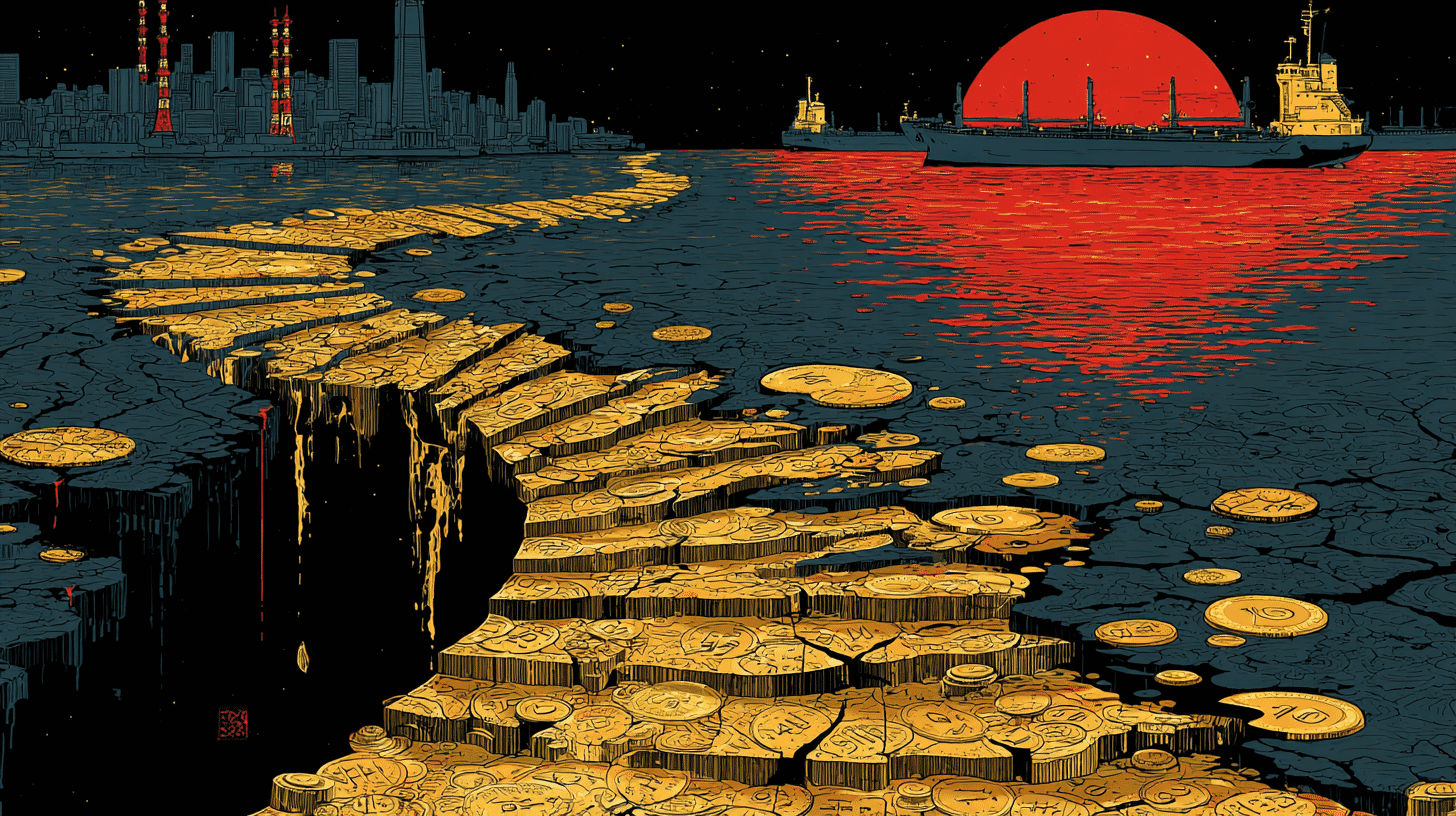
Markets have converged on April for the Bank of Japan's next rate hike. The policy rate sits at 0.75%, the terminal rate is pegged at 1.5%, and Japan is three decades into unwinding the cheapest money in the developed world. Then the Iran crisis sent crude soaring, and the arithmetic changed. Here is what matters ahead of the March 18-19 policy meeting.
Why Markets Are Zeroing In on April
A survey by Nikkei QUICK News of 28 "BOJ watchers", analysts who specialize in tracking the central bank's policy, found that the most common prediction for the next rate hike is April 2026. The Overnight Index Swap (OIS) market, which reflects traders' bets on future interest rates, shows nearly 80% probability of a hike by the April 27-28 meeting.
Former BOJ board member Seiji Adachi has stated that if the BOJ confirms that the underlying inflation trend has essentially reached the 2% target, a rate increase to 1.0% at the April meeting is a real possibility. His own calculations show that expected inflation, a key metric the BOJ watches closely, has already climbed to around 1.8%.
This represents a notable shift: just a few months ago, the consensus pointed to July. What changed? Japan's economy held up better than expected after the December 2025 hike to 0.75%, and spring wage negotiations (called "shuntō", the annual round in which unions and companies set pay increases) pointed to raises of around 5%, a third straight year above that mark and exactly the wage-price momentum the BOJ has been looking for.
The Road to 1.5%: Understanding the Terminal Rate
The "terminal rate" is the end point of a hiking cycle, the interest rate level at which a central bank stops tightening. For the BOJ, most economists peg this at around 1.5%, which is considered the "neutral rate" for Japan's economy: the rate that neither stimulates nor restrains growth.
From the current 0.75%, reaching 1.5% would require three more quarter-point hikes. Market expectations for the terminal rate have been steadily climbing: from 1.0% six months ago, to just above 1.0% three months ago, to the upper 1% range today.
Estimates of the end point vary, though. Most major banks and think tanks cluster around 1.25%, treating 1.5% as the ceiling rather than the base case. The International Monetary Fund has endorsed the BOJ's gradual approach, supporting a slow and steady path rather than aggressive tightening.
For context, 1.5% may sound remarkably low compared to rates in the US (3.50-3.75%) or Europe, but for Japan, a country that spent decades at zero or negative interest rates, this would be a seismic shift. It would be the highest policy rate since the late 1990s.
The Iran Crisis: Oil Shock Meets Stagflation Risk
Just as the BOJ's rate hike path seemed increasingly clear, the Middle East erupted. On February 28, US and Israeli military operations against Iran sent shockwaves through global markets, and oil prices surged. WTI crude touched $110 a barrel on March 9, breaking $100 for the first time in roughly three years and eight months, up more than 60% from around $67 before the strikes.
For Japan, this is particularly dangerous. The country imports 94% of its crude oil from the Middle East, and 80% of those shipments pass through the Strait of Hormuz, the narrow waterway between Iran and the Arabian Peninsula that handles roughly 20% of the world's oil supply. Reports that Iran's Revolutionary Guard Corps signaled a passage ban near the strait raised the specter of a de facto blockade.
Takahide Kiuchi of the Nomura Research Institute laid out three scenarios. In the base case (prolonged military tension, oil at $87/barrel), Japan's GDP would be dragged down by 0.18% while prices would be pushed up by 0.31%. In the worst case, a full, year-long closure of the Strait of Hormuz pushing oil to $140, Japan's GDP would drop 0.65% while inflation would spike 1.14%, plunging the economy into stagflation.
The impact is already being felt. On March 9, the Nikkei 225 plunged 2,892 points, the third-largest single-day drop in history, in a "triple sell-off" that hit stocks, bonds, and the yen at once. The national average gasoline price was ¥161.80 per liter on March 9, but wholesalers raised prices by ¥26 a liter from March 12 shipments, and some pumps are now posting ¥190-plus. On March 11 the government approved emergency subsidies aimed at holding the national average near ¥170.
The Stagflation Dilemma: Why It's the Worst-Case Scenario
Here's why stagflation is every central banker's nightmare: it removes all the good options.
Normally, when prices rise too fast, a central bank raises interest rates to cool things down. When the economy slumps, it cuts rates to stimulate growth. But stagflation, where prices surge AND the economy weakens at the same time, makes both responses counterproductive. Raise rates to fight inflation, and you crush an already struggling economy. Cut rates to support growth, and you pour fuel on the inflation fire.
A senior BOJ official has acknowledged that if this scenario materializes, "the policy response would be extremely difficult." BOJ Deputy Governor Ryozo Himino told reporters on March 2: "There are still many aspects that are hard to assess regarding future developments."
Former BOJ Executive Director Eiji Maeda estimated that the probability of an April hike has dropped to about 50% because of the Iran situation, down from what seemed like a near-certainty just weeks earlier.
How Other Central Banks Compare
The BOJ's hiking path stands in sharp contrast to its global counterparts.
The US Federal Reserve cut rates at three consecutive meetings in September, October, and December 2025, a total of 75 basis points, bringing the federal funds rate to 3.50-3.75%. The FOMC's dot plot projects one more cut in 2026, but views are deeply divided: 7 members favor no cuts at all, while 8 expect two or more. Powell's term as chair ends in May, and on January 30 Trump nominated former Fed governor Kevin Warsh as his successor. Trump wants deep cuts; markets read Warsh as relatively hawkish. That gap, plus an oil shock that threatens growth and stokes inflation at the same time, leaves the Fed's path unusually hard to call.
The European Central Bank has largely shifted to a "wait-and-see" mode for 2026. With the eurozone economy and inflation outlook improving, the debate has shifted from "when's the next cut?" to "when does the next hiking cycle begin?", potentially in 2027.
So the picture is: the Fed is debating whether to cut more or hold, the ECB is pausing and may soon discuss hiking, and the BOJ is the only major central bank actively raising rates. This divergence matters enormously for global capital flows.
The Yen Carry Trade: A ¥40 Trillion Time Bomb?
When Japan's rates were at zero, borrowing yen was essentially free. Investors worldwide exploited this by borrowing cheap yen, converting it to dollars or other currencies, and investing in higher-yielding assets, a strategy known as the "yen carry trade." The Bank for International Settlements estimated the scale of these positions at roughly ¥40 trillion.
As the BOJ raises rates, this trade becomes less profitable. If the rate differential between Japan and other countries narrows enough, or if market volatility triggers a panic, these positions could unwind rapidly. BCA Research has called the yen carry trade a "ticking time bomb," warning that a decline in carry assets or a yen rally could trigger a massive reversal, with each reinforcing the other.
The world got a preview of this in August 2024, when a BOJ rate hike sparked carry trade unwinding that contributed to the Nikkei's largest-ever single-day crash. The current combination of BOJ tightening and Iran-driven volatility has rekindled those concerns.
That said, the US-Japan rate gap remains roughly 3 percentage points, which is still large enough to maintain the carry trade's appeal for now. The real risk may be more gradual: Japanese institutional investors, insurance companies, pension funds, banks, are slowly bringing money home as domestic bond yields become more attractive, with Japan's 10-year government bond yield now above 2%.
What to Watch: The March 18-19 BOJ Meeting
Next week's policy meeting is widely expected to produce no change in rates, all 28 BOJ watchers surveyed predict the bank will hold steady. But the meeting still matters enormously for what it signals about April and beyond.
Three things to watch for in the statement and Governor Ueda's press conference (scheduled for March 19 at 3:30 PM JST, to be livestreamed):
First, how does the BOJ assess the Iran crisis? If officials characterize the oil shock as "temporary," that keeps the door wide open for an April hike. If they flag it as a structural risk, expectations will shift.
Second, the January economic data looks favorable: real wages turned positive for the first time in 13 months (+1.4% year-over-year), and Q4 2025 GDP was revised up to 1.3% annualized growth. How much weight does the BOJ put on this domestic strength versus external risks?
Third, February's corporate goods price index rose 2.0% year-over-year, showing that oil price pressures are already filtering through. Watch whether the BOJ views this as supportive of their inflation target or as a warning sign of cost-push inflation that could hurt the economy.
Most market participants expect this to be a "preparation meeting", laying the groundwork for action in April without committing to it. The degree to which Governor Ueda tips his hand will set the tone for markets in the weeks ahead.
Interest rate policy affects everyday life, from mortgage payments to savings account returns. What's your country's central bank doing right now? Are you feeling the impact of rising prices? Share your thoughts!
References
- https://www.bloomberg.com/jp/news/articles/2026-02-16/TADPMAT9NJLS00
- https://www.bloomberg.com/jp/news/articles/2026-03-06/TBGQKYT96OSJ00
- https://www.bloomberg.com/jp/news/articles/2026-03-09/TBMFRWT9NJLT00
- https://www.nri.com/jp/media/column/kiuchi/20260302.html
- https://am.jpmorgan.com/jp/ja/asset-management/per/insights/market-insights/on-the-minds-of-investors/strategist-views-2026q1-03/
- https://www.boj.or.jp/about/calendar/index.htm









Global Discussion
13 comments