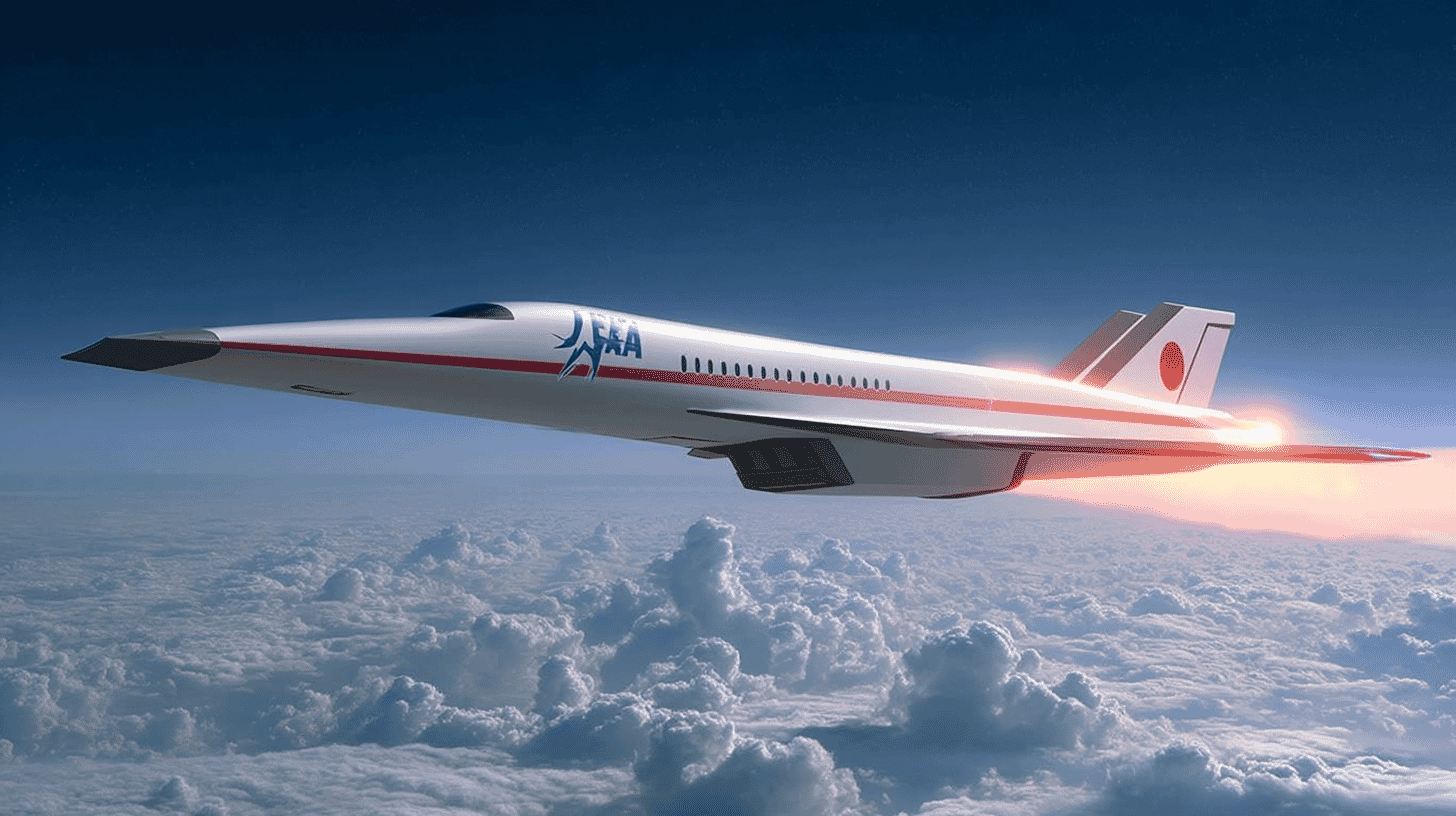
Tokyo to New York in just 2 hours. Six times faster than today's airliners, at Mach 5 (around 5,400 km/h or 3,350 mph), a "hypersonic passenger aircraft" could finally shatter the speed ceiling that has held commercial aviation flat for more than half a century, and the first rewrite may come from Japan. Waseda University, JAXA, the University of Tokyo, and Keio University have just completed Japan's first-ever Mach 5 combustion test using a hypersonic experimental vehicle. But in a race against a hard-charging United States and a military-first China, can Japan actually catch up?
The Mach 5 Test: What Was Actually Proven
On April 16, 2026, Waseda University announced that, in a joint research effort with Japan's Aerospace Exploration Agency (JAXA), the University of Tokyo, and Keio University, it had successfully completed Japan's first Mach 5 combustion test using a hypersonic experimental aircraft. The experiment took place at the ramjet engine test facility of JAXA's Kakuda Space Center in Miyagi Prefecture, simulating the flight environment at five times the speed of sound (roughly 5,400 km/h).
The experimental vehicle is tiny, only 2 meters long, but it packs everything needed for hypersonic flight. At Mach 5, compression heating pushes the air around the airframe to roughly 1,000°C (1,832°F). To survive that, the team combined heat-resistant materials with thermal insulation structures, creating a lightweight heat-resistant frame that kept the internal electronics working normally.
The principal investigator is Professor Tetsuya Sato of Waseda University's Faculty of Science and Engineering. The Sato Laboratory has been a flagship Japanese research base focused on "hypersonic" and "liquid hydrogen (cryogenic, two-phase flow)" as its core keywords, working with JAXA on next-generation aerospace transport systems. The Mach 5 test is a major milestone for the lab's JSPS Grant-in-Aid (S) program, "Construction of a Hypersonic Flight Test Bed Using Sounding Rockets and Demonstration of Integrated Airframe-Propulsion Control", that has been running since 2020.
Mach 5 in Context: Six Times Faster Than Today's Airliners
Just how fast is Mach 5 compared to the aircraft you actually fly on?
| Aircraft | Cruise speed | Tokyo → New York |
|---|---|---|
| Boeing 787 | Mach 0.85 (918 km/h / 570 mph) | ~13 hours |
| Airbus A350 | Mach 0.85 (916 km/h / 569 mph) | ~13 hours |
| Concorde (1976–2003) | Mach 2 (2,179 km/h / 1,354 mph) | ~5.5 hours |
| Hypersonic airliner (concept) | Mach 5 (5,400 km/h / 3,354 mph) | ~2 hours |
Here's a fact that surprises most people: airliner cruise speeds have barely changed since the Boeing 707 flew at Mach 0.8 in 1958. The reason is that today's dominant turbofan engines are optimized to operate just below the speed of sound. Concorde pushed past that with Mach 2, but poor fuel economy and the sonic boom problem over land doomed it commercially, and it was retired in 2003.
Mach 5 leapfrogs this entire limit. It makes Pacific crossings possible in 2 hours, and the same technology base can feed into "spaceplanes" reaching around 100 km altitude.
Japan's Distinctive Angle: Passenger Applications Up Front
What stands out about the Waseda–JAXA announcement is that the official press release explicitly frames the end goals as "a hypersonic passenger aircraft that can cross the Pacific in 2 hours" and "a spaceplane capable of reaching approximately 100 km altitude", both civilian applications.
Hypersonic flight involves extraordinary coupling between the airframe and the engine. As Mach number and aircraft attitude change, so do the shock waves forming on the body, which changes the airflow entering the engine. At the same time, engine thrust directly affects the vehicle's motion. You can't design them separately. Japan's long-standing research strength in "integrated airframe–propulsion design and control" treats both as a single unified system, exactly the problem the Mach 5 test validated.
On the propulsion side, strong candidates include the pre-cooled turbojet engine and the Air Turbo Ramjet Engine (ATREX) that the Sato Laboratory has researched for years. Both burn liquid hydrogen and could potentially span subsonic to hypersonic speeds in a single engine. This test also measured the exhaust temperature field of the hydrogen ramjet to study environmental impact, a clear sign that the team is building toward sustainable hypersonic airliners, not just raw performance.
The US Is Charging Hard: Hermeus, Lockheed, and Heavy Defense Spending
Meanwhile, the hypersonic race abroad is heating up fast.
In the United States, Hermeus, a startup founded in 2018, is pushing hard toward a Mach 5 passenger vehicle. Its unmanned test aircraft "Quarterhorse Mk 2.1" made its first flight in March 2026 and has entered the supersonic test campaign. The ultimate target is "Darkhorse," a Mach 5-class unmanned aircraft, by 2030. Roughly the size of an F-16 and powered by a Pratt & Whitney F100 engine, it's already flying hardware, putting Hermeus well ahead of Japan's current ground-test phase.
Lockheed Martin's Skunk Works division is also developing the SR-72, an unmanned military aircraft designed to exceed Mach 5 using hybrid turbine-plus-scramjet propulsion, with a prototype targeted around the end of 2025. The Pentagon's FY2025 hypersonic research budget is $6.9 billion, up sharply from $4.7 billion in FY2023.
China's Military-Focused Path
China is advancing from a different direction. In November 2025, the National University of Defense Technology (NUDT) unveiled a prototype of a "morphing" hypersonic missile capable of changing its aerodynamic shape mid-flight at speeds exceeding Mach 5. Retractable wings and actuators adjust the profile for optimal control. China has also reported a Mach 16 sodramjet (standing oblique detonation ramjet) test, at the extreme edge of raw speed.
But China's work is almost entirely military-focused, missiles and weapons, with virtually no public disclosure of passenger-aircraft applications. The US SR-72 is also military. In short, putting civilian passenger applications front and center is something that currently distinguishes Japan on the hypersonic map.
Reality Check: Can Japan Actually Catch Up?
So, can Japan close the gap with the US and China? A sober look gives a mixed picture.
Where Japan is ahead:
- Integrated airframe–propulsion control as a design philosophy
- Liquid-hydrogen air-breathing engine technology (pre-cooled turbo, ATREX)
- A clear public vision for civilian airliner and spaceplane applications
- Deep academic foundations backed by long-running government research grants
Where Japan lags:
- No actual flight yet, today's test was inside a wind tunnel
- Budgets are a small fraction of US hypersonic spending
- No Japanese startup equivalent to Hermeus
- Weak military driver, which has historically slowed progress speed
Based on this test, the team is now planning to mount the experimental vehicle on a sounding rocket for an actual Mach 5 flight test. If that succeeds, Japan moves from "ground testing" to "flight demonstration", and the gap with the US and China closes significantly.
Put another way, the next few years until that flight test are make-or-break. The level of additional funding and industry engagement Japan can attract will determine whether "Tokyo to New York in 2 hours" becomes reality in the 2040s, or stays a beautiful concept image.
Imagine a world where today's 13-hour flight to New York shrinks to 2 hours. It's an exciting thought, but the challenges are enormous: fuel costs, ticket prices, environmental impact, and noise along the flight route.
How is hypersonic passenger aviation being discussed in your country? If it became real, would you want to fly on one? Or would the environmental cost weigh more on you than the time saved? We'd love to hear your perspective in the comments.
References
- https://www.waseda.jp/inst/research/news/83981
- https://www.amech.waseda.ac.jp/laboratory/212/
- https://www.hermeus.com/quarterhorse
- https://www.flightglobal.com/engines/2026/03/hermeus-flies-first-supersonic-capable-quarterhorse-mk-2-1-aircraft/
- https://asiatimes.com/2025/11/chinas-latest-hypersonic-missile-morphs-at-mach-5/







Global Discussion
14 comments