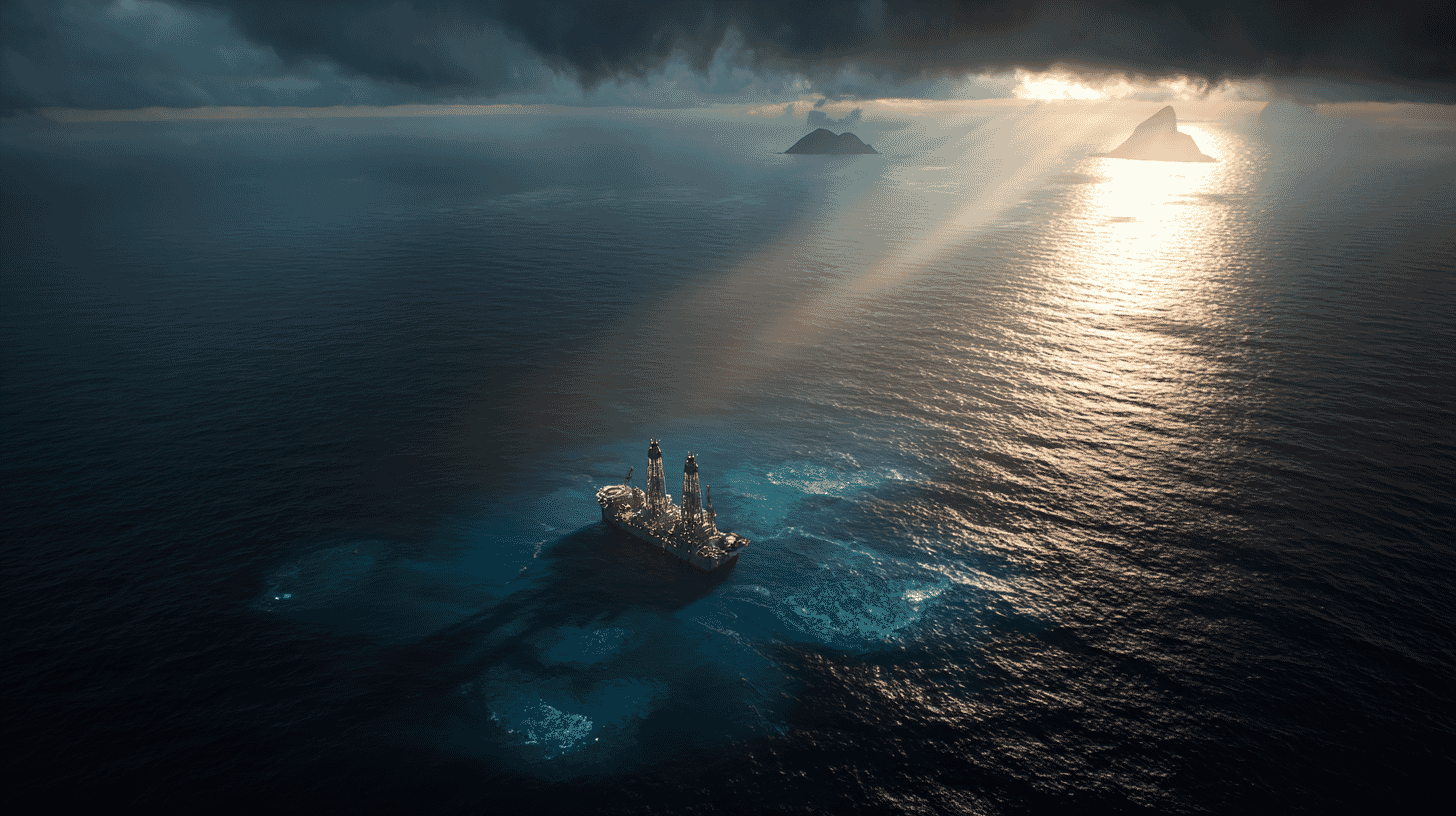
About 1,200 miles southeast of Tokyo, a silent war is unfolding around a tiny island most people have never heard of. The weapons aren't bullets; they're aircraft carriers and export bans. The battlefield lies 20,000 feet beneath the ocean floor, where mud worth centuries of rare earth supply sits waiting.
In June 2025, China's aircraft carrier Liaoning sailed near Japan's Exclusive Economic Zone around Minamitorishima Island, conducting flight deck operations. By March 2026, the US and Japan signed a formal agreement to jointly develop these deep-sea rare earths.
This isn't a story about minerals. It's a geopolitical power game with eerie parallels to the South China Sea.
Why China Sent a Carrier to a Remote Japanese Island
In June 2025, Japan's Ministry of Defense confirmed that a Chinese naval fleet, including the aircraft carrier Liaoning and multiple missile destroyers, was operating near the Exclusive Economic Zone (EEZ) surrounding Minamitorishima, Japan's easternmost island. The carrier repeatedly conducted fighter jet launch-and-recovery drills in waters that Japan considers critical to its national security.
While Beijing framed this as routine blue-water training, Japanese security analysts had a different interpretation. Kenji Minemura, a senior fellow at the Canon Institute for Global Studies, stated bluntly on national television that China was deliberately pressuring Japan, noting that the carrier's route clearly targeted the Minamitorishima area.
The reason is straightforward. Beneath the seabed around Minamitorishima lies what may be the world's largest deposit of rare earth-rich mud, enough to supply global demand for centuries. China currently controls roughly 70% of the world's rare earth production and about 90% of its refining capacity. If Japan taps this undersea treasure, China's most powerful diplomatic weapon loses its edge.
PM Takaichi's Taiwan Remarks and China's Retaliation
The situation escalated sharply in November 2025, when Japanese Prime Minister Sanae Takaichi stated in parliament that a Taiwan contingency could constitute an "existential crisis" for Japan, a legally significant term that could justify collective self-defense. Beijing reacted with fury.
On January 6, 2026, China's Ministry of Commerce announced strengthened export controls on dual-use goods destined for Japan. Rare earth products were widely expected to fall under the restrictions. In Japan, the impact was immediate. A precision equipment manufacturer in Hyogo Prefecture told reporters his factory had only two months of rare earth inventory left, calling the situation "a fight between nations, and we small businesses bleed first."
According to estimates by the Nomura Research Institute, a three-month halt in rare earth imports would cost Japan approximately $4.1 billion, while a full year of disruption could reach $16.3 billion. Rare earths, the so-called "vitamins of industry", are essential for EV motors, wind turbine generators, F-35 fighter missile guidance systems, and smartphones. Cutting off this supply threatens both Japan's economy and its national defense.
February 2026: World's First Deep-Sea Rare Earth Retrieval
Even as China tightened its grip, Japan was quietly building its escape route.
On January 12, 2026, the deep-sea drilling vessel Chikyu departed Shimizu Port in Shizuoka Prefecture. Its mission: retrieve rare earth-rich mud from the seafloor 20,000 feet (approximately 6,000 meters) below the ocean surface near Minamitorishima. On February 1, the first samples reached the ship's deck, marking the world's first successful continuous retrieval of rare earth mud from such extreme depth.
What makes this deposit particularly valuable is that it contains almost no radioactive materials, unlike land-based rare earth mines that typically produce thorny radioactive waste. The mud is also believed to contain "heavy" rare earths (dysprosium, terbium) that China has monopolized and weaponized as diplomatic leverage.
Japan plans a full-scale mining test in February 2027, targeting 350 tons of mud per day. The government allocated approximately $100 million in supplementary budget funds for infrastructure at Minamitorishima. The roadmap targets commercial production from 2028.
The US-Japan Summit: A Rare Earth Alliance Is Born
The March 19, 2026 summit between PM Takaichi and President Trump in Washington proved to be a turning point.
The two leaders signed a memorandum of cooperation on the development of rare earth and other deep-sea mineral resources around Minamitorishima. They established a joint working group to share project information, coordinate technology, and facilitate private-sector partnerships. Japan's Ministry of Foreign Affairs confirmed that both leaders agreed to "oppose all measures that threaten the stable supply of critical minerals, including export restrictions", a clear reference to China.
The summit also unveiled several critical mineral projects, including a Mitsubishi Materials rare earth venture and a Mitsubishi Corporation copper operation in the US. The two nations discussed establishing a "minimum price system" among allied nations to counter China's strategy of undercutting competitors with artificially cheap rare earth exports.
This isn't merely economic cooperation. It's the birth of what analysts are calling a "US-Japan Resource Alliance", and it's Beijing's worst-case scenario.
Uncomfortable Parallels With the South China Sea
There is a striking structural similarity between what's happening around Minamitorishima and the ongoing crisis in the South China Sea.
In the South China Sea, China has built artificial islands in violation of international law, militarized reefs, and used coast guard vessels to intimidate smaller nations like the Philippines and Vietnam, all to assert control over seabed resources and strategic shipping lanes. The 2016 ruling by the Permanent Court of Arbitration declaring China's expansive claims invalid has been flatly ignored by Beijing.
The situation around Minamitorishima is different in one crucial respect: there is no territorial dispute. The island is unambiguously Japanese territory, and the surrounding EEZ is legally Japan's under the UN Convention on the Law of the Sea. But the method of Chinese interference, combining military posturing (carrier deployments) with economic coercion (export restrictions) to block resource development, follows the same playbook.
Defense Minister Shinjiro Koizumi has instructed the Japan Coast Guard and Self-Defense Forces to strengthen coordination, preparing to authorize maritime security operations if necessary. The geopolitical tensions around Japan's waters have entered a new phase.
International Rules for Seabed Mining Lag Behind Technology
Another critical issue is that the international framework for deep-sea resource development has not kept pace with technology.
While the UN Convention on the Law of the Sea grants coastal nations exclusive rights to resources within their EEZ, the environmental standards, dispute resolution mechanisms, and transparency requirements for ultra-deep-sea mining remain largely undefined. Mining rare earth mud from 20,000 feet below the surface is unprecedented, and existing rules simply weren't designed for it.
As the EU, Australia, Canada, and other nations also seek to reduce their dependence on Chinese rare earths, the question of who writes the rules for deep-sea mining is becoming increasingly urgent. Japan's ability to lead this rulemaking process could significantly shape its international standing in the decades ahead.
The Invisible War Beneath Calm Waters
The rare earth contest around Minamitorishima has moved far beyond resource development. Carrier deployments, export restrictions, a presidential summit agreement, these are all pieces of a 21st-century geopolitical chess game.
Japan's successful trial extraction and the new US-Japan partnership could eventually neutralize China's rare earth monopoly, its most potent diplomatic card. But commercialization is years away, and China will certainly escalate pressure in the interim.
Deep-sea resource development is not just one country's problem. The international community needs clear rules for this new frontier, and must ensure that "might makes right" doesn't become the governing principle beneath the waves.
How does your country handle seabed resource development? Is there a debate about reducing dependence on China for critical minerals? We'd love to hear your perspective.








Global Discussion
15 comments